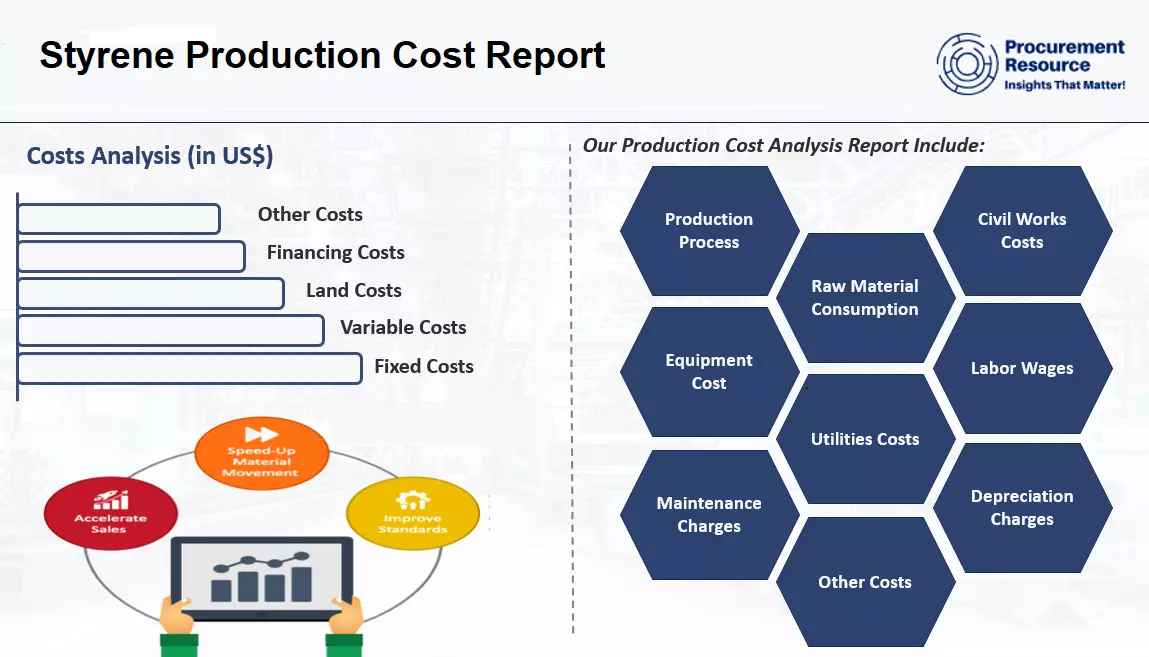
The report provides a detailed analysis essential for establishing a styrene production plant. It encompasses all critical aspects necessary for styrene production, including the cost of styrene production, styrene plant cost, styrene production costs, and the overall styrene production plant cost. Additionally, the study covers specific expenditures associated with setting up and operating a styrene production plant. These encompass production processes, raw material requirements, utility requirements, infrastructure needs, machinery and technology requirements, manpower requirements, packaging requirements, transportation requirements, and more.
Styrene is a synthetic chemical primarily used in the manufacture of car components, packaging, safety helmets, toys, etc. The Styrene industry is mainly employed in the production of materials that are used to produce various products in many downstream sectors. It is the most common and extensively used material used for production packaging, recreational equipment, safety helmets, toys, and consumer electronics because of its lightweight and protective qualities. The commodity is also used in the production of styrene-butadiene rubber (SBR), elastomers, and latexes. Also, it is added to various industrial products, including car tyres, belts as well as hoses for machinery, among many other items.
The rising demand for styrene as a vital ingredient in the production of material used for recreational equipment, safety helmets, toys, and consumer electronic products is what primarily drives the market for this commodity. It is also an important constituent in the production of styrene-butadiene rubber (SBR), which is used across a wide range of applications which include, including car tires, automotive parts, shoe soles, and mechanical rubber goods, which increases its demand for automotive, leather, plastics, rubber, and mechanical industries.
It is also of great value for the electronics, construction, and food industries, as it is extensively used to manufacture electronic products, toys, safety helmets, packaging, rigid food service containers, etc. Moreover, the availability and cost of production of styrene’s feedstock (ethylbenzene), styrene market prices, distribution (including trading and shipping), logistics, environmental regulations, safety standards, etc., are some of the elements that influence an industrial styrene procurement. The global procurement of this commodity is greatly influenced by its necessity as a key component for the automotive, plastics, construction, electronics, food, and leather industries.
Raw Material for Styrene Production
According to the Styrene production plant project report, the major raw materials for Styrene production include Ethylbenzene.
Production Process of Styrene
The extensive Styrene production cost report consists of this major industrial production process:
- Production Via Dehydrogenation: In a heat exchanger, new or recycled ethylbenzene is combined with steam and heated to the desired temperature. The mixture generates hot effluent, which greatly aids in preheating the mixture of ethylbenzene and steam. Further, the condensate, vent gas, and crude styrene are separated out of the condensed reactor. Finally, styrene is produced by distillation train from crude styrene.
Styrene is mainly a synthetic chemical that can be referred to as vinylbenzene, ethylbenzene, cinnamene, and phenylethylene. It is a monomer added primarily in paints, plastics, and synthetic rubber. Styrene appears to be a colourless liquid with a slight and sweet smell. Its molecular weight is 104.15 g/mol, and its density is 0.909 g/cm³ at room temperature. With its composition of various chemicals, it has a sharp and unpleasant smell. The product is extremely flammable and has a boiling point of 145 °C (293 °F). It can be dissolved in some liquids but not in water and has a freezing point of −30.6 °C (−23.1 °F), and readily evaporates. Styrene solubility is 0.24 g/lt.