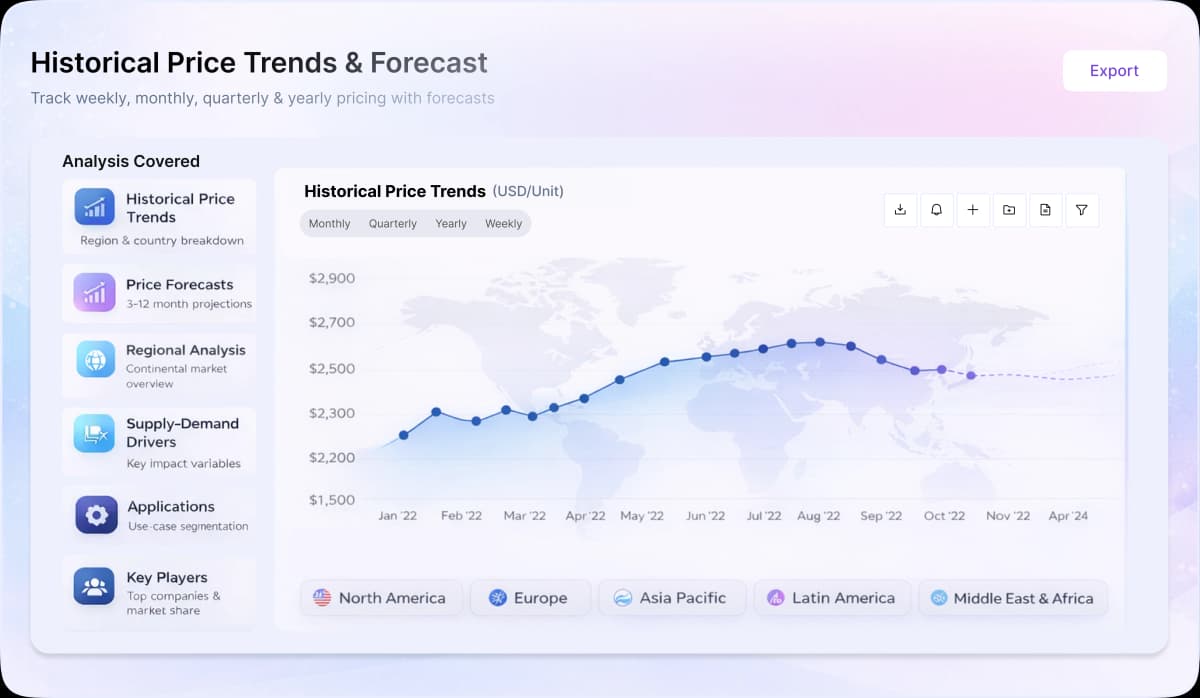
2-Propylheptanol Price Trend Analysis 2026: Historical Prices, Market Insights, Supply Demand Analysis, Price Drivers & Latest News

Udeesha Tomar profile photo
Written ByUdeesha Tomar

Procurement Resource Database

Laptop screen

Turn price intelligence into action with the Procurement Resource Database. Log in or subscribe to unlock live price trends, historical charts, supplier databases, cost curves, and analyst-backed insights across chemicals, agriculture, energy, packaging, and more. Use these tools to benchmark your contracts, plan budgets with confidence, and stay ahead of market moves on every product you buy.

0

+

Products

0

+

Regions

0

+

Subscriptions

Asia

In Asia, 2-Propylheptanol prices witnessed a downward trend, primarily due to weak demand from downstream plasticizer manufacturers and high inventory levels. The market was further pressured by reduced manufacturing activities in China, the region's largest consumer.

The sluggish demand from the construction and automotive sectors, major end-users of plasticizers, contributed to the bearish sentiment. Additionally, new capacity additions during the quarter created an oversupply situation, forcing producers to reduce their operating rates.

Europe

In Europe, the market showed an upward trajectory, supported by strong restocking activities ahead of the winter season. The increasing propane prices, as evidenced by the rising Northwest European propane cargo prices, directly impacted 2-Propylheptanol production costs. European manufacturers faced pressure from high energy costs, particularly natural gas prices, which led to increased production costs. Despite this, steady demand from the construction and automotive sectors helped maintain stable market conditions.

North America

North American 2-Propylheptanol prices followed an ascending trend. The market was supported by robust domestic demand from the plasticizer industry and limited product availability. The temporary maintenance shutdowns at major export terminals in Texas affected the supply chain, leading to tighter market conditions. The strong performance of the construction sector and increased manufacturing activities contributed to sustained demand throughout the quarter.


About 2-Propylheptanol

2-Propylheptanol or 2PH is a waxy solid belonging to the class of C-10 fatty alcohols. It serves as a vital feedstock/intermediate in production of plasticizers, surfactants, resins, and lubricants. It is used as a heat stabilizer during PVC manufacture. Its oleate and palmate-based products are valued in the cosmetic industry.

2-Propylheptanol Product Detail

HS Code
29051690
Chemical Formula

C10H22O

CAS Number
10042-59-8
Molecular Weight
158.285 g/mol
Industrial Uses

Plasticizers, Resins, Lubricants, Surfactants, Cosmetics, Solvents

Synonyms

2-propyl-1-heptanol, Isodecanol, 2PH, 8-methyl-1-nonanol

Supplier Database

Perstorp, BASF SE, Evonik Industries, Yanchang Petroleum Yan'an Energy and Chemical Co.

Regional Coverage

Asia Pacific

China, India, Indonesia, Pakistan, Bangladesh, Japan, Philippines, Vietnam, Iran, Thailand, South Korea, Iraq, Saudi Arabia, Malaysia, Nepal, Taiwan, Sri Lanka, UAE, Israel, Hongkong, Singapore, Oman, Kuwait, Qatar, Australia, and New Zealand

Europe

Germany, France, United Kingdom, Italy,Spain, Russia, Turkey, Netherlands, Poland, Sweden, Belgium, Austria, Ireland Switzerland, Norway, Denmark, Romania, Finland, Czech Republic, Portugal and Greece

North America

United States and Canada

Latin America

Brazil, Mexico, Argentina, Columbia, Chile, Ecuador, and Peru

Africa

South Africa, Nigeria, Egypt, Algeria, Morocco

CurrencyUS$ (Data can also be provided in local currency)

Supplier Database AvailabilityYes

Customization ScopeThe report can be customized as per the requirements of the customer

Post-Sale Analyst Support360-degree analyst support after report delivery

Note: Our supplier search experts can assist your procurement teams in compiling and validating a list of suppliers indicating they have products, services, and capabilities that meet your company's needs.

2-Propylheptanol Production Processes

  • Production of 2-Propylheptanol from C4 alkenes via Hydroformylation/Oxo Synthesis

Oxo synthesis is used in the production of aldehydes from an alkene. This reaction involves adding a formyl group (CHO ) and a hydrogen atom to the carbon-carbon double bond. This reaction is carried at elevated temperature and pressure. The product aldehyde is then hydrogenated to get the corresponding alcohol.

Frequently Asked Questions

The 2-Propylheptanol outlook for 2025 points to a stable market, as balanced supply and steady feedstock conditions are expected to keep price movements limited. Demand from plasticizer and coatings end-users will be the key swing factor, while any supply disruptions, feedstock cost spikes, or policy shifts could break the current equilibrium and drive meaningful price changes.
2-Propylheptanol prices are shaped primarily by C4-alkene feedstock costs and butadiene availability, since the product is made via hydroformylation of C4 alkenes drawn from crude oil refining and natural gas processing. Regional supply balances and logistics disruptions, including weather-related export interruptions, influence how quickly feedstock cost changes pass through to buyers. Demand from plasticizer and coatings end-users is the dominant downstream driver: producers use 2-propylheptanol mainly to manufacture DPHP for flexible PVC, so construction activity and PVC output set the pace of offtake, while softer industrial demand leaves supply comfortable and caps prices.
Major 2-propylheptanol producers include BASF SE, Evonik Industries, Perstorp, Dow Chemical Company, Sinopec (China Petrochemical Corporation), and Shaanxi Yanchang Petroleum, reflecting the product's concentration among large integrated petrochemical and specialty chemical groups. Production is centered in Germany, the United States, and China, tracking access to C4-alkene and butadiene feedstocks from refining and cracking operations. Key consuming regions include Europe, North America, and Asia Pacific, where flexible PVC, surfactant, and lubricant manufacturing drive demand. Butadiene availability and C4-alkene supply conditions remain the primary supply-chain risk for buyers.
2-Propylheptanol is produced from C4 alkenes derived from crude oil refining and natural gas processing. Via hydroformylation with synthesis gas, C4 alkenes form aldehydes, which are hydrogenated to yield 2-Propylheptanol. It is primarily consumed as a plasticizer alcohol to manufacture DPHP for flexible PVC in construction applications such as cable insulation and tarpaulin fabrics. It also serves as a key intermediate for surfactants in detergents and industrial cleaners, and for acrylates in adhesives, lubricants, and cosmetic ingredients.
2-Propylheptanol demand is driven primarily by the plastic and polymer industry, where it functions as a plasticizer alcohol to manufacture DPHP for flexible PVC used in cable insulation and tarpaulin fabrics in construction. Additional demand comes from the chemicals sector for surfactants in detergents and industrial cleaning, as well as from adhesives and lubricant manufacturers. Strong construction activity and polymer output tighten availability and push prices higher, while weak downstream demand softens the market.
Procurement Resource assesses 2-propylheptanol prices through a structured methodology combining direct engagement with producers, suppliers and traders, secondary market data, monitoring of feedstock and input costs, trade-flow and inventory tracking, and exchange or spot benchmarks. This data-driven approach is validated into a transparent price assessment and outlook. The detailed methodology is available on the Procurement Resource website.

Our Price Analysis Methodology

About the Author

Udeesha Tomar profile photo

Udeesha Tomar

AVP - Strategy and Solutions

Leading procurement research solutions across chemicals, materials, and food & beverages, with expertise in price forecasting and market analytics.

Schedule Demo

Schedule A Demo

Experience how Procurement Resource transforms raw material price data into clear, decision ready intelligence. Optimise your performance with reliable, expert market data and analysis. Schedule your demo today to experience a live walk-through where our experts will showcase interactive price charts, forecasted prices, and insights driving the prices for your key commodities, tailored to your workflows. Contact us now!

Our Team will be happy to assist you

We are just a text away

+1

Still Need Help?

Europe & Africa

+44 7573 171117

Sales@procurementresource.com

USA & Canada

+1 307 363 1045

Sales@procurementresource.com

APAC

+91 8850629517

Sales@procurementresource.com

Unlock full access to Procurement Resource's price databases, interactive charts, and short-term forecasts for thousands of commodities. Elevate your sourcing decisions by comparing prices across regions, downloading historical data, and layering in analyst-backed insights, all with our flexible plans that scale as your portfolio grows.

Still have any Questions

Contact Us
Mastercard
Wire
VISA
Stripe

Why Procurement Database

Commodity Market Intelligence

Commodity Market Intelligence

Track prices, market movements, supply-demand dynamics, and industry developments across hundreds of commodities through a centralized intelligence platform built for informed procurement decisions.

Price Forecasts & Market Outlooks

Price Forecasts & Market Outlooks

Understand market fluctuations using analyst-backed forecasts, historical pricing patterns, and evolving industry trends to strengthen sourcing strategies and budget planning.

Cost & Procurement Optimization

Cost & Procurement Optimization

Leverage cost models, pricing benchmarks, and procurement insights to evaluate purchasing opportunities, improve negotiations, and enhance operational efficiency.

Global & Regional Market Insights

Global & Regional Market Insights

Access region-specific price trends, trade activities, capacity changes, and supply chain developments influencing commodity markets worldwide.

1/4