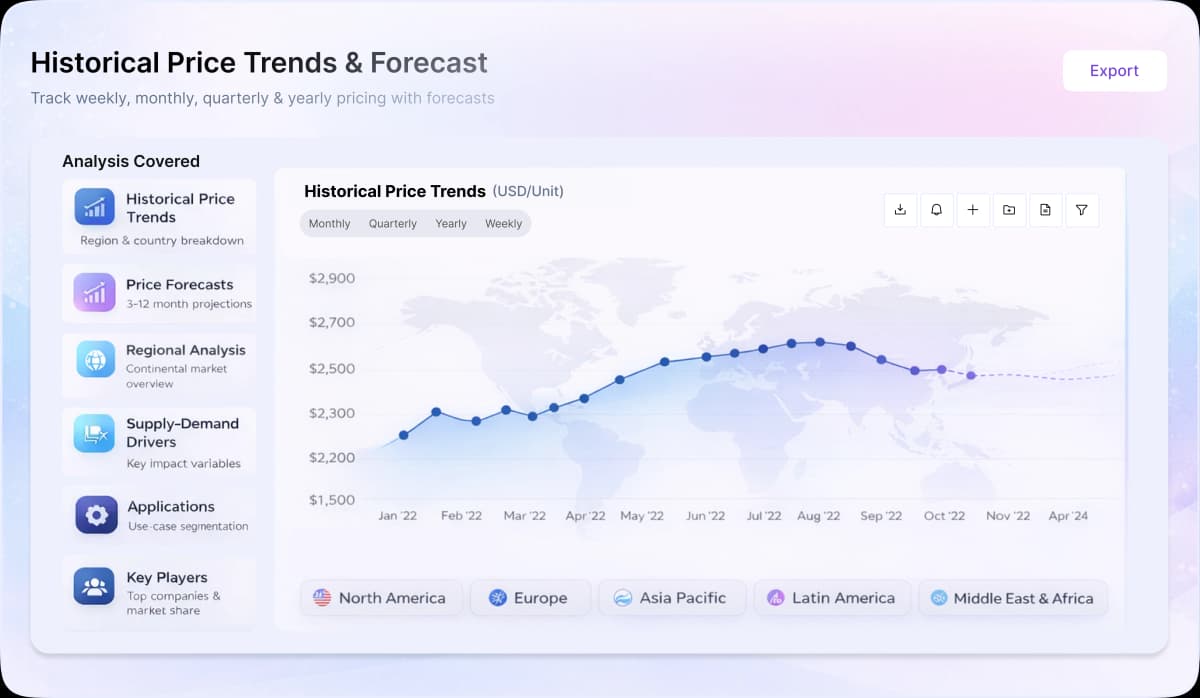
Adiponitrile Price Trend Analysis 2026: Price Drivers, Historical Prices, Latest News, Market Insights & Supply Demand Analysis

Udeesha Tomar profile photo
Written ByUdeesha Tomar

Procurement Resource Database

Laptop screen

Turn price intelligence into action with the Procurement Resource Database. Log in or subscribe to unlock live price trends, historical charts, supplier databases, cost curves, and analyst-backed insights across chemicals, agriculture, energy, packaging, and more. Use these tools to benchmark your contracts, plan budgets with confidence, and stay ahead of market moves on every product you buy.

0

+

Products

0

+

Regions

0

+

Subscriptions

About Adiponitrile

Adiponitrile is an organic compound with the chemical formula (CH2)4(CN)2, characterized by its clear, colorless pale yellow appearance and faint odor. It is a high-boiling liquid with a boiling point of approximately 295°C and a melting point of around 2.8°C. Slightly soluble in water but highly soluble in organic solvents like acetone and benzene, adiponitrile is primarily used as a key intermediate in the industrial production of nylon-6,6.

This synthesis process involves the hydrolysis of adiponitrile to hexamethylenediamine, a crucial monomer for nylon. Additionally, adiponitrile is used in the manufacture of other polymers, resins, and specialty chemicals. It is also employed as a solvent and as an intermediate in organic synthesis for various applications. Due to its versatile properties and significant role in producing high-performance materials, adiponitrile is an essential chemical in the polymer and synthetic fiber industries.

Adiponitrile Product Detail

HS Code
292690
Chemical Formula

C6H8N2

CAS Number
111-69-3
Molecular Weight
108.14 g/mol
Industrial Uses

Nylon 6,6 Production, Resin synthesis, Coatings, Pharmaceuticals

Supplier Database

Kishida Chemical Co Ltd, Ascend Performance Materials, Butachimie, INVISTA, BASF SE

Regional Coverage

Asia Pacific

China, India, Indonesia, Pakistan, Bangladesh, Japan, Philippines, Vietnam, Iran, Thailand, South Korea, Iraq, Saudi Arabia, Malaysia, Nepal, Taiwan, Sri Lanka, UAE, Israel, Hongkong, Singapore, Oman, Kuwait, Qatar, Australia, and New Zealand

Europe

Germany, France, United Kingdom, Italy,Spain, Russia, Turkey, Netherlands, Poland, Sweden, Belgium, Austria, Ireland Switzerland, Norway, Denmark, Romania, Finland, Czech Republic, Portugal and Greece

North America

United States and Canada

Latin America

Brazil, Mexico, Argentina, Columbia, Chile, Ecuador, and Peru

Africa

South Africa, Nigeria, Egypt, Algeria, Morocco

CurrencyUS$ (Data can also be provided in local currency)

Supplier Database AvailabilityYes

Customization ScopeThe report can be customized as per the requirements of the customer

Post-Sale Analyst Support360-degree analyst support after report delivery

Note: Our supplier search experts can assist your procurement teams in compiling and validating a list of suppliers indicating they have products, services, and capabilities that meet your company's needs.

Adiponitrile Production Process

The synthesis of adiponitrile via this method occurs in multiple steps. The process is initiated by the chlorination of butadiene, giving dichlorobutylene. This intermediate is then reacted with sodium cyanide to give 1,4-dicyclobutylene which in subsequent steps is hydrogenated and purified to give adiponitrile.

Frequently Asked Questions

The adiponitrile outlook for 2024 is cautiously bullish. Prices are expected to trend upward, driven by surging demand from downstream industries and escalating production costs. Geopolitical tensions, sea route disruptions, and tight Middle East crude oil supply are likely to keep feedstock costs elevated. However, the outlook could soften if crude supply normalizes, geopolitical risks ease, or downstream demand weakens.
Adiponitrile prices are driven mainly by butadiene and hydrogen cyanide feedstock costs, which track crude oil and the C4 chain, so crude and butadiene moves and the operating rates of a small set of producers set the cost base. Because production is highly concentrated, outages and logistics disruptions can move the market sharply. Demand from nylon 6,6 (for automotive and textiles) and polyurethane (via HDI) provides the pull. Tight feedstock or supply against firm nylon demand lifts prices, while ample supply and weak downstream buying eases them.
Adiponitrile is produced by a very small number of companies worldwide, chiefly INVISTA, Ascend Performance Materials, BASF and the Butachimie joint venture, which concentrates supply heavily. Primary consuming regions are Asia Pacific, Europe and North America. This concentration creates real supply-chain vulnerability, as an outage or logistics disruption at any one plant can squeeze availability across all major markets.
During Q1 2024, adiponitrile prices fell early in Asia and Europe from weak downstream consumption, carryover inventories, and surplus supply, then recovered mid-quarter as production slowed amid limited feedstock procurement, tight Middle East crude supply, and geopolitical sea route disruptions. In Europe, Suez Canal delays and port strikes further constricted supply while rebounding automotive and rubber demand added upward momentum. North America saw sustained uptrends from post-holiday restocking and elevated freight costs, with the outlook pointing to continued price support from growing downstream demand and rising production costs.


Adiponitrile is produced from butadiene and hydrogen cyanide (or sodium cyanide) as primary feedstocks. The production chain begins with chlorination of butadiene to form dichlorobutylene, which is then reacted with HCN or an alkali cyanide in the liquid phase to yield 1,4-dicyanobutylene. This intermediate is subsequently hydrogenated to produce adiponitrile. The finished product is mainly consumed as a precursor for nylon 6,6 used in automotive and textile applications, and as a feedstock for HDI, which supplies polyurethane coatings and adhesives across construction, packaging, and furniture industries.
Adiponitrile demand is driven primarily by the nylon 6,6 sector serving automotive and textile manufacturers, the polyurethane industry (via HDI) supplying construction insulation and furniture foams, and automotive lightweighting. When these industries expand they pull on adiponitrile supply and support prices; when they slow, oversupply and weak consumption push prices lower. Because a few plants supply the world, prices move mainly with butadiene and hydrogen cyanide feedstock costs and this concentrated supply-demand balance.
Procurement Resource assesses adiponitrile prices through a structured, data-driven methodology combining primary engagement with producers, suppliers and traders, secondary market data, continuous monitoring of feedstock and input costs, trade-flow and inventory tracking, and exchange or spot benchmarks. All inputs are validated and translated into a transparent price assessment and outlook. The detailed methodology is available on the Procurement Resource website.

Our Price Analysis Methodology

About the Author

Udeesha Tomar profile photo

Udeesha Tomar

AVP - Strategy and Solutions

Leading procurement research solutions across chemicals, materials, and food & beverages, with expertise in price forecasting and market analytics.

Schedule Demo

Schedule A Demo

Experience how Procurement Resource transforms raw material price data into clear, decision ready intelligence. Optimise your performance with reliable, expert market data and analysis. Schedule your demo today to experience a live walk-through where our experts will showcase interactive price charts, forecasted prices, and insights driving the prices for your key commodities, tailored to your workflows. Contact us now!

Our Team will be happy to assist you

We are just a text away

+1

Still Need Help?

Europe & Africa

+44 7573 171117

Sales@procurementresource.com

USA & Canada

+1 307 363 1045

Sales@procurementresource.com

APAC

+91 8850629517

Sales@procurementresource.com

Unlock full access to Procurement Resource's price databases, interactive charts, and short-term forecasts for thousands of commodities. Elevate your sourcing decisions by comparing prices across regions, downloading historical data, and layering in analyst-backed insights, all with our flexible plans that scale as your portfolio grows.

Still have any Questions

Contact Us
Mastercard
Wire
VISA
Stripe

Why Procurement Database

Commodity Market Intelligence

Commodity Market Intelligence

Track prices, market movements, supply-demand dynamics, and industry developments across hundreds of commodities through a centralized intelligence platform built for informed procurement decisions.

Price Forecasts & Market Outlooks

Price Forecasts & Market Outlooks

Understand market fluctuations using analyst-backed forecasts, historical pricing patterns, and evolving industry trends to strengthen sourcing strategies and budget planning.

Cost & Procurement Optimization

Cost & Procurement Optimization

Leverage cost models, pricing benchmarks, and procurement insights to evaluate purchasing opportunities, improve negotiations, and enhance operational efficiency.

Global & Regional Market Insights

Global & Regional Market Insights

Access region-specific price trends, trade activities, capacity changes, and supply chain developments influencing commodity markets worldwide.

1/4