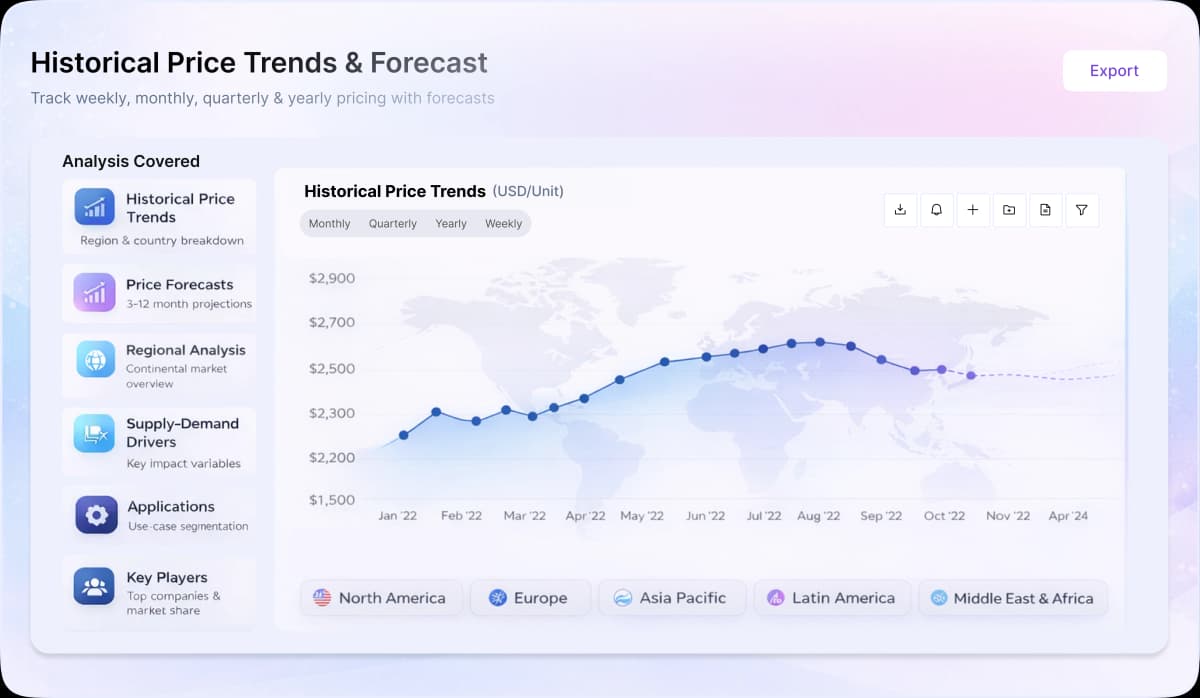
Alumina Ceramics Price Trend Analysis 2026: Historical Prices, Market Insights, Price Drivers, Latest News & Supply Demand Analysis

Pragati Agarwal profile photo
Written ByPragati Agarwal

Procurement Resource Database

Laptop screen

Turn price intelligence into action with the Procurement Resource Database. Log in or subscribe to unlock live price trends, historical charts, supplier databases, cost curves, and analyst-backed insights across chemicals, agriculture, energy, packaging, and more. Use these tools to benchmark your contracts, plan budgets with confidence, and stay ahead of market moves on every product you buy.

0

+

Products

0

+

Regions

0

+

Subscriptions

Alumina is the silky dense powder of Aluminium oxide used as the foundational material for synthesizing Alumina Ceramics. They are processed into Alumina ceramics by consolidating alumina powder through intricate sequential procedures. Alumina Ceramics are commonly employed as insulating materials in various electrical devices.

During the first half of the year 2023, the price trend for Alumina Ceramics kept wavering at the lower end of the price spectrum. The presence of excess unused inventories was the biggest reason the market sentiments were dull throughout. Consumption from the downstream sectors was also underwhelming because of the depreciation in the electronics market. High global inflation and reduced end-consumer purchasing powers were detrimental to the growth of Alumina Ceramics market.

About Alumina Ceramics

Alumina ceramics, also known as aluminum oxide ceramics, are advanced ceramic materials primarily composed of aluminum oxide (Al2O3). They exhibit exceptional mechanical, thermal, and electrical properties, making them valuable in various industrial applications. These ceramics are highly wear-resistant, thermally stable, and often used as insulators, components in electronics, cutting tools, and high-temperature structural materials.

Alumina Ceramics Product Detail

Industrial Uses

Electrical and Electronics, Aerospace and Aviation, Medical and Dental Equipment, Chemical and Petrochemical, Textile and Manufacturing, Food Processing, Refractory Applications, Insulation and High-Voltage Electrical Equipment

Supplier Database

Dynamic Ceramic, Ferrotec Ceramics, Innovacera, LSP Ceramics, Texers Technical Ceramics, Morgan Advanced Materials, Kyocera Corporation

Regional Coverage

Asia Pacific

China, India, Indonesia, Pakistan, Bangladesh, Japan, Philippines, Vietnam, Iran, Thailand, South Korea, Iraq, Saudi Arabia, Malaysia, Nepal, Taiwan, Sri Lanka, UAE, Israel, Hongkong, Singapore, Oman, Kuwait, Qatar, Australia, and New Zealand

Europe

Germany, France, United Kingdom, Italy,Spain, Russia, Turkey, Netherlands, Poland, Sweden, Belgium, Austria, Ireland Switzerland, Norway, Denmark, Romania, Finland, Czech Republic, Portugal and Greece

North America

United States and Canada

Latin America

Brazil, Mexico, Argentina, Columbia, Chile, Ecuador, and Peru

Africa

South Africa, Nigeria, Egypt, Algeria, Morocco

CurrencyUS$ (Data can also be provided in local currency)

Supplier Database AvailabilityYes

Customization ScopeThe report can be customized as per the requirements of the customer

Post-Sale Analyst Support360-degree analyst support after report delivery

Note: Our supplier search experts can assist your procurement teams in compiling and validating a list of suppliers indicating they have products, services, and capabilities that meet your company's needs.

Alumina Ceramics Production Process

Alumina powder obtained from bauxite ore is mixed with key materials to create a blend. This blend is further consolidated to form ceramics.

Frequently Asked Questions

The outlook for alumina ceramics through the remainder of 2026 is steady-to-firm. Feedstock alumina stability, supported by steady bauxite flows, and elevated energy and processing costs keep finished values underpinned. Durable demand from electronics, aerospace, medical devices, electric vehicles, and semiconductors provides a resilient floor, while lean buyer inventories limit downside. European prices carry a premium from higher energy overheads, and North American values track global cues on resilient aerospace and medical offtake. A sharper correction would require a meaningful pullback in downstream demand or a spike in bauxite or power costs.
Asia Pacific leads alumina ceramics manufacturing through China, India, and Japan, with Europe and North America supported by Germany, the UK, and the US. Production starts with bauxite mining, refined via the Bayer process into high-purity alumina powder, blended with binders, then sintered into finished ceramics. Asian markets trade steadily on electronics recovery, European material commands a premium from higher energy overheads, and North American prices track aerospace and medical offtake. The steady-to-firm outlook through 2026 rests on feedstock stability and durable downstream demand from electric vehicles, semiconductors, and high-voltage insulation.
Alumina ceramics prices are driven by upstream feedstock costs, energy and downstream demand. High-purity alumina powder, refined from bauxite via the Bayer process, is the main input, so bauxite and alumina costs set the base. The sintering step is energy-intensive, so power costs are a major lever, giving higher-energy regions such as Europe a cost premium. Demand from electronics, aerospace, medical devices, electric vehicles and semiconductors provides the pull. Firmer alumina or energy costs and tight supply against steady demand lift prices, while cheaper inputs or softer demand ease them.
Major alumina ceramics producers include Kyocera, Morgan Advanced Materials, CoorsTek, CeramTec and Denka, alongside Dynamic Ceramic, Ferrotec Ceramics, Innovacera, LSP Ceramics and Texers Technical Ceramics. Manufacturing is anchored in Asia, particularly China, India and Japan, with European and North American producers serving specialized aerospace and medical segments. This geographic concentration, the energy-intensive sintering process, and reliance on alumina powder from bauxite mean supply security is sensitive to energy costs and raw-material availability.
Downstream demand from electrical and electronics, aerospace and aviation, medical and dental, chemical processing and automotive industries drives alumina ceramics consumption. Electronics use it for substrates and insulators, aerospace and medical for high-performance components, and automotive for parts such as spark plugs. Because these are high-performance, largely structural end uses, alumina ceramics carries a durable demand base, so prices move mainly with alumina and energy costs and the balance between available supply and this downstream pull.
Procurement Resource assesses alumina ceramics prices through a structured methodology combining primary engagement with producers, suppliers and traders, secondary market data, monitoring of feedstock and input costs, trade-flow and inventory tracking, and exchange or spot benchmarks. These inputs are validated and translated into a transparent price assessment and outlook. The detailed methodology is available on the Procurement Resource website.

Our Price Analysis Methodology

About the Author

Pragati Agarwal profile photo

Pragati Agarwal

Senior Business Insights Analyst

Delivering price trend analysis and procurement market insights at Procurement Resource, with expertise in identifying commodity patterns, supporting purchasing strategies, and improving cost efficiency through actionable market intelligence.

Schedule Demo

Schedule a demo

Experience how Procurement Resource transforms raw material price data into clear, decision ready intelligence. Optimise your performance with reliable, expert market data and analysis. Schedule your demo today to experience a live walk-through where our experts will showcase interactive price charts, forecasted prices, and insights driving the prices for your key commodities, tailored to your workflows. Contact us now!


Our Team will be happy to assist you

We are just a text away

+1

Still Need Help?

Europe & Africa

+44 7573 171117

[email protected]

USA & Canada

+1 307 363 1045

[email protected]

APAC

+91 8850629517

[email protected]

Unlock full access to Procurement Resource's price databases, interactive charts, and short-term forecasts for thousands of commodities. Elevate your sourcing decisions by comparing prices across regions, downloading historical data, and layering in analyst-backed insights, all with our flexible plans that scale as your portfolio grows.

Still have any Questions

Contact Us
Mastercard
Wire
VISA
Stripe

Why Procurement Database

Commodity Market Intelligence

Commodity Market Intelligence

Track prices, market movements, supply-demand dynamics, and industry developments across hundreds of commodities through a centralized intelligence platform built for informed procurement decisions.

Price Forecasts & Market Outlooks

Price Forecasts & Market Outlooks

Understand market fluctuations using analyst-backed forecasts, historical pricing patterns, and evolving industry trends to strengthen sourcing strategies and budget planning.

Cost & Procurement Optimization

Cost & Procurement Optimization

Leverage cost models, pricing benchmarks, and procurement insights to evaluate purchasing opportunities, improve negotiations, and enhance operational efficiency.

Global & Regional Market Insights

Global & Regional Market Insights

Access region-specific price trends, trade activities, capacity changes, and supply chain developments influencing commodity markets worldwide.

1/4