Ammonium Bicarbonate Price Trend Analysis 2026: Historical Prices, Market Insights, Supply Demand Analysis, Latest News & Price Drivers

Udeesha Tomar profile photo
Written ByUdeesha Tomar

Procurement Resource Database

Laptop screen

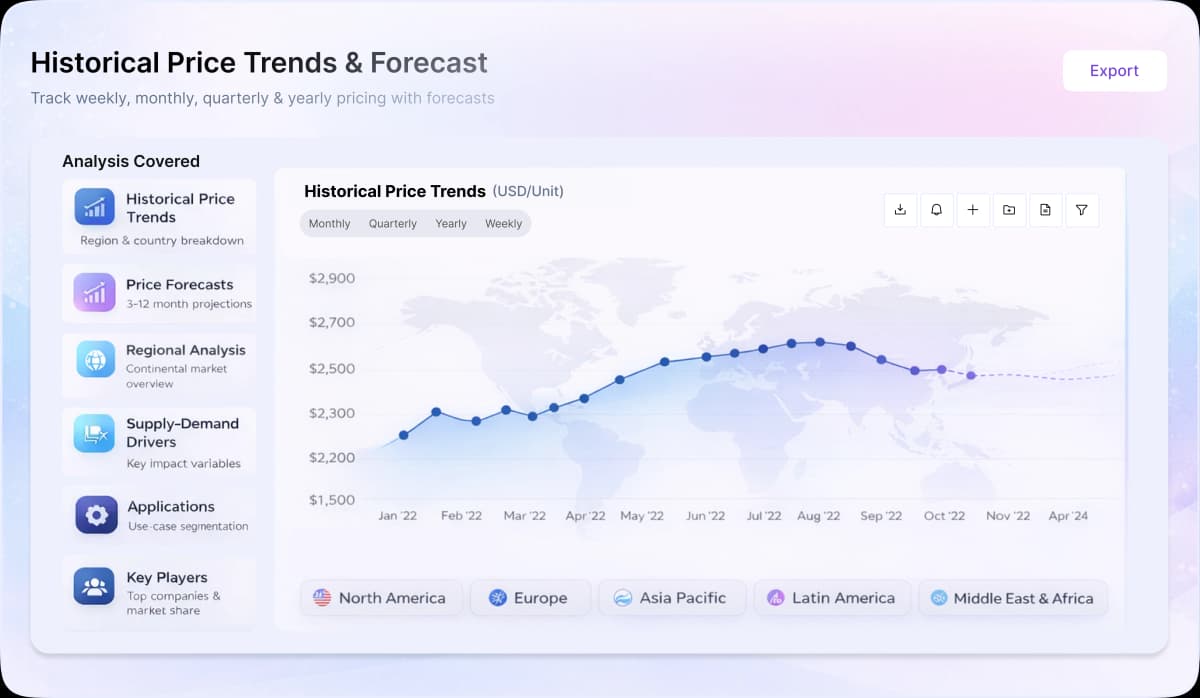
Turn price intelligence into action with the Procurement Resource Database. Log in or subscribe to unlock live price trends, historical charts, supplier databases, cost curves, and analyst-backed insights across chemicals, agriculture, energy, packaging, and more. Use these tools to benchmark your contracts, plan budgets with confidence, and stay ahead of market moves on every product you buy.

0

+

Products

0

+

Regions

0

+

Subscriptions

During the third quarter of 2025, the ammonium bicarbonate market showed an overall weak performance, with limited price movements and low buying activity across major sectors. Throughout the quarter, producers maintained relatively stable operating rates, resulting in consistent supply. However, demand remained soft across the board, especially from agriculture and food-grade applications, which typically influence seasonal demand.

Industrial usage was steady but not strong enough to boost prices. Agricultural consumption, which often increases ahead of planting seasons, stayed muted for most of the quarter. This kept inventories from drawing down at a healthy pace, adding pressure on prices. Market participants were cautious, mostly buying based on immediate needs rather than building stock.

A short-lived improvement was seen in late July when production at a few plants slowed due to maintenance. This slightly tightened availability but was not enough to change the overall market direction. In August and September, prices trended lower again as supply outweighed demand and downstream sectors continued purchasing conservatively.

One indirect factor was the subdued availability of carbon dioxide a key raw material for ammonium bicarbonate. Though upstream input prices saw occasional firmness, the lack of strong demand kept any cost pressure from significantly affecting finished product prices.

Analyst Insight

According to Procurement Resource, prices of Ammonium Bicarbonate are expected to remain steady with mild fluctuations. A small improvement could occur if agricultural demand picks up in the coming months, but a stronger recovery will depend on how industrial demand evolves.


About Ammonium Bicarbonate

Ammonium bicarbonate is a highly water-soluble salt of ammonia as it readily dissociates into ammonia, carbon dioxide, and water. In the food industry, it acts as a leavening agent as it releases carbon dioxide, which helps in dough rise. In addition, ammonium bicarbonate is used as a chemical reagent in a range of industrial and scientific settings, a pH regulator, and a fire suppressant in specialty extinguishers.

Ammonium Bicarbonate Product Detail

HS Code
28369990
Chemical Formula

NH4HCO3

CAS Number
1066-33-7
Molecular Weight
79.056 g/mol
Industrial Uses

Baking, Fire Extinguishers, Pharmaceuticals, Dyes and pigments, Foam and Rubber

Supplier Database

BASF SE, ADDCON, Sunitomo Chemicals, Clariant, DCW Ltd, Shandong Weijio Holdings Group Co Ltd

Synonyms

Ammonium hydrogen carbonate

Regional Coverage

Asia Pacific

China, India, Indonesia, Pakistan, Bangladesh, Japan, Philippines, Vietnam, Iran, Thailand, South Korea, Iraq, Saudi Arabia, Malaysia, Nepal, Taiwan, Sri Lanka, UAE, Israel, Hongkong, Singapore, Oman, Kuwait, Qatar, Australia, and New Zealand

Europe

Germany, France, United Kingdom, Italy,Spain, Russia, Turkey, Netherlands, Poland, Sweden, Belgium, Austria, Ireland Switzerland, Norway, Denmark, Romania, Finland, Czech Republic, Portugal and Greece

North America

United States and Canada

Latin America

Brazil, Mexico, Argentina, Columbia, Chile, Ecuador, and Peru

Africa

South Africa, Nigeria, Egypt, Algeria, Morocco

CurrencyUS$ (Data can also be provided in local currency)

Supplier Database AvailabilityYes

Customization ScopeThe report can be customized as per the requirements of the customer

Post-Sale Analyst Support360-degree analyst support after report delivery

Note: Our supplier search experts can assist your procurement teams in compiling and validating a list of suppliers indicating they have products, services, and capabilities that meet your company's needs.

Ammonium Bicarbonate Production Process

This reaction between carbon dioxide and ammonia is a single-step synthesis of ammonium bicarbonate under regulated conditions.

Frequently Asked Questions

The ammonium bicarbonate outlook for 2025 points to broadly stable prices with only minor shifts expected. Steady production output across China, India and domestic North American plants is keeping supplies ample, while softer agricultural and industrial demand limits upward momentum. Energy costs and transportation delays may cause occasional local fluctuations, but the overall trend is expected to hold steady. Any meaningful price movement would require a change in production levels or demand patterns.
Ammonium bicarbonate prices are driven mainly by ammonia and carbon-dioxide feedstock costs, with ammonia (made from natural gas via the Haber-Bosch route) the dominant lever, so gas and ammonia trends and producer operating rates set the cost base; energy and freight add further layers. Because output is concentrated in China and India, supply from those origins strongly influences the market. Demand from the food (leavening) and fertilizer industries provides the pull. Ample output against soft agricultural demand keeps prices subdued, while tighter supply or firmer demand lifts them.
Ammonium bicarbonate production and consumption are heavily concentrated in China, where it has long been used as a low-cost nitrogen fertilizer, with additional food-grade and technical-grade output in India, Europe and North America. Because much of the world's capacity sits in China and India, import-dependent buyers in Europe and North America face supply-chain exposure to those origins. Demand is driven mainly by fertilizer and food-industry leavening use across Asia Pacific, Europe and North America.
The ammonium bicarbonate value chain begins with natural gas, which supplies hydrogen for ammonia synthesis via the Haber-Bosch process. Ammonia is then reacted with compressed carbon dioxide in a single-step controlled reaction to produce ammonium bicarbonate. Downstream, it serves as a leavening agent in baked goods, a nitrogen source in fertilizers, a component in fire extinguishers, and an input for pharmaceuticals, dyes, pigments, ceramics, plastics, rubber, and cosmetics.
The food and baking industry is the dominant demand driver, using ammonium bicarbonate as a leavening agent in cookies, gingerbread and waffles. Fertilizer and agricultural use, where it serves as a nitrogen source, adds seasonal volume, and industrial buyers in plastics, rubber, ceramics and textiles, plus fire-safety and pharmaceutical applications, round out demand. Because food and fertilizer uses form a broad base, ammonium bicarbonate demand is fairly steady, so prices move mainly with ammonia and carbon-dioxide feedstock costs, Chinese and Indian supply and the balance against this downstream pull.

Procurement Resource assesses ammonium bicarbonate prices through a structured, data-driven methodology combining primary engagement with producers, suppliers and traders, secondary market data, monitoring of feedstock and input costs, trade-flow and inventory tracking, and exchange or spot benchmarks. These inputs are validated and translated into a transparent price assessment and outlook. The detailed methodology is available on the Procurement Resource website.


Our Price Analysis Methodology

About the Author

Udeesha Tomar profile photo

Udeesha Tomar

AVP - Strategy and Solutions

Leading procurement research solutions across chemicals, materials, and food & beverages, with expertise in price forecasting and market analytics.

Schedule Demo

Schedule A Demo

Experience how Procurement Resource transforms raw material price data into clear, decision ready intelligence. Optimise your performance with reliable, expert market data and analysis. Schedule your demo today to experience a live walk-through where our experts will showcase interactive price charts, forecasted prices, and insights driving the prices for your key commodities, tailored to your workflows. Contact us now!

Our Team will be happy to assist you

We are just a text away

+1

Still Need Help?

Europe & Africa

+44 7573 171117

[email protected]

USA & Canada

+1 307 363 1045

[email protected]

APAC

+91 8850629517

[email protected]

Unlock full access to Procurement Resource's price databases, interactive charts, and short-term forecasts for thousands of commodities. Elevate your sourcing decisions by comparing prices across regions, downloading historical data, and layering in analyst-backed insights, all with our flexible plans that scale as your portfolio grows.

Still have any Questions

Contact Us
Mastercard
Wire
VISA
Stripe

Why Procurement Database

Commodity Market Intelligence

Commodity Market Intelligence

Track prices, market movements, supply-demand dynamics, and industry developments across hundreds of commodities through a centralized intelligence platform built for informed procurement decisions.

Price Forecasts & Market Outlooks

Price Forecasts & Market Outlooks

Understand market fluctuations using analyst-backed forecasts, historical pricing patterns, and evolving industry trends to strengthen sourcing strategies and budget planning.

Cost & Procurement Optimization

Cost & Procurement Optimization

Leverage cost models, pricing benchmarks, and procurement insights to evaluate purchasing opportunities, improve negotiations, and enhance operational efficiency.

Global & Regional Market Insights

Global & Regional Market Insights

Access region-specific price trends, trade activities, capacity changes, and supply chain developments influencing commodity markets worldwide.

1/4