Ammonium Oxide Price Trend Analysis 2026: Market Insights, Price Drivers, Supply Demand Analysis, Historical Prices & Latest News

Pragati Agarwal profile photo
Written ByPragati Agarwal

Procurement Resource Database

Laptop screen

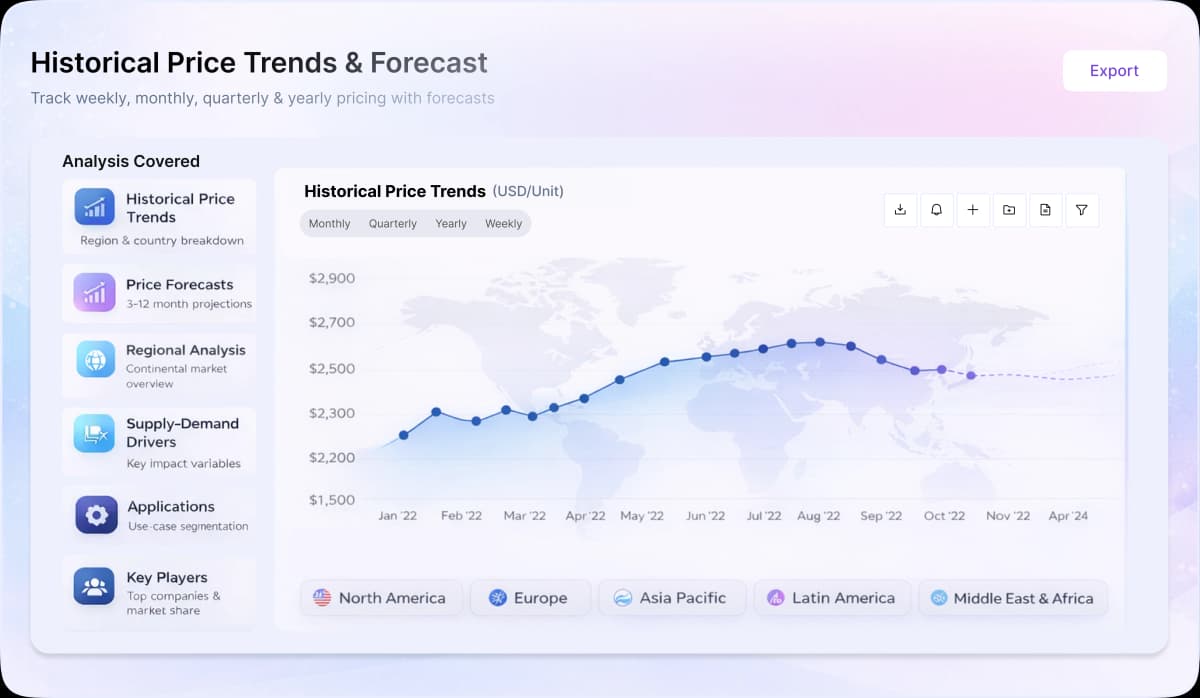
Turn price intelligence into action with the Procurement Resource Database. Log in or subscribe to unlock live price trends, historical charts, supplier databases, cost curves, and analyst-backed insights across chemicals, agriculture, energy, packaging, and more. Use these tools to benchmark your contracts, plan budgets with confidence, and stay ahead of market moves on every product you buy.

0

+

Products

0

+

Regions

0

+

Subscriptions

Asia

The Asia market for ammonium oxide experienced varied trends during the fourth quarter of 2025. During October, the market was relatively stable as production was high and inventories were adequate. Demand from the fertilizer and industrial markets was not very strong, which did not allow the market to go up significantly. During November, the market was better as some ammonia plants operated at lower rates due to maintenance and inspection activities. This provided some tightness to the market, which allowed the market to go up. Also, agricultural markets improved and some plants increased their rates, which provided further support to the market. However, during December, the market conditions eased somewhat as plants returned to normal operations. Inclement weather conditions in some northern areas resulted in inventory buildup due to transportation issues. Demand was slow towards the end of the year, and the market softened somewhat.

Europe

In the European market, prices of ammonium oxide were relatively stable with minor fluctuations during Q4’25. The supply situation was largely balanced as production continued at normal rates and import supply was supportive as well. In October, seasonal demand from the agricultural sector was low, keeping prices under mild pressure as industrial demand was stable. During November, prices were somewhat supported by a tighter global ammonia supply situation and cost pressure. However, demand was still cautious, with most buyers purchasing based on their immediate requirements only. The prices were relatively soft again in December as demand from downstream sectors reduced towards the end of the year.

North America

The North American market also followed a similar trend as its global counterparts. October saw stable conditions due to comfortable supply and moderate demand. November saw lower operating rates for some ammonia plants and steady fertilizer markets, which contributed to strengthening the market slightly. Consistent industrial markets were not overly aggressive. As supply improved and seasonal markets softened in December, prices adjusted lower.


About Ammonium Oxide

Ammonium Oxide is a weak basic salt of ammonia with very low melting-boiling points and ammoniacal odor. In an industrial process, it serves as a reservoir of ammonia and also helps maintain the alkalinity of the solution. In the fertilizers sector, it acts as a source of nitrogen for plants and also as a reducing agent for aluminium production.


Ammonium Oxide Product Detail

Chemical Formula

(NH4)2O

CAS Number
12046-03-6
Molecular Weight
52.075 g/mol
Industrial Uses

Fertilizers, Cleaning products, Explosives

Supplier Database

BASF SE, Evonik Industries AG, Arkema , Clariant AG, Nouryon, Cayman Chemical, Penta Bioscience Products, Zaclon LLC, Alfa Aesar, Merck KGaA

Regional Coverage

Asia Pacific

China, India, Indonesia, Pakistan, Bangladesh, Japan, Philippines, Vietnam, Iran, Thailand, South Korea, Iraq, Saudi Arabia, Malaysia, Nepal, Taiwan, Sri Lanka, UAE, Israel, Hongkong, Singapore, Oman, Kuwait, Qatar, Australia, and New Zealand

Europe

Germany, France, United Kingdom, Italy,Spain, Russia, Turkey, Netherlands, Poland, Sweden, Belgium, Austria, Ireland Switzerland, Norway, Denmark, Romania, Finland, Czech Republic, Portugal and Greece

North America

United States and Canada

Latin America

Brazil, Mexico, Argentina, Columbia, Chile, Ecuador, and Peru

Africa

South Africa, Nigeria, Egypt, Algeria, Morocco

CurrencyUS$ (Data can also be provided in local currency)

Supplier Database AvailabilityYes

Customization ScopeThe report can be customized as per the requirements of the customer

Post-Sale Analyst Support360-degree analyst support after report delivery

Note: Our supplier search experts can assist your procurement teams in compiling and validating a list of suppliers indicating they have products, services, and capabilities that meet your company's needs.

Frequently Asked Questions

The ammonium oxide outlook for 2026 points to a broadly balanced market with a firm near-term bias. Prices stay supported as elevated ammonia feedstock costs, driven by firm natural gas prices and turnaround activity, and spring planting season fertilizer-linked demand underpin the market. Lean North American inventories and tighter European feedstock economics add regional upward pressure. The agricultural calendar remains the principal swing factor, with sustained softening requiring easing ammonia costs, higher plant operating rates, or a pullback in fertilizer demand.
Ammonium oxide prices are driven mainly by ammonia feedstock costs, which track natural gas prices, so gas trends, producer operating rates and ammonia turnaround activity set the cost base. Fertilizer-linked demand adds a seasonal pull around planting periods, while downstream industrial cleaning and explosives consumption provides a steady base. Regional feedstock economics and inventory levels shape landed prices, with import-reliant markets carrying a premium. Firmer natural-gas and ammonia costs or tight supply against steady demand lift prices, while easing feedstock costs and higher operating rates ease them.
Ammonium oxide production and trade are concentrated across Asia Pacific, Europe and North America, tied to ammonia and fertilizer capacity. Established nitrogen and fertilizer producers active in the associated value chains include Yara International, CF Industries, OCI Global, Nutrien and Koch Industries, alongside diversified chemical manufacturers such as BASF SE, Evonik Industries, Arkema and Solvay. Because the market rests on widely available ammonia feedstock, supply is relatively diffuse, so buyers weigh natural-gas and ammonia costs and regional logistics as the main supply considerations.
The ammonium oxide value chain begins with tertiary aliphatic amines and hydrogen peroxide as primary feedstocks. Hydrogen peroxide is produced from anthraquinone and hydrogen, making its cost sensitive to upstream raw-material price swings. Tertiary aliphatic amines are oxidized using hydrogen peroxide under controlled temperature, forming an amine oxide intermediate separated by phase separation to yield ammonium oxide. The finished product is consumed as a nitrogen source in fertilizers such as urea and ammonium nitrate, in household and industrial cleaning agents, and as a reactant and pH adjuster in chemical synthesis.
Fertilizer manufacturing is the dominant demand driver, with spring planting seasons lifting requirement-led buying and creating the strongest price pressure. Industrial and household cleaning product makers provide steady baseline consumption, while explosives producers add dependable but modest offtake. Natural gas and ammonia feedstock costs transmit directly into ammonium oxide pricing, and disciplined production with lean inventories during peak agricultural periods amplifies the firm bias.
Procurement Resource assesses ammonium oxide prices through a structured, data-driven methodology. Primary engagement with producers, suppliers and traders is combined with secondary market data, continuous monitoring of feedstock and input costs, trade-flow and inventory tracking, and exchange or spot benchmarks. All inputs are validated and translated into a transparent price assessment and outlook. The detailed methodology is available on the Procurement Resource website.

Our Price Analysis Methodology

About the Author

Pragati Agarwal profile photo

Pragati Agarwal

Senior Business Insights Analyst

Delivering price trend analysis and procurement market insights at Procurement Resource, with expertise in identifying commodity patterns, supporting purchasing strategies, and improving cost efficiency through actionable market intelligence.

Schedule Demo

Schedule A Demo

Experience how Procurement Resource transforms raw material price data into clear, decision ready intelligence. Optimise your performance with reliable, expert market data and analysis. Schedule your demo today to experience a live walk-through where our experts will showcase interactive price charts, forecasted prices, and insights driving the prices for your key commodities, tailored to your workflows. Contact us now!

Our Team will be happy to assist you

We are just a text away

+1

Still Need Help?

Europe & Africa

+44 7573 171117

Sales@procurementresource.com

USA & Canada

+1 307 363 1045

Sales@procurementresource.com

APAC

+91 8850629517

Sales@procurementresource.com

Unlock full access to Procurement Resource's price databases, interactive charts, and short-term forecasts for thousands of commodities. Elevate your sourcing decisions by comparing prices across regions, downloading historical data, and layering in analyst-backed insights, all with our flexible plans that scale as your portfolio grows.

Still have any Questions

Contact Us
Mastercard
Wire
VISA
Stripe

Why Procurement Database

Commodity Market Intelligence

Commodity Market Intelligence

Track prices, market movements, supply-demand dynamics, and industry developments across hundreds of commodities through a centralized intelligence platform built for informed procurement decisions.

Price Forecasts & Market Outlooks

Price Forecasts & Market Outlooks

Understand market fluctuations using analyst-backed forecasts, historical pricing patterns, and evolving industry trends to strengthen sourcing strategies and budget planning.

Cost & Procurement Optimization

Cost & Procurement Optimization

Leverage cost models, pricing benchmarks, and procurement insights to evaluate purchasing opportunities, improve negotiations, and enhance operational efficiency.

Global & Regional Market Insights

Global & Regional Market Insights

Access region-specific price trends, trade activities, capacity changes, and supply chain developments influencing commodity markets worldwide.

1/4