Anthracene Price Trend Analysis 2026: Market Insights, Latest News, Supply Demand Analysis, Price Drivers & Historical Prices

Pragati Agarwal profile photo
Written ByPragati Agarwal

Procurement Resource Database

Laptop screen

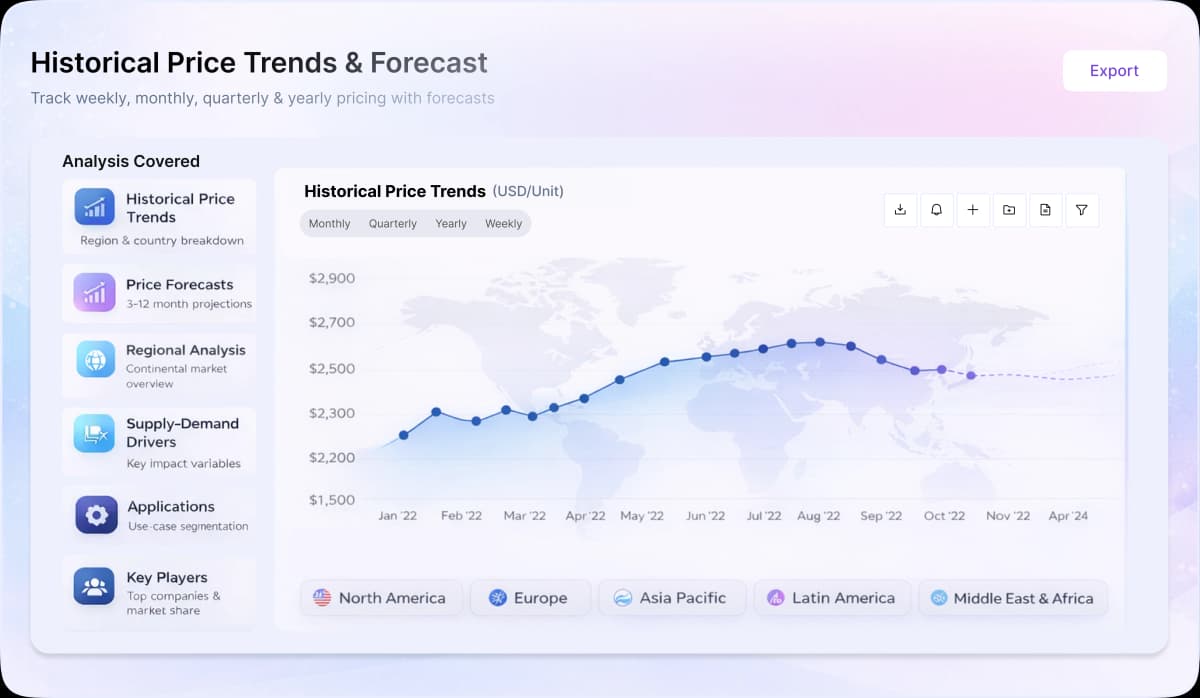
Turn price intelligence into action with the Procurement Resource Database. Log in or subscribe to unlock live price trends, historical charts, supplier databases, cost curves, and analyst-backed insights across chemicals, agriculture, energy, packaging, and more. Use these tools to benchmark your contracts, plan budgets with confidence, and stay ahead of market moves on every product you buy.

0

+

Products

0

+

Regions

0

+

Subscriptions

Anthracene is a polycyclic hydrocarbon made up of three benzene rings fused together. This hydrocarbon is a crucial component for pigment and agriculture industries (pesticides, and fungicides). Thereby, the demands from these sectors determine the downstream pricing outlook for anthracene. Feedstock prices and other manufacturing costs influence the upstream pricing outlooks. Since anthracene is extracted via fractional distillation of coal tar, the price indices for both anthracene and coal tar show great similarities.

During the first quarter of the year 2024 as well, the market behavior exhibited similarities for anthracene and coal tar. Coal production has seen impressive increments in recent times. In India, the stockpiles surpassed 43 million tonnes; this resulted in a turndown of external cost pressure. The import volumes also took a hit. Concurrently, given this feedstock supply surplus, anthracene also felt the pressure. Suppliers started discounting the prices in order to sustain the product movement volumes. Some demand upticks momentarily pushed the prices up. However, the overall market sentiments remained downward, wavering for anthracene for the most part.


About Anthracene

Anthracene is a solid polycyclic aromatic hydrocarbon (PAH) consisting of three fused benzene rings, forming a flat, plate-like structure. This compound is derived primarily from coal tar and is used extensively in the production of dyes, pigments, and the synthesis of other chemicals. Anthracene is also a key precursor in the manufacture of anthraquinone, which is pivotal in dye production. Additionally, it finds application in the electronics industry for making organic light-emitting diodes (OLEDs). Anthracene is known for its luminescence properties.

Anthracene Product Detail

Chemical Formula

C14H10

Cas Number
120-12-7
Molecular Weight
178.229 g/mol
Industrial Uses

Chemical Manufacturing, Pharmaceuticals, Dye and Pigment, Electronics (particularly in organic light-emitting diodes, OLEDs), Pesticides, Paper Manufacturing

Supplier Database

Merck KGaA, Tokyo Chemical Industry Co., Ltd., Santa Cruz Biotechnology Inc., Haihang Industry Co. Ltd.

Regional Coverage

Asia Pacific

China, India, Indonesia, Pakistan, Bangladesh, Japan, Philippines, Vietnam, Iran, Thailand, South Korea, Iraq, Saudi Arabia, Malaysia, Nepal, Taiwan, Sri Lanka, UAE, Israel, Hongkong, Singapore, Oman, Kuwait, Qatar, Australia, and New Zealand

Europe

Germany, France, United Kingdom, Italy,Spain, Russia, Turkey, Netherlands, Poland, Sweden, Belgium, Austria, Ireland Switzerland, Norway, Denmark, Romania, Finland, Czech Republic, Portugal and Greece

North America

United States and Canada

Latin America

Brazil, Mexico, Argentina, Columbia, Chile, Ecuador, and Peru

Africa

South Africa, Nigeria, Egypt, Algeria, Morocco

CurrencyUS$ (Data can also be provided in local currency)

Supplier Database AvailabilityYes

Customization ScopeThe report can be customized as per the requirements of the customer

Post-Sale Analyst Support360-degree analyst support after report delivery

Note: Our supplier search experts can assist your procurement teams in compiling and validating a list of suppliers indicating they have products, services, and capabilities that meet your company's needs.

Frequently Asked Questions

Anthracene's outlook for 2026 is range-bound to mildly firm. Coal tar feedstock availability and dye-sector demand are the decisive swing factors. Sustained tightening in coke-oven supply or a revival in pigment offtake would tilt sentiment upward, while comfortable coal tar supply and soft pigment pull would cap gains. The electronics-grade segment continues to add quality-driven interest, though in thin volumes.
Anthracene prices are driven primarily by coal tar supply and coke-oven output, since anthracene is recovered from coal tar, itself a byproduct of the coking process in steel manufacturing. Regional production economics vary: Asian material from China and India tends to be competitively priced and sets export benchmarks, while European supply typically commands a premium reflecting leaner local coking output. Downstream demand from dye and pigment manufacturers, via anthraquinone and related intermediates, is the dominant offtake driver, with the electronics-grade segment for OLED applications adding a smaller, quality-sensitive demand layer.


Anthracene production and export is concentrated in Asia, with China and India anchoring competitively priced material that sets the tone for global availability. Europe holds a firmer supply premium amid leaner coking output and steady dye and pigment demand, while North America relies largely on imported material. Key producers in the coal-tar-to-anthracene value chain include Himadri Speciality Chemical and Hindustan Swarnashilp Chemicals Limited (HSCL) in India, alongside major coal-tar processors based in China. Rain Carbon and Koppers are established Western producers of coal-tar-derived aromatics including anthracene.
In H1 2026, anthracene prices trended range-bound to firm, supported by intermittent coke-oven tightness offsetting comfortable coal tar supply. Asian material from Chinese and Indian producers remained competitive, while European supply held a firmer premium. Himadri is advancing an anthracene and carbazole project targeting Q2 FY27 commissioning, and HSCL is progressing its own anthracene-carbazole line also slated for Q2 FY27, alongside a coal tar pitch debottleneck to 600 ktpa and a carbon black expansion to 130,000 mtpa. Anthraquinone and dye-intermediate offtake remained the dominant demand driver, with electronics-grade adding quality-driven interest.
Anthracene is produced from coal tar, a byproduct of the coking process in steel manufacturing. Coal tar undergoes fractional distillation at high temperatures, followed by vacuum distillation to remove impurities such as potassium carbazole, yielding purified anthracene as the final product. Downstream, anthracene serves as a key intermediate for anthraquinone, carbazole, and phenanthrene, which feed into dyes, pigments, pharmaceuticals, and OLEDs. It is also used directly as an organic semiconductor and scintillator in radiation detection and medical dosimetry.
The dye and pigment industry is the dominant driver of anthracene demand, consuming it as a key intermediate for anthraquinone and other dyestuff chemicals. The chemical and petrochemical sector draws heavily on anthracene for producing carbazole, phenanthrene, and related derivatives. The electronics industry, particularly OLED manufacturing, adds a smaller but quality-sensitive demand layer. Together, these sectors translate into firm procurement pull, with dye-sector offtake serving as the primary swing factor for price direction.
Procurement Resource assesses anthracene prices through a structured, data-driven methodology combining primary engagement with producers, suppliers and traders, secondary market data, continuous monitoring of feedstock and input costs, trade-flow and inventory tracking, and exchange or spot benchmarks. All inputs are validated and translated into a transparent price assessment and outlook. The detailed methodology is available on the Procurement Resource website.

Our Price Analysis Methodology

About the Author

Pragati Agarwal profile photo

Pragati Agarwal

Senior Business Insights Analyst

Delivering price trend analysis and procurement market insights at Procurement Resource, with expertise in identifying commodity patterns, supporting purchasing strategies, and improving cost efficiency through actionable market intelligence.

Schedule Demo

Schedule a demo

Experience how Procurement Resource transforms raw material price data into clear, decision ready intelligence. Optimise your performance with reliable, expert market data and analysis. Schedule your demo today to experience a live walk-through where our experts will showcase interactive price charts, forecasted prices, and insights driving the prices for your key commodities, tailored to your workflows. Contact us now!

Our Team will be happy to assist you

We are just a text away

+1

Still Need Help?

Europe & Africa

+44 7573 171117

Sales@procurementresource.com

USA & Canada

+1 307 363 1045

Sales@procurementresource.com

APAC

+91 8850629517

Sales@procurementresource.com

Unlock full access to Procurement Resource's price databases, interactive charts, and short-term forecasts for thousands of commodities. Elevate your sourcing decisions by comparing prices across regions, downloading historical data, and layering in analyst-backed insights, all with our flexible plans that scale as your portfolio grows.

Still have any Questions

Contact Us
Mastercard
Wire
VISA
Stripe

Why Procurement Database

Commodity Market Intelligence

Commodity Market Intelligence

Track prices, market movements, supply-demand dynamics, and industry developments across hundreds of commodities through a centralized intelligence platform built for informed procurement decisions.

Price Forecasts & Market Outlooks

Price Forecasts & Market Outlooks

Understand market fluctuations using analyst-backed forecasts, historical pricing patterns, and evolving industry trends to strengthen sourcing strategies and budget planning.

Cost & Procurement Optimization

Cost & Procurement Optimization

Leverage cost models, pricing benchmarks, and procurement insights to evaluate purchasing opportunities, improve negotiations, and enhance operational efficiency.

Global & Regional Market Insights

Global & Regional Market Insights

Access region-specific price trends, trade activities, capacity changes, and supply chain developments influencing commodity markets worldwide.

1/4