Barium Oxide Price Trend Analysis 2026: Supply Demand Analysis, Market Insights, Price Drivers, Latest News & Historical Prices

Pragati Agarwal profile photo
Written ByPragati Agarwal

Procurement Resource Database

Laptop screen

Turn price intelligence into action with the Procurement Resource Database. Log in or subscribe to unlock live price trends, historical charts, supplier databases, cost curves, and analyst-backed insights across chemicals, agriculture, energy, packaging, and more. Use these tools to benchmark your contracts, plan budgets with confidence, and stay ahead of market moves on every product you buy.

0

+

Products

0

+

Regions

0

+

Subscriptions

In Q4’25, barium oxide prices remained generally firm, supported by steady demand and balanced supply conditions. The market was influenced by consistent consumption from glass, ceramics, and specialty chemical industries. Stable raw material availability helped producers maintain regular operations, keeping production costs under control. While demand was steady, buyers were cautious and avoided bulk purchases, which limited any sharp price movements.

Supply conditions were comfortable across major producing regions, with manufacturers operating at normal rates and relying on existing inventories to manage minor fluctuations. Export activity remained steady but not aggressive enough to push prices significantly higher. In regions dependent on imported raw materials, the ongoing reliance maintained a slight underlying firmness in the market.

Overall, barium oxide prices moved within a controlled range during the quarter, reflecting a balance between supply, production costs, and moderate demand from downstream industries. The market exhibited limited volatility, with both producers and buyers maintaining cautious strategies to ensure stability.


About Barium Oxide

Barium oxide (BaO) is a chemical compound that is a white, crystalline substance with various industrial applications. It is synthesized through the thermal decomposition of barium nitrate. Barium oxide is known for its high melting point, electrical insulating properties, and its use in the production of special glasses, ceramics, catalysts, and metallurgical processes. However, it is toxic and must be handled with care.

Barium Oxide Product Detail

Chemical Formula

BaO

Molecular Weight
153.33g/mol
Industrial Uses

Glass and Ceramics, Chemicals, Metallurgy, Petroleum Industry, Nuclear Industry, Water Treatment

Synonyms

Barium(II) oxide

Supplier Database

Solvay SA , Tata Chemicals Limited , Merck KGaA, Nippon Chemical Industries Co., Ltd, Showa Denko KK , American Elements Corporation

Regional Coverage

Asia Pacific

China, India, Indonesia, Pakistan, Bangladesh, Japan, Philippines, Vietnam, Iran, Thailand, South Korea, Iraq, Saudi Arabia, Malaysia, Nepal, Taiwan, Sri Lanka, UAE, Israel, Hongkong, Singapore, Oman, Kuwait, Qatar, Australia, and New Zealand

Europe

Germany, France, United Kingdom, Italy,Spain, Russia, Turkey, Netherlands, Poland, Sweden, Belgium, Austria, Ireland Switzerland, Norway, Denmark, Romania, Finland, Czech Republic, Portugal and Greece

North America

United States and Canada

Latin America

Brazil, Mexico, Argentina, Columbia, Chile, Ecuador, and Peru

Africa

South Africa, Nigeria, Egypt, Algeria, Morocco

CurrencyUS$ (Data can also be provided in local currency)

Supplier Database AvailabilityYes

Customization ScopeThe report can be customized as per the requirements of the customer

Post-Sale Analyst Support360-degree analyst support after report delivery

Note: Our supplier search experts can assist your procurement teams in compiling and validating a list of suppliers indicating they have products, services, and capabilities that meet your company's needs.

Barium Oxide Production Process

  • Barium Oxide is produced by thermal decomposition of Barium Nitrate

Barium Nitrate breaks down into Barium Oxide, Oxygen, and Nitrogen dioxide when heated at high temperatures.

Frequently Asked Questions

The barium oxide outlook for 2026 points to firm and stable pricing. Feedstock costs, energy expenses, and consistent downstream demand from specialty glass, advanced ceramics, catalysts, and petroleum processing are expected to keep the market balanced. Asian supply faces ongoing pressure from environmental compliance constraints, while Southeast Asia remains sensitive to high-grade barite availability. European prices carry a freight-driven premium and cautious import logistics, and North American material stays elevated on domestic costs. Any fresh supply side disruption could shift this otherwise range-bound tone.

Barium oxide prices are shaped by several interconnected drivers. Upstream barite and barium carbonate costs set the production-cost floor, while energy expenses add to costs for Asian producers, particularly in China, where periodic environmental compliance constraints can tighten supply. Southeast Asian pricing remains sensitive to high-grade barite availability. In Europe, freight costs and cautious import logistics typically add a premium, while North American prices reflect generally elevated domestic production costs. Downstream consumption from specialty glass, ceramics, and catalysts stays steady, with measured, hand-to-mouth buying capping sharp upward moves.
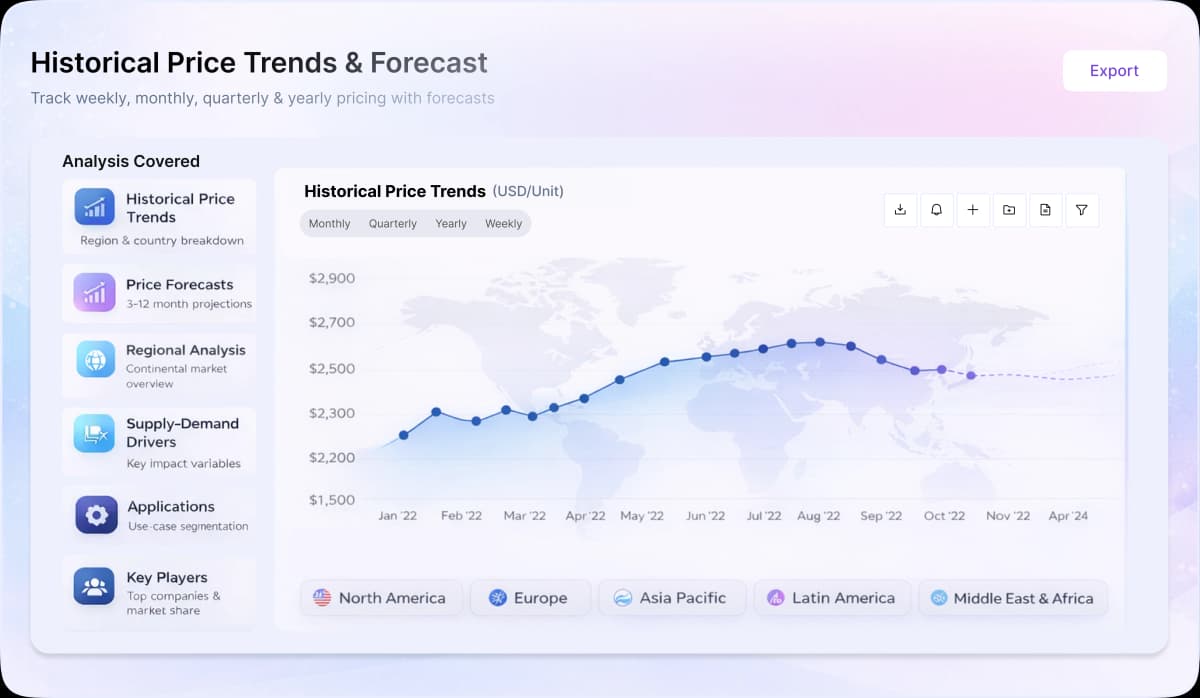
Barium oxide production is concentrated in China, India, and the United States, with China's output anchoring Asian supply at firm prices due to input-cost pressure and environmental-compliance curbs. Southeast Asia depends on high grade barite, while Europe relies on imports and North America on domestic production, with European material commanding a freight-driven premium. Key manufacturers include Solvay, Honeywell International, Chemical Products Corporation, Nippon Chemical Industrial, Sakai Chemical Industry, Shaanxi Ankang Jianghua Group, BASF, and American Elements.
The barium oxide value chain begins with barium carbonate or barium chloride, which are reacted with nitric acid to produce barium nitrate. This is then thermally decomposed at approximately 600 °C to yield barium oxide, with nitrogen dioxide, oxygen, and nitric oxide as by-products. Finished barium oxide is supplied to optical glass and ceramics producers, chemical manufacturers using it as an ethoxylation catalyst for ethylene oxide, electronics makers coating hot cathodes, and the oil and gas sector for drilling muds.
Barium oxide demand is driven primarily by the chemical industry, where it serves as an ethoxylation catalyst in ethylene oxide production and as an oxidizing agent in isomer separation. The glass and ceramics sector draws on it for optical crown glass, while metallurgy, petroleum processing, and consumer electronics - through hot cathode coatings - provide steady secondary demand. Together, these end-markets keep downstream buying measured but consistent, underpinning firm pricing.
Procurement Resource assesses barium oxide price trends through a structured, data-driven methodology combining primary engagement with producers, suppliers and traders, secondary market data, monitoring of feedstock and input costs, trade-flow and inventory tracking, and exchange or spot benchmarks. These inputs are validated and translated into a transparent price assessment and outlook. The detailed methodology is available on the Procurement Resource website.

Our Price Analysis Methodology

About the Author

Pragati Agarwal profile photo

Pragati Agarwal

Senior Business Insights Analyst

Delivering price trend analysis and procurement market insights at Procurement Resource, with expertise in identifying commodity patterns, supporting purchasing strategies, and improving cost efficiency through actionable market intelligence.

Schedule Demo

Schedule A Demo

Experience how Procurement Resource transforms raw material price data into clear, decision ready intelligence. Optimise your performance with reliable, expert market data and analysis. Schedule your demo today to experience a live walk-through where our experts will showcase interactive price charts, forecasted prices, and insights driving the prices for your key commodities, tailored to your workflows. Contact us now!

Our Team will be happy to assist you

We are just a text away

+1

Still Need Help?

Europe & Africa

+44 7573 171117

Sales@procurementresource.com

USA & Canada

+1 307 363 1045

Sales@procurementresource.com

APAC

+91 8850629517

Sales@procurementresource.com

Unlock full access to Procurement Resource's price databases, interactive charts, and short-term forecasts for thousands of commodities. Elevate your sourcing decisions by comparing prices across regions, downloading historical data, and layering in analyst-backed insights, all with our flexible plans that scale as your portfolio grows.

Still have any Questions

Contact Us
Mastercard
Wire
VISA
Stripe

Why Procurement Database

Commodity Market Intelligence

Commodity Market Intelligence

Track prices, market movements, supply-demand dynamics, and industry developments across hundreds of commodities through a centralized intelligence platform built for informed procurement decisions.

Price Forecasts & Market Outlooks

Price Forecasts & Market Outlooks

Understand market fluctuations using analyst-backed forecasts, historical pricing patterns, and evolving industry trends to strengthen sourcing strategies and budget planning.

Cost & Procurement Optimization

Cost & Procurement Optimization

Leverage cost models, pricing benchmarks, and procurement insights to evaluate purchasing opportunities, improve negotiations, and enhance operational efficiency.

Global & Regional Market Insights

Global & Regional Market Insights

Access region-specific price trends, trade activities, capacity changes, and supply chain developments influencing commodity markets worldwide.

1/4