Bio-Propanediol Price Trend Analysis 2026: Price Drivers, Latest News, Market Insights, Historical Prices & Supply Demand Analysis

Udeesha Tomar profile photo
Written ByUdeesha Tomar

Procurement Resource Database

Laptop screen

Turn price intelligence into action with the Procurement Resource Database. Log in or subscribe to unlock live price trends, historical charts, supplier databases, cost curves, and analyst-backed insights across chemicals, agriculture, energy, packaging, and more. Use these tools to benchmark your contracts, plan budgets with confidence, and stay ahead of market moves on every product you buy.

0

+

Products

0

+

Regions

0

+

Subscriptions

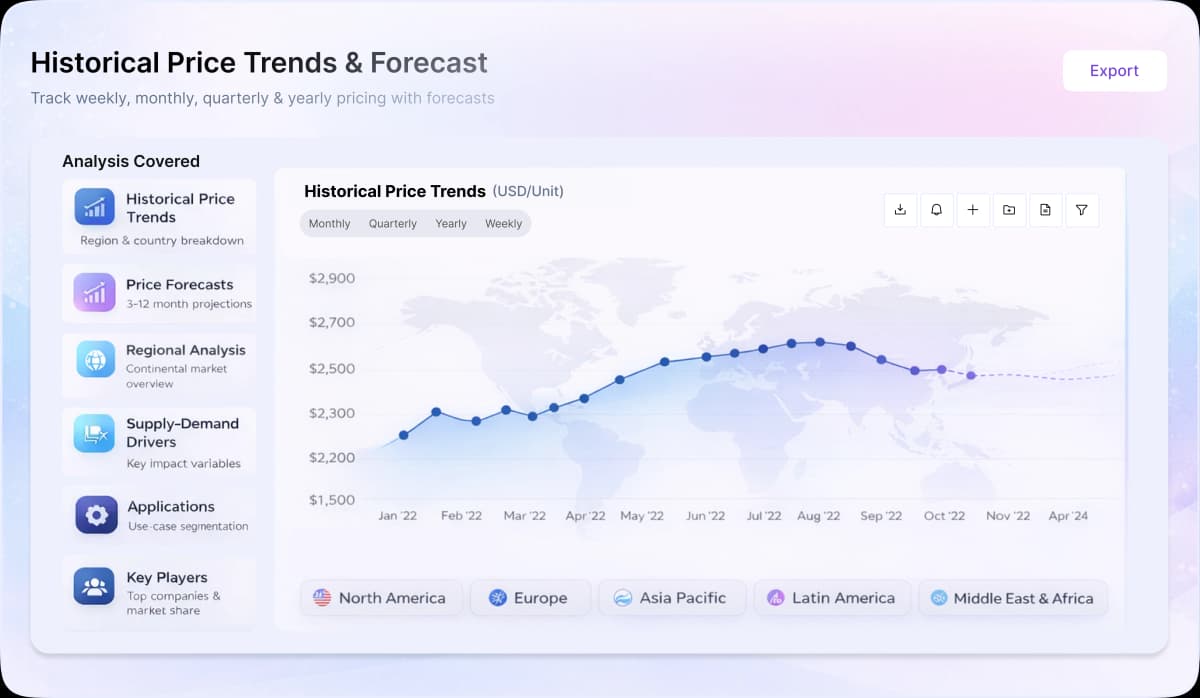
Bio-Propanediol exhibited mixed price patterns throughout the period under discussion. Various factors like weather conditions, inventory stocks, downstream demands, crop yields, etc., determined the overall market behavior for Bio-Propanediol. Stable demands from downstream polyurethane and cosmetic industries were observed, whereas the supplies remained fluctuating in various global markets.

The prices of feedstock corn stabilized in the second quarter as supplies from Russia and Ukraine entered the market. Whereas sugar prices rose continuously owing to disturbed monsoon rain cycles as some regions received excess rainfall while others had to experience drought-like conditions. Hence, these inclined feedstock prices pressured the price trend for Bio-Propanediol.


About Bio-Propanediol

Bio-Propanediol is the simplest member of the class of propane-1,3-diols, consisting of a linear chain propane in which one hydrogen from each methyl group is substituted by a hydroxy group. Bio-Propanediol is petroleum free and is made from renewable sources of raw materials such as carbohydrates.

Bio-Propanediol Product Detail

Chemical Formula

C3H8O2

Molecular Weight
76.09 g/mol
Industrial Uses

Production of sustainable polyurethanes, Anti-freeze/coolant applications, Production of skin care products, Cosmetics industry

Synonyms

Bio-based 1,3-Propanediol

Supplier Database

DuPont, Glory Biomaterial, Shenghong Group

Regional Coverage

Asia Pacific

China, India, Indonesia, Pakistan, Bangladesh, Japan, Philippines, Vietnam, Iran, Thailand, South Korea, Iraq, Saudi Arabia, Malaysia, Nepal, Taiwan, Sri Lanka, UAE, Israel, Hongkong, Singapore, Oman, Kuwait, Qatar, Australia, and New Zealand

Europe

Germany, France, United Kingdom, Italy,Spain, Russia, Turkey, Netherlands, Poland, Sweden, Belgium, Austria, Ireland Switzerland, Norway, Denmark, Romania, Finland, Czech Republic, Portugal and Greece

North America

United States and Canada

Latin America

Brazil, Mexico, Argentina, Columbia, Chile, Ecuador, and Peru

Africa

South Africa, Nigeria, Egypt, Algeria, Morocco

CurrencyUS$ (Data can also be provided in local currency)

Supplier Database AvailabilityYes

Customization ScopeThe report can be customized as per the requirements of the customer

Post-Sale Analyst Support360-degree analyst support after report delivery

Note: Our supplier search experts can assist your procurement teams in compiling and validating a list of suppliers indicating they have products, services, and capabilities that meet your company's needs.

Bio-Propanediol Production Processes

  • Production of Bio-Propanediol from Corn Syrup via Fermentation

In this procedure, bio-propanediol is produced using fermentation by a genetically modified strain of E. Coli under favourable temperature and pressure conditions.

Frequently Asked Questions

The bio-propanediol outlook hinges primarily on the corn harvest and corn syrup feedstock costs, since corn syrup is the sole raw material converted via fermentation into the finished product. A larger corn harvest tends to depress feedstock costs and pressure prices, while a tighter harvest or rising farm input costs firm the market. Consumer demand for sustainable, bio-based cosmetics and eco-friendly polytrimethylene terephthalate fibers provides a structural demand floor that can offset some feedstock-driven softness. Farm economics, including fuel, fertilizer, and storage costs, remain the key variables to watch for price direction.
Bio-propanediol prices are shaped primarily by corn harvest size and corn syrup feedstock costs, since corn syrup is the sole raw material feeding fermentation. An abundant corn harvest tends to depress feedstock costs and squeeze farmer margins, while rising fuel and fertilizer expenses raise farm production costs and can push feedstock prices higher. Higher interest rates also matter indirectly, since they make grain storage more expensive and riskier for farmers, influencing how quickly surplus corn reaches the market. Seasonal procurement patterns, such as holiday-linked demand upticks, provide only partial and temporary relief from feedstock-driven price swings.
The bio-propanediol market features a concentrated manufacturing base. Leading producers include DuPont Tate & Lyle Bio Products, Archer-Daniels-Midland Company (ADM), Mitsui & Co., Ltd., BASF SE, and Corbion NV, operating across North America, Europe, and Asia, alongside Glory Biomaterial and Shenghong Group as additional suppliers. Demand is driven by cosmetics, polymers (notably PTT), and pharmaceutical applications, with major consuming economies including the United States, China, India, Germany, France, and Japan. This concentration among fermentation-specialized firms creates supply security considerations for procurement managers.
Bio-propanediol is produced from corn syrup, the sole primary feedstock derived from corn crops. The production chain begins with corn processed into corn syrup, which is then fed into a fermentation vessel containing a genetically modified E. coli strain. Under controlled temperature and pressure, the bacteria convert the corn syrup carbohydrates into bio-propanediol. The resulting petroleum-free diol is used as a chemical building block for polytrimethylene terephthalate polymers and polyurethanes, and as a humectant and emollient in cosmetics, as well as in solvents, antifreeze, and industrial coatings.

Bio-propanediol demand is driven by the polymer, personal care, and cosmetics industries. Polymer producers use it as a chemical building block for polytrimethylene terephthalate and eco-friendly polyester fibers, while personal care formulators value its emollient and humectant properties in skin creams, lotions, and shampoos. Robust consumer interest in sustainable, bio-based products sustains procurement across both sectors. Because the feedstock is entirely corn-syrup based, swings in the corn harvest and farm input costs transmit directly into feedstock economics and, in turn, into downstream buying patterns.
Procurement Resource assesses bio-propanediol prices through a structured, data driven methodology combining primary engagement with producers, suppliers and traders, secondary market data, continuous monitoring of feedstock and input costs, trade-flow and inventory tracking, and exchange or spot benchmarks. All inputs are validated and translated into a transparent price assessment and outlook. The detailed methodology is available on the Procurement Resource website.

Our Price Analysis Methodology

About the Author

Udeesha Tomar profile photo

Udeesha Tomar

AVP - Strategy and Solutions

Leading procurement research solutions across chemicals, materials, and food & beverages, with expertise in price forecasting and market analytics.

Schedule Demo

Schedule A Demo

Experience how Procurement Resource transforms raw material price data into clear, decision ready intelligence. Optimise your performance with reliable, expert market data and analysis. Schedule your demo today to experience a live walk-through where our experts will showcase interactive price charts, forecasted prices, and insights driving the prices for your key commodities, tailored to your workflows. Contact us now!

Our Team will be happy to assist you

We are just a text away

+1

Still Need Help?

Europe & Africa

+44 7573 171117

Sales@procurementresource.com

USA & Canada

+1 307 363 1045

Sales@procurementresource.com

APAC

+91 8850629517

Sales@procurementresource.com

Unlock full access to Procurement Resource's price databases, interactive charts, and short-term forecasts for thousands of commodities. Elevate your sourcing decisions by comparing prices across regions, downloading historical data, and layering in analyst-backed insights, all with our flexible plans that scale as your portfolio grows.

Still have any Questions

Contact Us
Mastercard
Wire
VISA
Stripe

Why Procurement Database

Commodity Market Intelligence

Commodity Market Intelligence

Track prices, market movements, supply-demand dynamics, and industry developments across hundreds of commodities through a centralized intelligence platform built for informed procurement decisions.

Price Forecasts & Market Outlooks

Price Forecasts & Market Outlooks

Understand market fluctuations using analyst-backed forecasts, historical pricing patterns, and evolving industry trends to strengthen sourcing strategies and budget planning.

Cost & Procurement Optimization

Cost & Procurement Optimization

Leverage cost models, pricing benchmarks, and procurement insights to evaluate purchasing opportunities, improve negotiations, and enhance operational efficiency.

Global & Regional Market Insights

Global & Regional Market Insights

Access region-specific price trends, trade activities, capacity changes, and supply chain developments influencing commodity markets worldwide.

1/4