Udeesha Tomar
AVP - Strategy and Solutions
Leading procurement research solutions across chemicals, materials, and food & beverages, with expertise in price forecasting and market analytics.
Asia
Bitumen prices in Asia increased during Q1’26, mainly due to higher crude oil and refinery residue costs after Middle East supply risks intensified. Buying activity stayed subdued in markets such as Singapore, South Korea, Indonesia, and Malaysia, as construction demand was weak and buyers resisted higher offers. However, the feedstock impact was stronger than the demand weakness, as crude-linked costs rose by more than ~40% during the quarter. Freight uncertainty and tighter vessel availability also added pressure, especially for import-dependent buyers.
Europe
Bitumen prices in Europe followed a firm trend in Q1’26 as higher crude costs, fuel oil tightness, and refinery margin pressure raised production costs. Demand from road construction remained seasonally slow, but supply-side pressure supported the market. However, later in the quarter, the Strait of Hormuz disruption exposed nearly ~20% of global oil and LNG flows, lifting energy and shipping risk across European supply chains. Importers faced higher freight costs and reduced flexibility in cargo movement, which limited any major price correction despite weak construction demand.
North America
Bitumen prices in North America remained firm during Q1’26, supported by higher upstream crude costs and steady infrastructure-related demand. Asphalt producers faced higher refining and transport expenses as global crude markets reacted to the Iran conflict. Downstream demand was not strong enough to create a sharp rally, but road maintenance, public infrastructure activity, and limited seasonal availability helped prevent price weakness. The region was less directly exposed to Hormuz trade flows than Asia or Europe, but global crude volatility still raised production costs.
Analyst Insight
According to Procurement Resource, bitumen prices may remain firm in the near term if crude volatility and freight risks continue. Any easing in Middle East tensions or weaker road construction demand could slow further increases.
Get real-time price assessments, periodic trends, forecasts and price driver insights across key global markets.
Unlock Price Insights NowOur Clients

Turn price intelligence into action with the Procurement Resource Database. Log in or subscribe to unlock live price trends, historical charts, supplier databases, cost curves, and analyst-backed insights across chemicals, agriculture, energy, packaging, and more. Use these tools to benchmark your contracts, plan budgets with confidence, and stay ahead of market moves on every product you buy.

0
+Products
0
+Regions
0
+Subscriptions
Bitumen is a black, viscous, hydrocarbon-based material obtained primarily as the heaviest residue from crude oil refining. It possesses excellent waterproofing, adhesive, and binding properties, making it an essential material in road construction and infrastructure development. Bitumen is available in various grades depending on penetration and viscosity requirements and is widely used in paving, roofing, waterproofing membranes, and industrial applications worldwide.
Saudi Aramco, Shell, ExxonMobil, Chevron, TotalEnergies, Indian Oil Corporation (IOC), Bharat Petroleum Corporation Limited (BPCL)
Asphalt, Petroleum Bitumen, Asphalt Binder and Road Bitumen
CurrencyUS$ (Data can also be provided in local currency)
Supplier Database AvailabilityYes
Customization ScopeThe report can be customized as per the requirements of the customer
Post-Sale Analyst Support360-degree analyst support after report delivery
Note: Our supplier search experts can assist your procurement teams in compiling and validating a list of suppliers indicating they have products, services, and capabilities that meet your company's needs.
Bitumen is produced during petroleum refining through atmospheric and vacuum distillation of crude oil. After lighter fractions such as gasoline, kerosene, and diesel are removed, the heavy vacuum residue is further processed to obtain bitumen. Depending on product specifications, air blowing or oxidation processes may be employed to modify viscosity and performance characteristics. The final product is stored, blended into specific grades, and supplied for paving and industrial applications.
Bitumen is extensively used in road construction as a binder for asphalt pavements, highways, airport runways, and parking surfaces. It is also utilized in roofing materials, waterproofing membranes, pipe coatings, insulation products, bridge decks, and industrial flooring systems. Due to its durability, flexibility, and resistance to water penetration, bitumen remains a critical material in transportation infrastructure and construction projects globally.



AVP - Strategy and Solutions
Leading procurement research solutions across chemicals, materials, and food & beverages, with expertise in price forecasting and market analytics.
Our Price Analysis Methodology

Experience how Procurement Resource transforms raw material price data into clear, decision ready intelligence. Optimise your performance with reliable, expert market data and analysis. Schedule your demo today to experience a live walk-through where our experts will showcase interactive price charts, forecasted prices, and insights driving the prices for your key commodities, tailored to your workflows. Contact us now!
Our Team will be happy to assist you
We are just a text away
Still Need Help?
Unlock full access to Procurement Resource's price databases, interactive charts, and short-term forecasts for thousands of commodities. Elevate your sourcing decisions by comparing prices across regions, downloading historical data, and layering in analyst-backed insights, all with our flexible plans that scale as your portfolio grows.
Still have any Questions
Contact Us


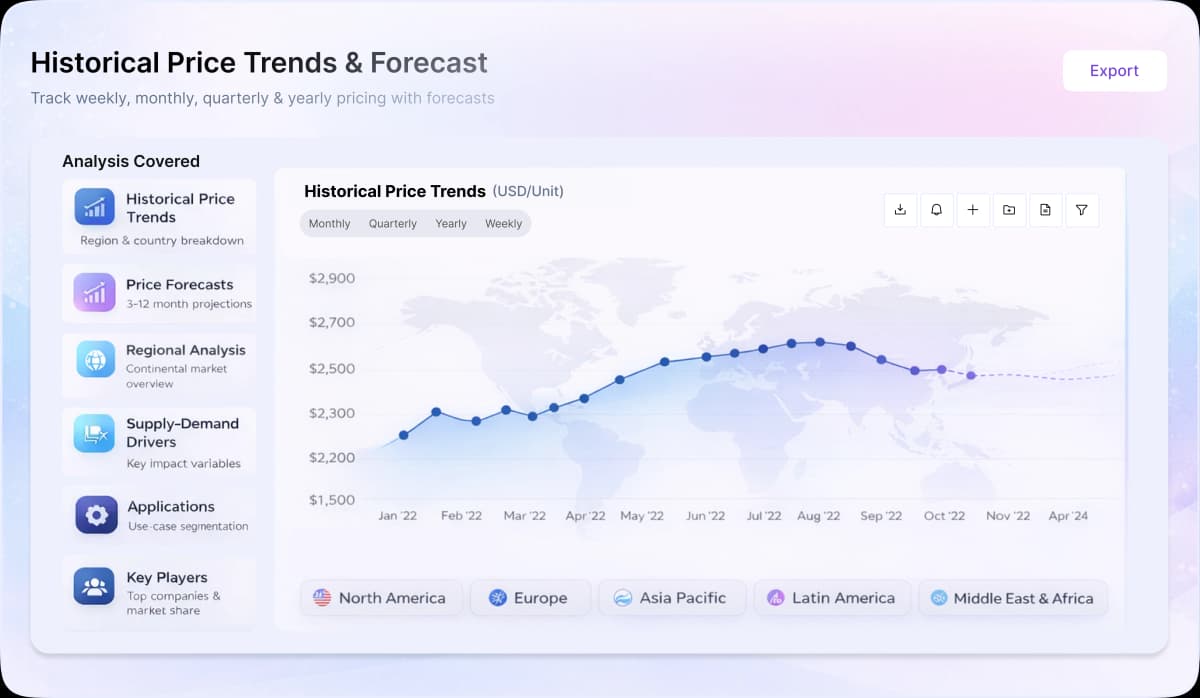
Price Trend Dashboard - What's Included
Price trends across a diverse portfolio of categories and products, spanning board to niche chemicals
Coverage extendable to grade-specific chemicals based on procurement requirements
Regular price tracking supported by robust historical datasets
News, policy updates, and key market drivers impacting price movements
Short-term and long-term price outlooks and forecasts
Supply-demand dynamics and capacity-driven market analysis