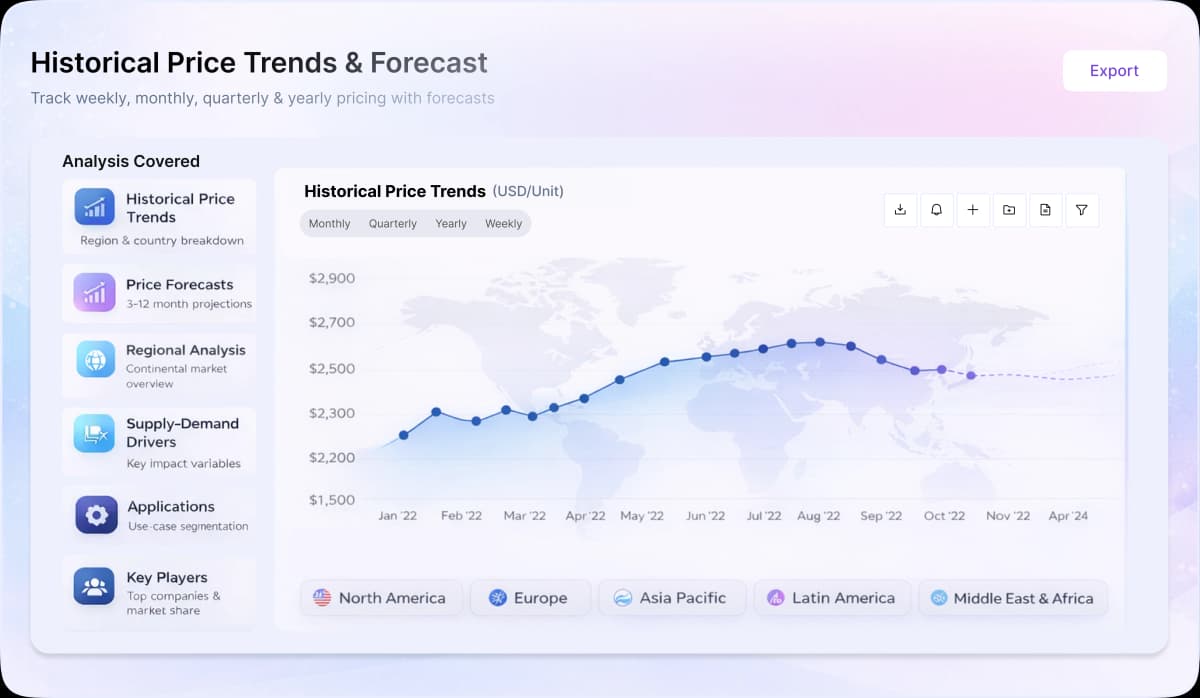
Butyl Glycol Price Trend Analysis 2026: Supply Demand Analysis, Market Insights, Historical Prices, Price Drivers & Latest News

Procurement Resource Database

Laptop screen

Turn price intelligence into action with the Procurement Resource Database. Log in or subscribe to unlock live price trends, historical charts, supplier databases, cost curves, and analyst-backed insights across chemicals, agriculture, energy, packaging, and more. Use these tools to benchmark your contracts, plan budgets with confidence, and stay ahead of market moves on every product you buy.

Butyl Glycol Dashboard Inclusions

Butyl Glycol Price Dasboard

0

+

Products

0

+

Regions

0

+

Subscriptions

Asia

Butyl glycol prices in China experienced a fluctuating trajectory with a downward bias during the third quarter. Butanol, a critical raw material in the ethoxylation production process, faced downward pressure as key producers maintained steady output levels while downstream demand remained muted. This created a favourable cost environment for butyl glycol manufacturers, who benefited from reduced raw material expenses. High feedstock inventory levels across the supply chain translated into softer production costs throughout the early and middle portions of the quarter. Demand from coatings applications, industrial cleaning formulations, and solvent sectors remained measured, with buyers adopting cautious procurement strategies focused on immediate requirements. The limited purchasing enthusiasm from downstream industries provided little support for price recovery despite temporarily reduced feedstock operating rates mid-quarter. By the quarter's end, continued feedstock availability and ongoing inventory clearance activities by suppliers maintained downward pressure on butyl glycol pricing.

Europe

European butyl glycol markets reflected the mixed feedstock dynamics observed during the quarter, with prices fluctuating within a relatively narrow range. Early-period weakness stemmed from adequate butanol supply and cautious purchasing behaviour from the construction and coatings industries. Production costs for butyl glycol remained under pressure as feedstock fundamentals stayed weak, limiting upward price momentum. Mid-quarter developments, including maintenance activities at some chemical facilities, provided temporary cost support, though these effects proved short-lived. Demand from architectural coatings, specialty cleaning products, and industrial applications remained inconsistent, preventing sustained price recovery. Supply availability for butyl glycol stayed sufficient throughout the region, and trading activity remained moderate. The quarter concluded with prices settling slightly lower, reflecting the cumulative impact of oscillating feedstock costs and restrained end-user demand.

North America

North American butyl glycol pricing demonstrated sideways movement during the quarter, influenced by fluctuating feedstock availability and moderate downstream consumption. Early stability in demand from paint, automotive, and adhesive sectors was offset by rising feedstock inventory levels and slower construction activity. Temporary supply disruptions at certain production facilities provided brief support to pricing, though the overall trajectory remained range-bound. Feedstock cost volatility remained limited, which kept butyl glycol price movements contained. As the quarter progressed, ample supply conditions and measured downstream purchasing exerted a mild downward influence, though prices remained relatively stable compared to the quarter's opening levels.


About Butyl Glycol

Butyl glycol, commonly referred to as 2-butoxyethanol, has the molecular formula C4H9OCH2CH2OH. It has a light, sweet scent and is a transparent, colorless liquid. In numerous industrial applications, including paints, coatings, cleaning supplies, and chemical processing where it is frequently employed as a solvent. It has great dissolving capabilities, which make it excellent in mixing and dissolving various substances. However, because of the potential health risks, it should be treated carefully.


Butyl Glycol Product Detail
Hs Code
29094900
Chemical Formula

C6H14O2

Cas Number
111-76-2
Molecular Weight
118.17 g/mol
Industrial Uses

Cleaning products, Metal cleaning surfaces, Printing inks, Paints and coatings

Synonyms

Butoxyethanol, 2-butoxyethanol

Supplier Database

Nippon Nyukazai Co Ltd, Sasol Ltd, Lyondell Basell industries N.V., Eastman Chemical Corporation, Asia Pacific Petrochemicals Co Ltd, Dow Chemical Company, BASF SE, INEOS

Regional Coverage

Asia Pacific

China, India, Indonesia, Pakistan, Bangladesh, Japan, Philippines, Vietnam, Iran, Thailand, South Korea, Iraq, Saudi Arabia, Malaysia, Nepal, Taiwan, Sri Lanka, UAE, Israel, Hongkong, Singapore, Oman, Kuwait, Qatar, Australia, and New Zealand

Europe

Germany, France, United Kingdom, Italy,Spain, Russia, Turkey, Netherlands, Poland, Sweden, Belgium, Austria, Ireland Switzerland, Norway, Denmark, Romania, Finland, Czech Republic, Portugal and Greece

North America

United States and Canada

Latin America

Brazil, Mexico, Argentina, Columbia, Chile, Ecuador, and Peru

Africa

South Africa, Nigeria, Egypt, Algeria, Morocco

CurrencyUS$ (Data can also be provided in local currency)

Supplier Database AvailabilityYes

Customization ScopeThe report can be customized as per the requirements of the customer

Post-Sale Analyst Support360-degree analyst support after report delivery

Note: Our supplier search experts can assist your procurement teams in compiling and validating a list of suppliers indicating they have products, services, and capabilities that meet your company's needs.

Butyl Glycol Production Processes

In ethoxylation, ethylene oxide is reacted with any regular alcohol, like butanol, in the presence of a catalyst. If the ratio of ethylene oxide to n-butanol exceeds 1, di- or tri-ethylene glycol monoethers may be produced. The contaminants are subsequently taken out of the mixture, which is then cleansed and collected.

Our Price Analysis Methodology

Schedule Demo

Schedule A Demo

Experience how Procurement Resource transforms raw material price data into clear, decision ready intelligence. Optimise your performance with reliable, expert market data and analysis. Schedule your demo today to experience a live walk-through where our experts will showcase interactive price charts, forecasted prices, and insights driving the prices for your key commodities, tailored to your workflows. Contact us now!

Our Team will be happy to assist you

We are just a text away

Still Need Help ?

Europe & Africa

+44 7573 171117

[email protected]

USA & Canada

+1 307 363 1045

[email protected]

APAC

+91 8850629517

[email protected]

Unlock full access to Procurement Resource's price databases, interactive charts, and short-term forecasts for thousands of commodities. Elevate your sourcing decisions by comparing prices across regions, downloading historical data, and layering in analyst-backed insights, all with our flexible plans that scale as your portfolio grows.

Still have any Questions

Contact Us
Mastercard
Wire
VISA
Stripe

Why Procurement Database

Extensive Commodity Price Database

Extensive Commodity Price Database

Track prices, market movements, supply-demand dynamics, and industry developments across hundreds of commodities through a centralized intelligence platform built for informed procurement decisions.

Reliable Price Forecasting & Market Outlooks

Reliable Price Forecasting & Market Outlooks

Understand market fluctuations using analyst-backed forecasts, historical pricing patterns, and evolving industry trends to strengthen sourcing strategies and budget planning.

Data Driven Cost & Procurement Optimization

Data Driven Cost & Procurement Optimization

Leverage cost models, pricing benchmarks, and procurement insights to evaluate purchasing opportunities, improve negotiations, and enhance operational efficiency.

Global Coverage with region-specific Market Insights

Global Coverage with region-specific Market Insights

Access region-specific price trends, trade activities, capacity changes, and supply chain developments influencing commodity markets worldwide.

1/4