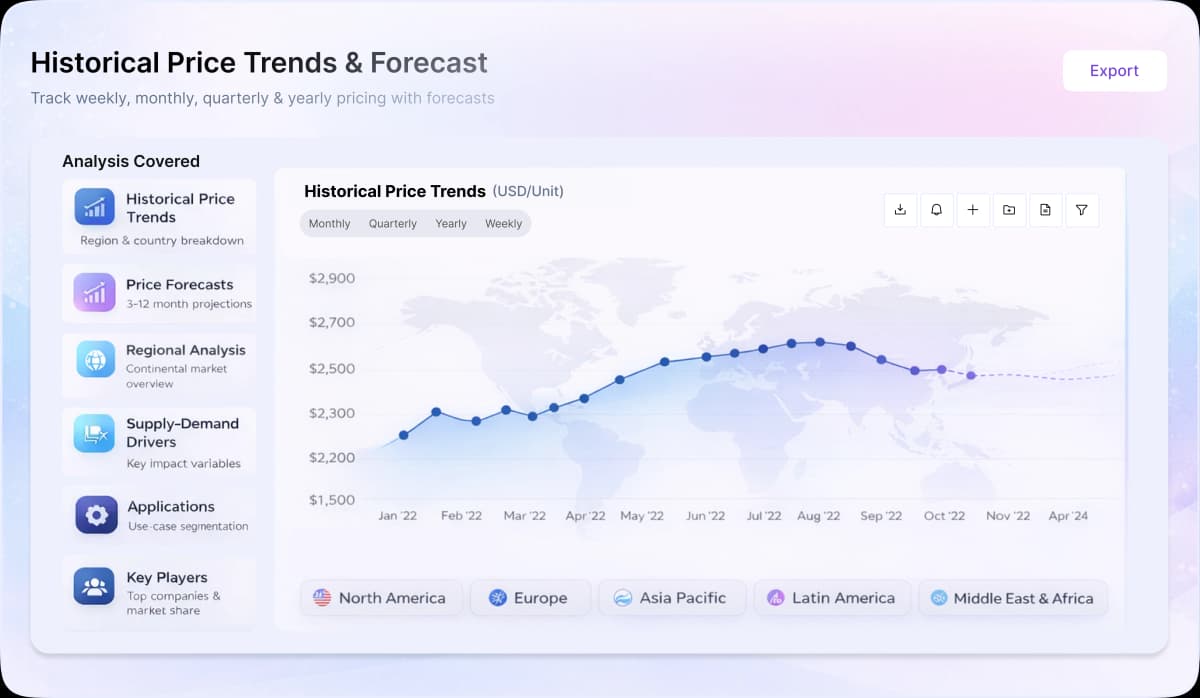
Need latest CAPB (Cocamidopropyl Betaine) prices?
Get real-time price assessments, periodic trends, forecasts and price driver insights across key global markets.
Unlock Price Insights NowOur Clients
Asia
In H2 2024, the Asian CAPB (Cocamidopropyl Betaine) market experienced heightened volatility. While the first half of the year saw relatively stable prices, rising raw material costs and logistical challenges in Q2 caused upward pressure.
The third quarter faced severe disruptions, particularly in China, as typhoons in Hainan province led to supply chain interruptions and production halts. By Q4, improved inventory levels and stabilized shipping conditions provided some relief, though prices remained higher than the previous year, reflecting the earlier challenges.
Europe
The European CAPB (Cocamidopropyl Betaine) market maintained an overall bullish trend in H2 2024. The second half of the year saw persistent price increases driven by high energy costs and raw material limitations. In Q3, geopolitical tensions exacerbated production challenges, particularly with disruptions to gas supplies at the Sudzha transit station. Despite this, demand remained strong across both personal care and industrial sectors throughout Q4, keeping prices elevated as production costs stayed high.
North America
In North America, CAPB prices showed mixed trends in H2 2024. While the first part of the year saw downward pressure due to adequate feedstock availability and muted demand, the market shifted in Q2 as production costs rose and seasonal demand picked up. The third quarter brought additional challenges from hurricanes, which disrupted production facilities and logistics networks. By Q4, raw material costs had stabilized, but ongoing supply chain inefficiencies prevented a significant decline in prices, resulting in a relatively stable market environment.
Related Report
Get real-time price assessments, periodic trends, forecasts and price driver insights across key global markets.
Unlock Price Insights NowOur Clients

Turn price intelligence into action with the Procurement Resource Database. Log in or subscribe to unlock live price trends, historical charts, supplier databases, cost curves, and analyst-backed insights across chemicals, agriculture, energy, packaging, and more. Use these tools to benchmark your contracts, plan budgets with confidence, and stay ahead of market moves on every product you buy.

0
+Products
0
+Regions
0
+Subscriptions
Asia
In the first half of 2024, the price trend of CAPB (Cocamidopropyl Betaine) in Asia, particularly in China and India, was largely impacted by the bearish momentum in DMAPA prices. With dimethylamine and propylene feedstock costs declining due to oversupply and weak demand, the production costs of CAPB also experienced downward pressure. This was particularly evident in the personal care and household cleaning sectors, where the demand for CAPB was subdued.

Despite a slight recovery in methylamine prices in China by mid-Q2, the overall market for CAPB remained lackluster, as downstream demand from cosmetics and detergents failed to pick up significantly. Additionally, geopolitical factors like tensions around the Red Sea dampened international trade, further restricting CAPB market growth in the region.
Europe
In Europe, CAPB prices during H1 2024 reflected the weak performance of DMAPA, which saw a decline due to reduced feedstock costs and soft demand from various industries, including personal care. The region's economic uncertainties, adverse weather conditions affecting agricultural sectors, and lower purchasing power contributed to weak demand for CAPB, despite its widespread use in detergents and cosmetics. As DMAPA prices fell due to lower methanol and ammonia costs, CAPB prices followed a similar downward trajectory. Toward the end of the second quarter, there was some improvement in market activity as purchasing activities increased slightly, but this did little to offset the overall weak trend in CAPB prices during the first half of the year.
North America
In North America, CAPB prices during H1 2024 mirrored the challenges faced by DMAPA, driven by declining dimethylamine and propylene prices, along with sluggish demand from key sectors such as personal care and cleaning products. Economic policies, high freight costs, and logistical challenges further exacerbated the situation, limiting any potential price gains. While there were stable production levels and ample supply of CAPB, the demand from the personal care and household sectors remained muted, contributing to the downward price pressure throughout the region. Despite some stabilization toward the end of Q2, CAPB prices in North America largely remained under pressure due to the challenging market conditions and subdued feedstock prices.
CAPB or Cocamidopropyl betaine, a mixture of closely related organic compounds, is a fatty acid amide. It is extracted from dimethylaminopropylamine (DMAPA) and coconut oil. In appearance, it is a pale-yellow coloured viscous solution. Cocamidopropyl betaine is widely utilised as a surfactant in personal care products as it is mild in nature.
C19H38N2O3
Laundry detergents and home care products, Furnishing Care Products, Fabric, Textile, Leather Products, Laundry and Dishwashing Products, Personal Care Products, Sporting Equipment
4292-10-8, {[3-(Dodecanoylamino)propyl](dimethyl)ammonio}acetate, 2-[(3-Dodecanamidopropyl)dimethylaminio]acetate
Unilever PLC, Evonik Industries AG, Kao Corporation, EOC Group, Stepan Company, Miwon Commercial Co., Ltd, Prasol Chemicals Pvt. Ltd
CurrencyUS$ (Data can also be provided in local currency)
Supplier Database AvailabilityYes
Customization ScopeThe report can be customized as per the requirements of the customer
Post-Sale Analyst Support360-degree analyst support after report delivery
Note: Our supplier search experts can assist your procurement teams in compiling and validating a list of suppliers indicating they have products, services, and capabilities that meet your company's needs.
CAPB is produced in two steps, where the first step utilises a reaction between DMAPA and fatty acids, particularly obtained from coconut oil or palm kernel oil. This results in DMAPA’s selective addition, transforming primary amine present in it to amide. Finally, the remaining tertiary amine in DMAPA is reacted with chloroacetic acid to produce a quaternary ammonium centre, thus giving out CAPB.
Our Price Analysis Methodology

Experience how Procurement Resource transforms raw material price data into clear, decision ready intelligence. Optimise your performance with reliable, expert market data and analysis. Schedule your demo today to experience a live walk-through where our experts will showcase interactive price charts, forecasted prices, and insights driving the prices for your key commodities, tailored to your workflows. Contact us now!
Our Team will be happy to assist you
We are just a text away
Still Need Help ?
Unlock full access to Procurement Resource's price databases, interactive charts, and short-term forecasts for thousands of commodities. Elevate your sourcing decisions by comparing prices across regions, downloading historical data, and layering in analyst-backed insights, all with our flexible plans that scale as your portfolio grows.
Still have any Questions
Contact Us


Price Trend Dashboard - What's Included
Price trends across a diverse portfolio of categories and products, spanning board to niche chemicals
Coverage extendable to grade-specific chemicals based on procurement requirements
Regular price tracking supported by robust historical datasets
News, policy updates, and key market drivers impacting price movements
Short-term and long-term price outlooks and forecasts
Supply–demand dynamics and capacity-driven market analysis