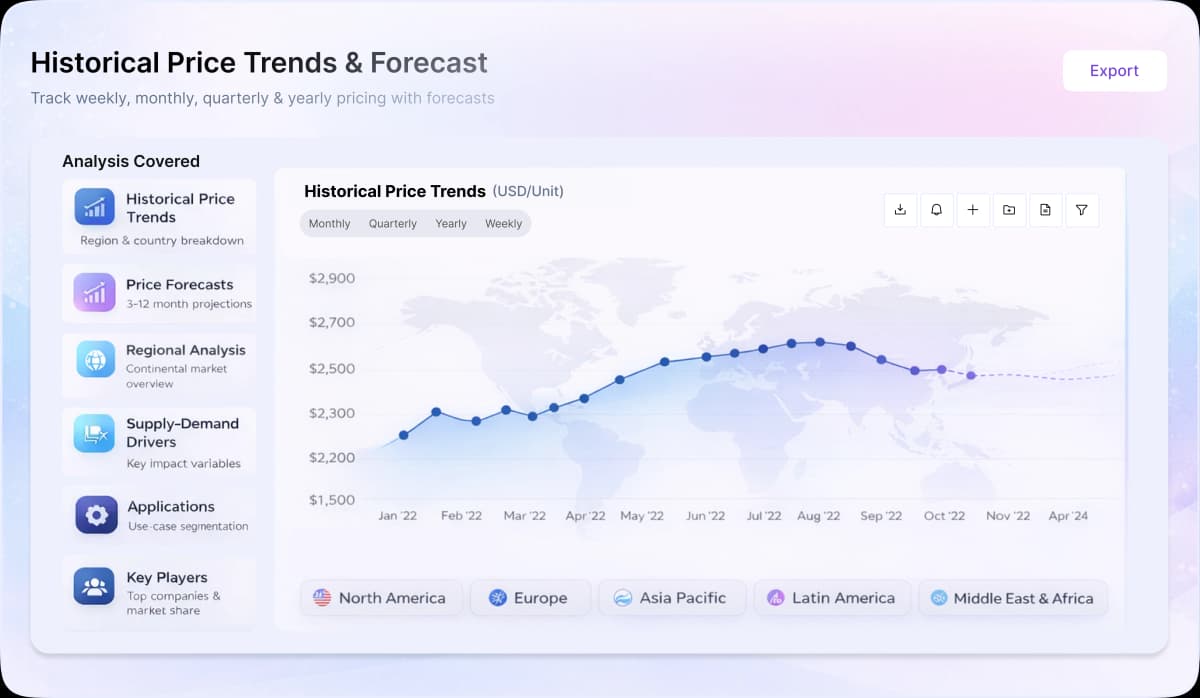
Carbon Monoxide Price Trend Analysis 2026: Price Drivers, Latest News, Historical Prices, Supply Demand Analysis & Market Insights

Shriya Singh profile photo
Written ByShriya Singh

Procurement Resource Database

Laptop screen

Turn price intelligence into action with the Procurement Resource Database. Log in or subscribe to unlock live price trends, historical charts, supplier databases, cost curves, and analyst-backed insights across chemicals, agriculture, energy, packaging, and more. Use these tools to benchmark your contracts, plan budgets with confidence, and stay ahead of market moves on every product you buy.

0

+

Products

0

+

Regions

0

+

Subscriptions

The market for Carbon Monoxide experienced fluctuating pricing dynamics throughout the year, influenced by movements in carbon dioxide, a key feedstock used in certain production processes. Early months witnessed price increases supported by demand from chemical synthesis applications, particularly acetic acid and methanol production, with industrial gas requirements contributing to steady consumption. Metallurgical sector demand from steel production and iron reduction processes maintained baseline support, though logistics constraints and feedstock availability created supply tightness that drove prices upward in several regional markets.

As the year progressed, prices eased with weakening demand from specialty chemical manufacturing and reduced metallurgical applications as steel sector activity softened. The middle months brought steady price movement with slight upward trends, though rising energy costs and feedstock supply complications caused fluctuations. Pharmaceutical manufacturing and carbonyl compound production maintained moderate consumption levels, providing stability amid broader market volatility. Later in the year, prices remained mostly firm owing to steady demand from chemical intermediates and industrial gas applications, particularly phosgene production and specialty synthesis operations. However, regulatory actions regarding production standards and environmental compliance kept market participants alert regarding possible supply adjustments. Trade activity reflected these varying conditions, with suppliers adjusting delivery volumes based on sector-specific requirements across chemical and metallurgical end-users.


About Carbon Monoxide

Carbon monoxide is an odorless and colorless gas formed by the incomplete combustion of fuels. Carbon monoxide consists of one carbon atom and one oxygen atom connected by a triple bond. There are several environmental and biological sources that generate and emit a significant amount of carbon monoxide.

When people are exposed to CO gas, the CO molecules displace the oxygen in their bodies and lead to poisoning. Since CO has no odor, color, or taste, it cannot be detected by our senses, which means that dangerous concentrations of the gas can build up, and humans have no way to detect the problem until they become ill. It is also one of the major greenhouse gases responsible for climate change.

Carbon Monoxide Product Detail

HS Code
28112940
Chemical Formula

CO

CAS Number
630-08-0
Molecular Weight
28.010 g/mol
Industrial Uses

Pharmaceuticals, Metal Industry, Chemicals like methanol, Fragrances, Food and Beverages, Electronics

Synonyms

Carbonic oxide, Carbonous oxide, Carbon(II) oxide

Supplier Database

Air Liquide, Linde Plc., Sipchem, Messer, American Gas Products, Praxair

Regional Coverage

Asia Pacific

China, India, Indonesia, Pakistan, Bangladesh, Japan, Philippines, Vietnam, Iran, Thailand, South Korea, Iraq, Saudi Arabia, Malaysia, Nepal, Taiwan, Sri Lanka, UAE, Israel, Hongkong, Singapore, Oman, Kuwait, Qatar, Australia, and New Zealand

Europe

Germany, France, United Kingdom, Italy,Spain, Russia, Turkey, Netherlands, Poland, Sweden, Belgium, Austria, Ireland Switzerland, Norway, Denmark, Romania, Finland, Czech Republic, Portugal and Greece

North America

United States and Canada

Latin America

Brazil, Mexico, Argentina, Columbia, Chile, Ecuador, and Peru

Africa

South Africa, Nigeria, Egypt, Algeria, Morocco

CurrencyUS$ (Data can also be provided in local currency)

Supplier Database AvailabilityYes

Customization ScopeThe report can be customized as per the requirements of the customer

Post-Sale Analyst Support360-degree analyst support after report delivery

Note: Our supplier search experts can assist your procurement teams in compiling and validating a list of suppliers indicating they have products, services, and capabilities that meet your company's needs.

Carbon Monoxide Production Process

  • Carbon Monoxide Production from Carbon and Oxygen; from Metal Oxides; from Carbon Dioxide; from Steam and Carbon; from Producer Gas

Via Producer Gas: Producer gas is prepared by simultaneously blowing coke or coal with air and steam. In an oven, the air is passed through a coke bed, and the initially produced carbon dioxide reacts with the remaining hot carbon to produce the desired carbon monoxide.

Frequently Asked Questions

The carbon monoxide outlook for 2026 points to broadly stable prices, anchored by range-bound upstream hydrocarbon feedstock costs and steady, downstream demand from acetic acid, methanol, and pharmaceutical synthesis. Metallurgical consumption is likely to remain subdued alongside the steel sector. The key conditions that could shift this view are a sustained move in hydrocarbon feedstock prices, a pickup or pullback in chemical and metallurgical activity, or supply adjustments triggered by tighter regulatory standards on production.
Hydrocarbon feedstock costs are the central driver of carbon monoxide prices, since range-bound upstream costs tend to provide consistent cost support without prompting producers to raise offers. Demand from acetic acid and methanol synthesis typically offers a stable base, while metallurgical consumption tracks the health of the steel sector. Competitive Asian supply tends to cap regional price sentiment, whereas elevated European energy costs and tighter logistics can carry a modest premium. Regulatory attention on production standards is an ongoing watch point for potential supply adjustments.
Major carbon monoxide producers include Linde plc, Air Liquide, Air Products and Chemicals, BASF SE, and Sinopec, alongside suppliers Sipchem, Messer, American Gas Products, and Praxair. These industrial gas and integrated chemical firms supply CO as a merchant gas and internal feedstock. Key consuming regions include China, India, Saudi Arabia, and the UAE for chemicals and metallurgy, while North America and Europe rely on pharmaceutical and carbonyl demand. Supply security is closely tied to operating rates and feedstock access of this concentrated group of global industrial gas leaders.

Carbon monoxide is produced from feedstocks including carbon (coal, coke, or biomass), air or oxygen, steam, metal oxide ores, and carbon dioxide. Coke or coal burned with air and steam generates producer gas, where carbon dioxide reacts with hot carbon to yield carbon monoxide. Steam also reacts endothermically with carbon to produce water gas, a hydrogen, and carbon monoxide mixture. Carbon dioxide can be electrolyzed at high temperatures via solid oxide electrolysis.

Carbon monoxide demand is led by the chemical and metallurgical industries, which consume it as a syngas component and reducing agent for metal production. Demand from acetic acid and methanol synthesis, alongside pharmaceutical and carbonyl-compound producers, tends to offer a stable base. Food and beverages, fragrances, electronics, and construction also amplify consumption. When feedstock hydrocarbon costs stay range-bound and downstream activity remains dependable; the market tends toward equilibrium, keeping price pressure modest across regions.

Procurement Resource assesses carbon monoxide prices through a structured methodology combining primary engagement with producers, suppliers and traders, secondary market data, monitoring of feedstock and input costs, trade-flow and inventory tracking, and exchange or spot benchmarks. These inputs are validated and translated into a transparent price assessment and outlook. The detailed methodology is available on the Procurement Resource website.

Our Price Analysis Methodology

About the Author

Shriya Singh profile photo

Shriya Singh

Business Insights Analyst

Helping procurement and sourcing teams navigate complex markets through data-driven research, category intelligence, and actionable insights - with a focus on identifying market trends, analyzing supply-side developments, and delivering clear intelligence that supports informed business decisions.

Schedule Demo

Schedule A Demo

Experience how Procurement Resource transforms raw material price data into clear, decision ready intelligence. Optimise your performance with reliable, expert market data and analysis. Schedule your demo today to experience a live walk-through where our experts will showcase interactive price charts, forecasted prices, and insights driving the prices for your key commodities, tailored to your workflows. Contact us now!

Our Team will be happy to assist you

We are just a text away

+1

Still Need Help?

Europe & Africa

+44 7573 171117

[email protected]

USA & Canada

+1 307 363 1045

[email protected]

APAC

+91 8850629517

[email protected]

Unlock full access to Procurement Resource's price databases, interactive charts, and short-term forecasts for thousands of commodities. Elevate your sourcing decisions by comparing prices across regions, downloading historical data, and layering in analyst-backed insights, all with our flexible plans that scale as your portfolio grows.

Still have any Questions

Contact Us
Mastercard
Wire
VISA
Stripe

Why Procurement Database

Commodity Market Intelligence

Commodity Market Intelligence

Track prices, market movements, supply-demand dynamics, and industry developments across hundreds of commodities through a centralized intelligence platform built for informed procurement decisions.

Price Forecasts & Market Outlooks

Price Forecasts & Market Outlooks

Understand market fluctuations using analyst-backed forecasts, historical pricing patterns, and evolving industry trends to strengthen sourcing strategies and budget planning.

Cost & Procurement Optimization

Cost & Procurement Optimization

Leverage cost models, pricing benchmarks, and procurement insights to evaluate purchasing opportunities, improve negotiations, and enhance operational efficiency.

Global & Regional Market Insights

Global & Regional Market Insights

Access region-specific price trends, trade activities, capacity changes, and supply chain developments influencing commodity markets worldwide.

1/4