Chlorine Dioxide Price Trend Analysis 2026: Historical Prices, Supply Demand Analysis, Latest News, Market Insights & Price Drivers

Pragati Agarwal profile photo
Written ByPragati Agarwal

Procurement Resource Database

Laptop screen

Turn price intelligence into action with the Procurement Resource Database. Log in or subscribe to unlock live price trends, historical charts, supplier databases, cost curves, and analyst-backed insights across chemicals, agriculture, energy, packaging, and more. Use these tools to benchmark your contracts, plan budgets with confidence, and stay ahead of market moves on every product you buy.

0

+

Products

0

+

Regions

0

+

Subscriptions

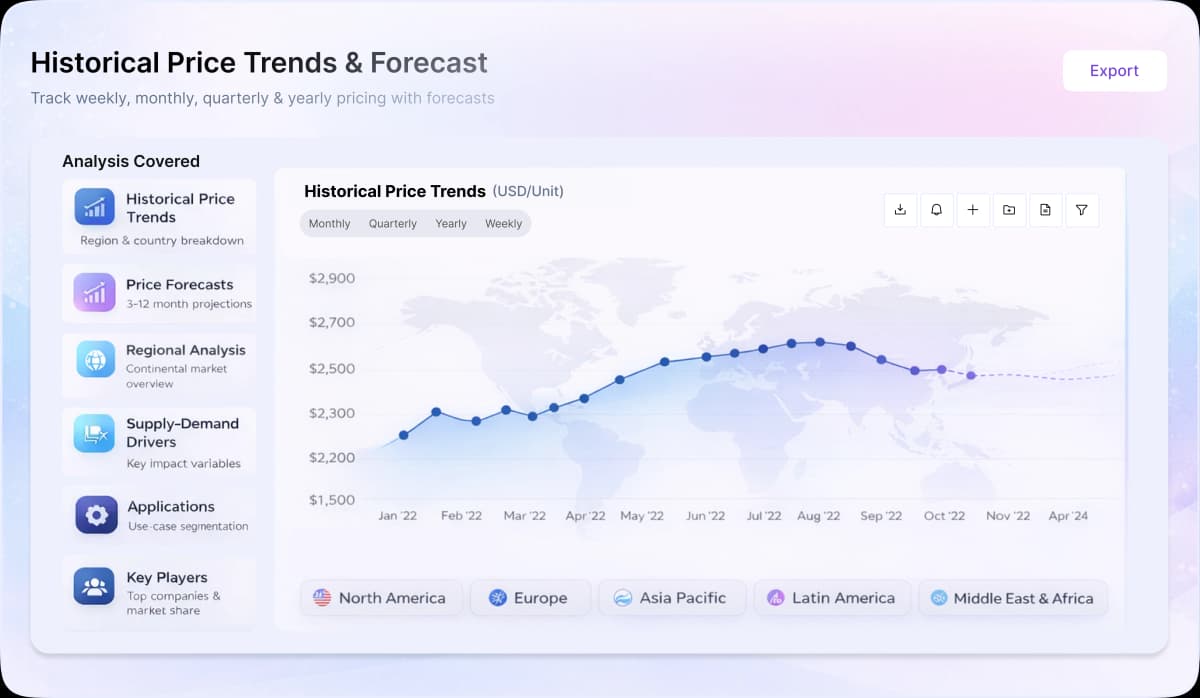
During 2025, the chlorine dioxide market follow Chlorine ed a fluctuating but generally balanced trajectory, shaped primarily by feedstock cost movements and steady demand from key downstream sectors. In the first quarter, the market in Asia remained range bound as stable production and moderate demand from water treatment and pulp and paper industries were briefly disrupted by seasonal shutdowns linked to the Chinese New Year. These temporary production cuts tightened supply and supported short-term price increases, although the market later softened as operations resumed and inventories rose faster than demand. In the second quarter, the Indian chlorine dioxide market continued to reflect mixed price movements, initially rising due to stronger demand from water treatment and industrial applications alongside higher chlorine-related production costs. However, this trend reversed later in the quarter as upstream chlorine prices declined, easing production expenses and weighing on market sentiment. During the third quarter, prices again moved in line with chlorine feedstock trends, strengthening temporarily as maintenance shutdowns at select chlor-alkali plants tightened supply and supported moderate price gains. Toward the quarter’s end, improved chlorine availability and slower procurement led to renewed softness. In the fourth quarter, the market displayed a firmer tone, initially easing before recovering strongly as sodium chlorate costs increased and demand from municipal water treatment, industrial disinfection, and pulp bleaching improved. The year closed on a stronger note, with prices supported by firmer feedstock economics and healthier downstream offtake.


About Chlorine Dioxide

Chlorine Dioxide is a manufactured gas that ranges in colour from yellow to reddish yellow. Frozen chlorine dioxide hydrate is an orange-colored solid that resembles a block of ice and has a slight chlorine odour. Only a private or contracted motor carrier may transport it when it is frozen. The hydrate has a melting point of about 30 °F.

Chlorine Dioxide Product Detail

HS Code
38220019
Chemical Formula

ClO2

CAS Number
10049-04-4
Molecular Weight
67.45 g/mol
Industrial Uses

Decontaminant, In pharmaceutical industry in treatment of halitosis, Paper manufacturing plants, Bleaching agent, Processing of flour

Synonyms

Chlorosyloxidanyl

Supplier Database

Accepta, Ecolab, Grundfos, ProMinent, Evoqua, The Sabre Companies LLC

Regional Coverage

Asia Pacific

China, India, Indonesia, Pakistan, Bangladesh, Japan, Philippines, Vietnam, Iran, Thailand, South Korea, Iraq, Saudi Arabia, Malaysia, Nepal, Taiwan, Sri Lanka, UAE, Israel, Hongkong, Singapore, Oman, Kuwait, Qatar, Australia, and New Zealand

Europe

Germany, France, United Kingdom, Italy,Spain, Russia, Turkey, Netherlands, Poland, Sweden, Belgium, Austria, Ireland Switzerland, Norway, Denmark, Romania, Finland, Czech Republic, Portugal and Greece

North America

United States and Canada

Latin America

Brazil, Mexico, Argentina, Columbia, Chile, Ecuador, and Peru

Africa

South Africa, Nigeria, Egypt, Algeria, Morocco

CurrencyUS$ (Data can also be provided in local currency)

Supplier Database AvailabilityYes

Customization ScopeThe report can be customized as per the requirements of the customer

Post-Sale Analyst Support360-degree analyst support after report delivery

Note: Our supplier search experts can assist your procurement teams in compiling and validating a list of suppliers indicating they have products, services, and capabilities that meet your company's needs.

Chlorine Dioxide Production Processes

  • Production of Chlorine Dioxide from Hydrochloric Acid; from Sulfuric Acid

In the process using HCl, sodium hypochlorite is reduced using the acid via electrolysis producing chlorine dioxide as the final product.

Frequently Asked Questions

The chlorine dioxide outlook for 2026 remains stable to firm, with sentiment underpinned by dependable water treatment and pulp processing demand and closely tethered to chlorine and chlorate feedstock economics. European prices carry a premium on elevated energy costs, while North American sentiment firmed on tighter chlorine availability following scheduled chlor-alkali maintenance. Cautious procurement against adequate Asian inventories caps upside, but the balance of risk tilts toward upstream cost movements. Sharper moves would require a sustained shift in feedstock supply, energy prices, or downstream offtake.
Upstream chlor-alkali and sodium chlorate feedstock dynamics are central to chlorine dioxide pricing, since the compound's cost structure is anchored in chlorine and chlorate economics. Scheduled chlor-alkali maintenance can tighten chlorine availability and lift producer offers, while elevated power and energy costs tend to push European prices to a premium. Steady municipal and industrial water-treatment offtake provides a demand floor, but cautious procurement against adequate Asian inventories and workable chlorate supply generally prevents steeper gains, keeping the market broadly firm but range-bound.
The chlorine dioxide market spans North America, Europe, and Asia Pacific, with production concentrated in the United States, Germany, and China. Significant consumption and import demand come from India, Brazil, Saudi Arabia, and South Korea, alongside broader Asia Pacific and Latin American markets where municipal disinfection and pulp processing drive offtake. Key companies include Accepta, Ecolab Inc., ProMinent GmbH, Evoqua Water Technologies LLC, and The Sabre Companies LLC, alongside equipment suppliers such as Grundfos that provide on-site generation systems. Feedstock availability and logistics are critical to uninterrupted supply.
Chlorine dioxide is manufactured through two primary routes. The sodium chlorate route begins with electrolysis of salt to produce sodium chlorate, which is reduced by sulfuric acid with hydrogen peroxide to yield the gas. The sodium hypochlorite route combines chlorine and caustic soda to make sodium hypochlorite, which reacts with hydrochloric acid and sodium chlorite to produce chlorine dioxide. The finished gas is then supplied to water treatment plants, pulp and paper mills, medical facilities, and food processors for disinfection and bleaching applications.


Water treatment is the dominant demand driver, with municipal and industrial disinfection providing steady, resilient offtake that underpins price stability. Pulp and paper bleaching adds a second pillar of demand, while food sterilisation-fruit and vegetable washing, poultry processing-and pharmaceutical hygiene applications provide incremental support. Together these sectors translate into consistent procurement that limits downside price risk, though the extent of any upward move remains governed by chlor-alkali feedstock costs and energy-linked production expenses rather than demand strength alone.
Procurement Resource assesses chlorine dioxide prices through a structured, data-driven methodology. Primary engagement with producers, suppliers and traders is combined with secondary market data, continuous monitoring of feedstock and input costs, and trade-flow and inventory tracking. Exchange and spot benchmarks are validated and translated into a transparent price assessment and outlook. The detailed methodology is available on the Procurement Resource website.

Our Price Analysis Methodology

About the Author

Pragati Agarwal profile photo

Pragati Agarwal

Senior Business Insights Analyst

Delivering price trend analysis and procurement market insights at Procurement Resource, with expertise in identifying commodity patterns, supporting purchasing strategies, and improving cost efficiency through actionable market intelligence.

Schedule Demo

Schedule A Demo

Experience how Procurement Resource transforms raw material price data into clear, decision ready intelligence. Optimise your performance with reliable, expert market data and analysis. Schedule your demo today to experience a live walk-through where our experts will showcase interactive price charts, forecasted prices, and insights driving the prices for your key commodities, tailored to your workflows. Contact us now!

Our Team will be happy to assist you

We are just a text away

+1

Still Need Help?

Europe & Africa

+44 7573 171117

[email protected]

USA & Canada

+1 307 363 1045

[email protected]

APAC

+91 8850629517

[email protected]

Unlock full access to Procurement Resource's price databases, interactive charts, and short-term forecasts for thousands of commodities. Elevate your sourcing decisions by comparing prices across regions, downloading historical data, and layering in analyst-backed insights, all with our flexible plans that scale as your portfolio grows.

Still have any Questions

Contact Us
Mastercard
Wire
VISA
Stripe

Why Procurement Database

Commodity Market Intelligence

Commodity Market Intelligence

Track prices, market movements, supply-demand dynamics, and industry developments across hundreds of commodities through a centralized intelligence platform built for informed procurement decisions.

Price Forecasts & Market Outlooks

Price Forecasts & Market Outlooks

Understand market fluctuations using analyst-backed forecasts, historical pricing patterns, and evolving industry trends to strengthen sourcing strategies and budget planning.

Cost & Procurement Optimization

Cost & Procurement Optimization

Leverage cost models, pricing benchmarks, and procurement insights to evaluate purchasing opportunities, improve negotiations, and enhance operational efficiency.

Global & Regional Market Insights

Global & Regional Market Insights

Access region-specific price trends, trade activities, capacity changes, and supply chain developments influencing commodity markets worldwide.

1/4