

Udeesha Tomar
AVP - Strategy and Solutions
Leading procurement research solutions across chemicals, materials, and food & beverages, with expertise in price forecasting and market analytics.

The Colloidal Silicon Dioxide market in 2025 recorded a mostly soft and stable trend in the major regions. In Asia, the Colloidal Silicon Dioxide market fluctuated with mixed momentum in the first half of 2025, with some supply constraints due to production cuts and higher energy costs, but weak demand from downstream industries such as pharmaceuticals, personal care, and electronics kept the market at a slow pace. The high inventory level and careful buying attitude also prevented a strong rise in prices. In the second half of 2025, the Colloidal Silicon Dioxide market was under pressure because of oversupply and moderate demand, although some improvement in solar and semiconductor related demand helped to support prices at the end of the year.
In the European region, the prices exhibited a downward to stable movement throughout 2025. This could be attributed to the low demand from the industrial sector and the availability of sufficient supply. During this period, the demand for short-term purchasing prevailed, considering the uncertain economy. As far as the North American region is concerned, the market exhibited stable performance with slightly downward pressure. This can be attributed to the balanced supply and demand. During this period, the slowdown in the inventory management prevented the prices from rising.
Analyst Insight
According to Procurement Resource, Colloidal Silicon Dioxide prices are expected to remain stable, with recovery depending on stronger demand from pharmaceutical, electronics, and specialty chemical sectors.
Related Report
Need Latest Colloidal Silicon Dioxide Prices?
Get real-time price assessments, periodic trends, forecasts and price driver insights across key global markets.
Our Clients































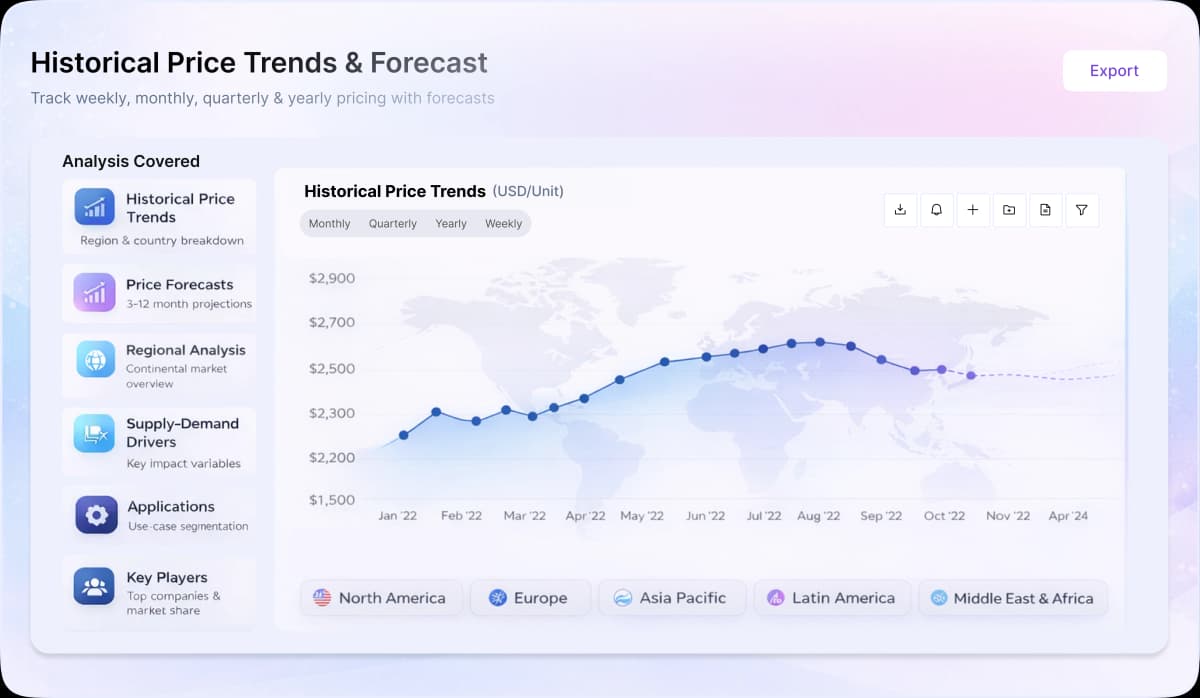
Turn price intelligence into action with the Procurement Resource Database. Log in or subscribe to unlock live price trends, historical charts, supplier databases, cost curves, and analyst-backed insights across chemicals, agriculture, energy, packaging, and more. Use these tools to benchmark your contracts, plan budgets with confidence, and stay ahead of market moves on every product you buy.
0
+Products
0
+Regions
0
+Subscriptions
For the second half of 2024, Colloidal Silicon Dioxide prices generally moved in a soft trend in most regions worldwide. In Asia, prices continued to fall due to oversupply in China and weak downstream demand. Manufacturers were faced with high inventories, while buyers continued with a conservative buying strategy, which resulted in a slow market.
In Europe, prices corrected in H2’24, having increased in previous periods. Demand from the construction and automotive industries slowed, while higher imports from Asia increased supply, which resulted in a soft trend in prices, despite energy prices impacting market stability.
North America recorded a steady and slightly soft trend during this time. Demand from the semiconductor and solar industry remained consistent, thus maintaining a steady rate of consumption. However, as imports started to gain traction in the market due to price competitiveness, prices were not able to appreciate significantly. Domestic production remained steady in this region.
Colloidal silicon dioxide is a fine, amorphous, white powder consisting of highly dispersed silicon dioxide particles suspended in a liquid. Known for its high surface area and small particle size, it exhibits excellent dispersibility and stability. These properties make it an effective anti-caking agent, thickener, and stabilizer. It is widely used in pharmaceuticals to improve powder flow, in food products to prevent clumping, and in cosmetics to enhance texture and stability. Additionally, it finds applications in coatings, adhesives, and sealants, contributing to improved mechanical properties and durability.
SiO2
Pharmaceutical Industry, Food Industry, Cosmetics, Coatings and adhesives
Fuso Chemical, Merck, Nissan Chemical, Dow Chemical Company, Evonik Industries, Sterling Chemicals
CurrencyUS$ (Data can also be provided in local currency)
Supplier Database AvailabilityYes
Customization ScopeThe report can be customized as per the requirements of the customer
Post-Sale Analyst Support360-degree analyst support after report delivery
Note: Our supplier search experts can assist your procurement teams in compiling and validating a list of suppliers indicating they have products, services, and capabilities that meet your company's needs.
The synthesis begins with the preparation of a silicon precursor mixture using sodium silicate and water. This mixture is then reacted with nitric acid that breaks the gel into small particles giving the colloidal silicon dioxide solution.
Our Price Analysis Methodology
AVP - Strategy and Solutions
Leading procurement research solutions across chemicals, materials, and food & beverages, with expertise in price forecasting and market analytics.
Experience how Procurement Resource transforms raw material price data into clear, decision ready intelligence. Optimise your performance with reliable, expert market data and analysis. Schedule your demo today to experience a live walk-through where our experts will showcase interactive price charts, forecasted prices, and insights driving the prices for your key commodities, tailored to your workflows. Contact us now!
Our Team will be happy to assist you
We are just a text away
Still Need Help?
Unlock full access to Procurement Resource's price databases, interactive charts, and short-term forecasts for thousands of commodities. Elevate your sourcing decisions by comparing prices across regions, downloading historical data, and layering in analyst-backed insights, all with our flexible plans that scale as your portfolio grows.
Still have any Questions
Contact Us



Price Trend Dashboard - What's Included
Price trends across a diverse portfolio of categories and products, spanning board to niche chemicals
Coverage extendable to grade-specific chemicals based on procurement requirements
Regular price tracking supported by robust historical datasets
News, policy updates, and key market drivers impacting price movements
Short-term and long-term price outlooks and forecasts
Supply–demand dynamics and capacity-driven market analysis

Track prices, market movements, supply-demand dynamics, and industry developments across hundreds of commodities through a centralized intelligence platform built for informed procurement decisions.

Understand market fluctuations using analyst-backed forecasts, historical pricing patterns, and evolving industry trends to strengthen sourcing strategies and budget planning.

Leverage cost models, pricing benchmarks, and procurement insights to evaluate purchasing opportunities, improve negotiations, and enhance operational efficiency.
Access region-specific price trends, trade activities, capacity changes, and supply chain developments influencing commodity markets worldwide.