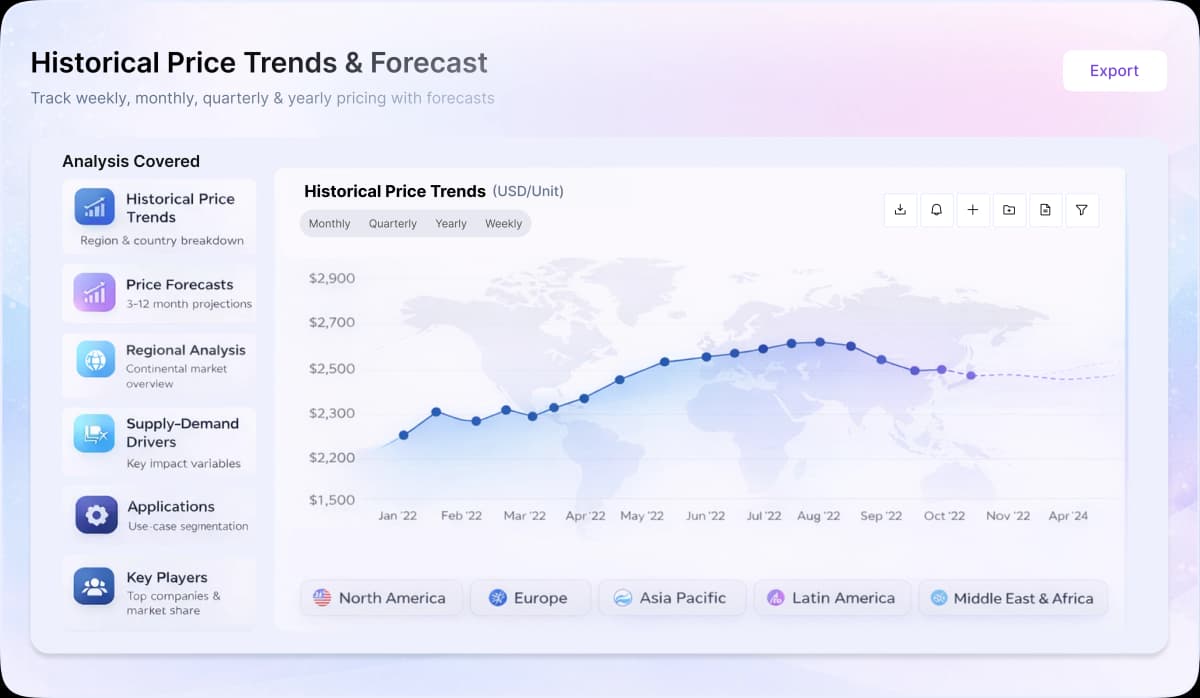
Dextrin Price Trend Analysis 2026: Historical Prices, Price Drivers, Market Insights, Supply Demand Analysis & Latest News

Siddharth David profile photo
Written BySiddharth David

Procurement Resource Database

Laptop screen

Turn price intelligence into action with the Procurement Resource Database. Log in or subscribe to unlock live price trends, historical charts, supplier databases, cost curves, and analyst-backed insights across chemicals, agriculture, energy, packaging, and more. Use these tools to benchmark your contracts, plan budgets with confidence, and stay ahead of market moves on every product you buy.

0

+

Products

0

+

Regions

0

+

Subscriptions

In the second half of 2024, the Dextrin market experienced an unstable price movement. In the initial days, the Dextrin market experienced an improvement in the supply side, as the disturbances in the supply chain were addressed. This had an impact on the operations of the market. In the second half, the demand from the food, pharmaceutical, and industrial sectors also increased during the festive season. This had an impact on the procurement activity in the market. The raw material supply was also available at comfortable levels, but the efficiency in the supply chain did not allow the prices to move on the higher side.

As time went on, the supply chains stabilized, and the inventories were gradually leveled. This ensured that the prices were kept in check. At the end of H2’24, there were signs of easing in the cost of feedstocks, which ensured stability in the market. At the same time, buyers were cautious in their purchasing patterns to avoid stockpiling. In general, the market has been in balance, with slight changes due to seasonal influences.


About Dextrin

Dextrin is a carbohydrate derivative produced by the hydrolysis of starch, typically through enzymatic or acid treatment. It is a white, odorless powder with adhesive properties. Dextrin finds diverse industrial applications due to its ability to form adhesive solutions when mixed with water. It is widely used in adhesives for paper, textiles, and labels, as well as in the food industry as a thickening agent and binder. Additionally, dextrin is employed in pharmaceuticals, cosmetics, and construction materials, showcasing its versatility across various sectors.

Dextrin Product Detail

Chemical Formula

C18H32O16

CAS Number
9004-53-9
Molecular Weight
504.43 g/mol
Industrial Uses

Adhesives, Textiles, Paper Products, Pharmaceuticals, Cosmetics

Supplier Database

Archer Daniels Midland Company, Cargill, Inc., Tate & Lyle, Roquette Frères S.A, Ingredion Incorporated, American Key Products, Inc., Meelunie B.V, Agridient Inc.

Regional Coverage

Asia Pacific

China, India, Indonesia, Pakistan, Bangladesh, Japan, Philippines, Vietnam, Iran, Thailand, South Korea, Iraq, Saudi Arabia, Malaysia, Nepal, Taiwan, Sri Lanka, UAE, Israel, Hongkong, Singapore, Oman, Kuwait, Qatar, Australia, and New Zealand

Europe

Germany, France, United Kingdom, Italy,Spain, Russia, Turkey, Netherlands, Poland, Sweden, Belgium, Austria, Ireland Switzerland, Norway, Denmark, Romania, Finland, Czech Republic, Portugal and Greece

North America

United States and Canada

Latin America

Brazil, Mexico, Argentina, Columbia, Chile, Ecuador, and Peru

Africa

South Africa, Nigeria, Egypt, Algeria, Morocco

CurrencyUS$ (Data can also be provided in local currency)

Supplier Database AvailabilityYes

Customization ScopeThe report can be customized as per the requirements of the customer

Post-Sale Analyst Support360-degree analyst support after report delivery

Note: Our supplier search experts can assist your procurement teams in compiling and validating a list of suppliers indicating they have products, services, and capabilities that meet your company's needs.

Dextrin Production Process

The preparation of dextrin is carried by the chemical reaction between starch and a strong acidic chemical. Initially, the starch obtained from natural sources such as wheat and corn, is heated and then dried for processing it into dextrin.

Frequently Asked Questions

The dextrin outlook remains tied to corn supply and food and industrial demand recovery. Oversupply, enhanced production efficiency, and weak downstream consumption from food, pharmaceutical, and industrial segments tend to keep prices soft. A meaningful rebound in demand or a tightening in maize availability would be required to shift the outlook firmer.

Corn availability is the primary feedstock driver of dextrin prices. Robust Asian crops and strong maize supply tend to keep prices flat to soft, while supply-chain disruptions or transportation issues can provide brief upward pressure. Higher regional production costs can drive more pronounced gains in a given market. Oversupply and enhanced production efficiency tend to push prices down across regions when they coincide with weak demand from food, pharmaceutical, and industrial segments, while stable inventories and moderate downstream demand generally keep prices soft.
The dextrin market is led by five major industrial manufacturers: Archer Daniels Midland, Cargill, Ingredion, Tereos, and Roquette Frères. Other active suppliers include Tate & Lyle, American Key Products, Meelunie B.V., and Agridient Inc. Production is concentrated among large global starch processors, with North America and Europe hosting the most prominent players. Asia Pacific, including China, India, Indonesia, and Japan, represents a significant consuming and trading region.



Dextrin is produced from starch derived from corn or wheat, combined with a strong acidic compound such as hydrochloric or nitric acid. The starch is first extracted from corn or wheat kernels via wet milling, then heated and dried. It then undergoes an acid-catalyzed hydrolysis reaction, where the strong acid breaks down the starch molecules into dextrin. The result is a white, odorless powder used as a thickener and binder in food, an adhesive in paper and textiles, and a disintegrant in pharmaceuticals.

Dextrin demand from food and beverage manufacturers is driven by its use as a thickener, texture enhancer, and low-calorie fat alternative in soups, stews, baby food, and ready-to-eat products. When producers scale output or reformulate for cleaner labels, procurement rises. Since dextrin is corn-derived, shifts in corn supply or food production volumes directly affect procurement pressure and pricing. Demand lifts from food and pharma segments can occur periodically, though the broader trend tends to stay soft whenever oversupply and weak downstream consumption dominate.

Dextrin prices respond to corn and maize supply, inventory levels, transportation costs, and downstream demand. Robust Asian corn crops and strong maize supply tend to keep prices flat to soft, while shipping disruptions or transport issues can raise costs and lift prices temporarily. High regional inventories and broad-based oversupply tend to drive prices down, while higher production costs and stronger food and pharma demand can push prices up in a given region. Weak food, pharma, and industrial demand compounds any downside pressure when it coincides with ample supply.

Procurement Resource assesses dextrin price trends through a structured, data-driven methodology combining primary engagement with producers, suppliers and traders, secondary market data, monitoring of feedstock and input costs, trade-flow and inventory tracking, and exchange or spot benchmarks. These inputs are validated and translated into a transparent price assessment and outlook. The detailed methodology is available on the Procurement Resource website.

Our Price Analysis Methodology

About the Author

Siddharth David profile photo

Siddharth David

Manager - Market Research

Delivering market research and procurement intelligence at Procurement Resource with a focus on economic forecasting, commodity analysis, and client advisory to help sourcing teams make data-backed purchasing decisions.

Schedule Demo

Schedule A Demo

Experience how Procurement Resource transforms raw material price data into clear, decision ready intelligence. Optimise your performance with reliable, expert market data and analysis. Schedule your demo today to experience a live walk-through where our experts will showcase interactive price charts, forecasted prices, and insights driving the prices for your key commodities, tailored to your workflows. Contact us now!

Our Team will be happy to assist you

We are just a text away

+1

Still Need Help?

Europe & Africa

+44 7573 171117

[email protected]

USA & Canada

+1 254 254 1750

[email protected]

APAC

+91 8850629517

[email protected]

Unlock full access to Procurement Resource's price databases, interactive charts, and short-term forecasts for thousands of commodities. Elevate your sourcing decisions by comparing prices across regions, downloading historical data, and layering in analyst-backed insights, all with our flexible plans that scale as your portfolio grows.

Still have any Questions

Contact Us
Mastercard
Wire
VISA
Stripe

Why Procurement Database

Commodity Market Intelligence

Commodity Market Intelligence

Track prices, market movements, supply-demand dynamics, and industry developments across hundreds of commodities through a centralized intelligence platform built for informed procurement decisions.

Price Forecasts & Market Outlooks

Price Forecasts & Market Outlooks

Understand market fluctuations using analyst-backed forecasts, historical pricing patterns, and evolving industry trends to strengthen sourcing strategies and budget planning.

Cost & Procurement Optimization

Cost & Procurement Optimization

Leverage cost models, pricing benchmarks, and procurement insights to evaluate purchasing opportunities, improve negotiations, and enhance operational efficiency.

Global & Regional Market Insights

Global & Regional Market Insights

Access region-specific price trends, trade activities, capacity changes, and supply chain developments influencing commodity markets worldwide.

1/4