Rutile Prices Decline Amid Inventory Surge
Rutile titanium dioxide prices weakened in October as inventory levels rose, reflecting oversupply and weak downstream demand. The market saw a downward trend with no signs of recovery.

Rutile titanium dioxide prices weakened in October as inventory levels rose, reflecting oversupply and weak downstream demand. The market saw a downward trend with no signs of recovery.
LB Group signed a term sheet to acquire approximately 80% of the Durack and Yandanooka mineral sands projects in Western Australia, which contain rutile among their valuable minerals, for roughly 160 million Australian dollars. The projects hold significant heavy mineral resources and are intended to produce heavy mineral concentrate including rutile, ilmenite, and zircon, supporting long-term upstream supply security for the company's titanium operations.
| Product | Region | Incoterm Basis | Price | Last Updated Month |
|---|---|---|---|---|
| Ferrotitanium | China | EXW | USD 1,908.00/MT | August 2026 |
| Ferrotitanium | India | CIF | USD 3,726.00/MT | August 2026 |
| Ferrotitanium | Netherlands | DDP | USD 5,539.00/MT | August 2026 |
| Ferrotitanium | China | EXW | USD 1,894.00/MT | July 2026 |
| Ferrotitanium | India | CIF | USD 3,665.00/MT | July 2026 |
| Ferrotitanium | Netherlands | DDP | USD 5,547.00/MT | July 2026 |
Stay updated with the latest Ferrotitanium prices, historical data, and tailored regional analysis
Ferrotitanium markets remained shaped by geopolitical restructuring and changing procurement patterns during H1 2026. European supply chains continued adjusting to the disruption of Russian ferro-titanium flows following the implementation of EU sanctions, with buyers increasingly relying on regional producers and alternative suppliers. The shift was already evident in 2025, when EU ferro-titanium imports reached their lowest level in more than a decade, while shipments from India increased substantially and regional European supply gained importance. The broader titanium market also remained strategically sensitive because China continued to account for a large share of global titanium processing and sponge production, while aerospace-grade and defense-qualified material remained concentrated among a limited number of suppliers. In North America, government-backed efforts to develop domestic titanium production continued during H1 2026, with IperionX receiving the final funding under its previously announced U.S. government award to support capacity expansion and supply-chain localization. Overall, H1 2026 ferrotitanium markets were characterized by trade-flow realignment, regional supply diversification, strategic demand from aerospace and defense, and continued efforts to reduce dependence on concentrated overseas supply chains.
Analyst Insight
According to Procurement Resource, ferrotitanium values are likely to stay regionally divergent, with aerospace-driven demand and import dependency providing underlying support while weak European steel consumption and ongoing supply-chain realignment cap near-term gains.
Need Latest Ferrotitanium Prices?
Get real-time price assessments, periodic trends, forecasts and price driver insights across key global markets.
Our Clients































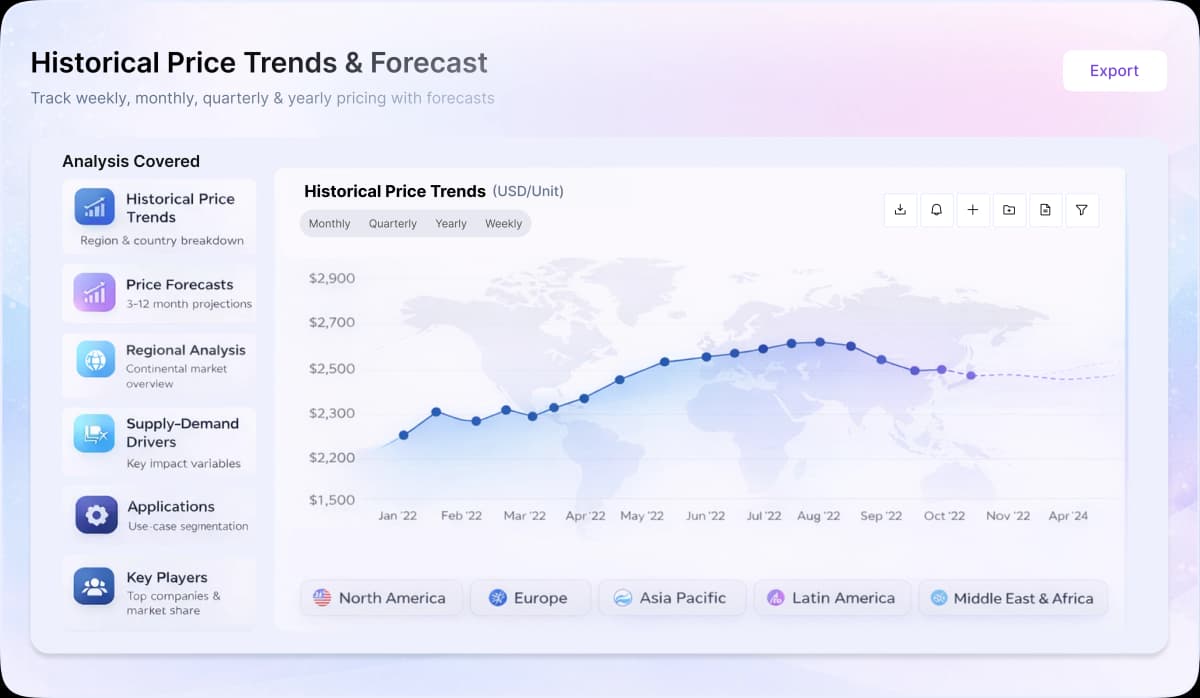
Turn price intelligence into action with the Procurement Resource Database. Log in or subscribe to unlock live price trends, historical charts, supplier databases, cost curves, and analyst-backed insights across chemicals, agriculture, energy, packaging, and more. Use these tools to benchmark your contracts, plan budgets with confidence, and stay ahead of market moves on every product you buy.
0
+Products
0
+Regions
0
+Subscriptions
Ferrotitanium is an iron-titanium ferroalloy supplied in several grades, often containing about 30% or 70% titanium depending on the intended steelmaking use. Titanium has a strong affinity for oxygen, nitrogen, sulfur, and carbon, so ferrotitanium is valued as a refining and alloying addition. It can improve grain control and help stabilize stainless and specialty steels. Commercial material is supplied as lumps, granules, powder, or cored-wire feed, with impurity limits tailored to steel specifications.
Osaka Titanium Technologies Co., Ltd., Westbrook Light Alloys, AMG Superalloys UK Ltd., MAST Europe OÜ, Metraco NV, Asia Pacific Titanium (Thailand) Co., Ltd.
Ferro titanium, FeTi, titanium-iron alloy, iron-titanium master alloy
CurrencyUS$ (Data can also be provided in local currency)
Supplier Database AvailabilityYes
Customization ScopeThe report can be customized as per the requirements of the customer
Post-Sale Analyst Support360-degree analyst support after report delivery
Note: Our supplier search experts can assist your procurement teams in compiling and validating a list of suppliers indicating they have products, services, and capabilities that meet your company's needs.
Ferrotitanium Production by Induction Melting : Ferrotitanium is commonly made by melting prepared titanium scrap or titanium sponge with iron in an induction furnace. The charge is selected and cleaned to control oxygen, nitrogen, carbon, aluminum, and vanadium. After melting and composition adjustment, the alloy is cast into ingots, cooled, crushed, screened, and packed to the required particle size. Some producers also use aluminothermic reduction routes based on titanium-bearing raw materials, followed by refining and sizing for steelmaking applications.
Ferrotitanium is used mainly in steel and stainless-steel production as a deoxidizer, denitrifying agent, grain refiner, and titanium alloying source. It is added to interstitial-free, high-strength low-alloy, stainless, tool, and specialty steels where controlled titanium content supports carbide and nitride formation. Fine ferrotitanium is also used in cored wire for ladle treatment and in some welding consumables. Low-impurity grades are important when oxygen, nitrogen, carbon, aluminum, or vanadium limits are strict.
Our Price Analysis Methodology

Senior Business Insights Analyst
Delivering price trend analysis and procurement market insights at Procurement Resource, with expertise in identifying commodity patterns, supporting purchasing strategies, and improving cost efficiency through actionable market intelligence.
Experience how Procurement Resource transforms raw material price data into clear, decision ready intelligence. Optimise your performance with reliable, expert market data and analysis. Schedule your demo today to experience a live walk-through where our experts will showcase interactive price charts, forecasted prices, and insights driving the prices for your key commodities, tailored to your workflows. Contact us now!
Our Team will be happy to assist you
We are just a text away
Still Need Help?
Unlock full access to Procurement Resource's price databases, interactive charts, and short-term forecasts for thousands of commodities. Elevate your sourcing decisions by comparing prices across regions, downloading historical data, and layering in analyst-backed insights, all with our flexible plans that scale as your portfolio grows.
Still have any Questions
Contact Us



Price Trend Dashboard - What's Included
Price trends across a diverse portfolio of categories and products, spanning board to niche chemicals
Coverage extendable to grade-specific chemicals based on procurement requirements
Regular price tracking supported by robust historical datasets
News, policy updates, and key market drivers impacting price movements
Short-term and long-term price outlooks and forecasts
Supply–demand dynamics and capacity-driven market analysis

Track prices, market movements, supply-demand dynamics, and industry developments across hundreds of commodities through a centralized intelligence platform built for informed procurement decisions.

Understand market fluctuations using analyst-backed forecasts, historical pricing patterns, and evolving industry trends to strengthen sourcing strategies and budget planning.

Leverage cost models, pricing benchmarks, and procurement insights to evaluate purchasing opportunities, improve negotiations, and enhance operational efficiency.
Access region-specific price trends, trade activities, capacity changes, and supply chain developments influencing commodity markets worldwide.
