Gallium Price Trend Analysis 2026: Market Insights, Latest News, Price Drivers, Historical Prices & Supply Demand Analysis

Rakesh Nandi profile photo
Written ByRakesh Nandi

Procurement Resource Database

Laptop screen

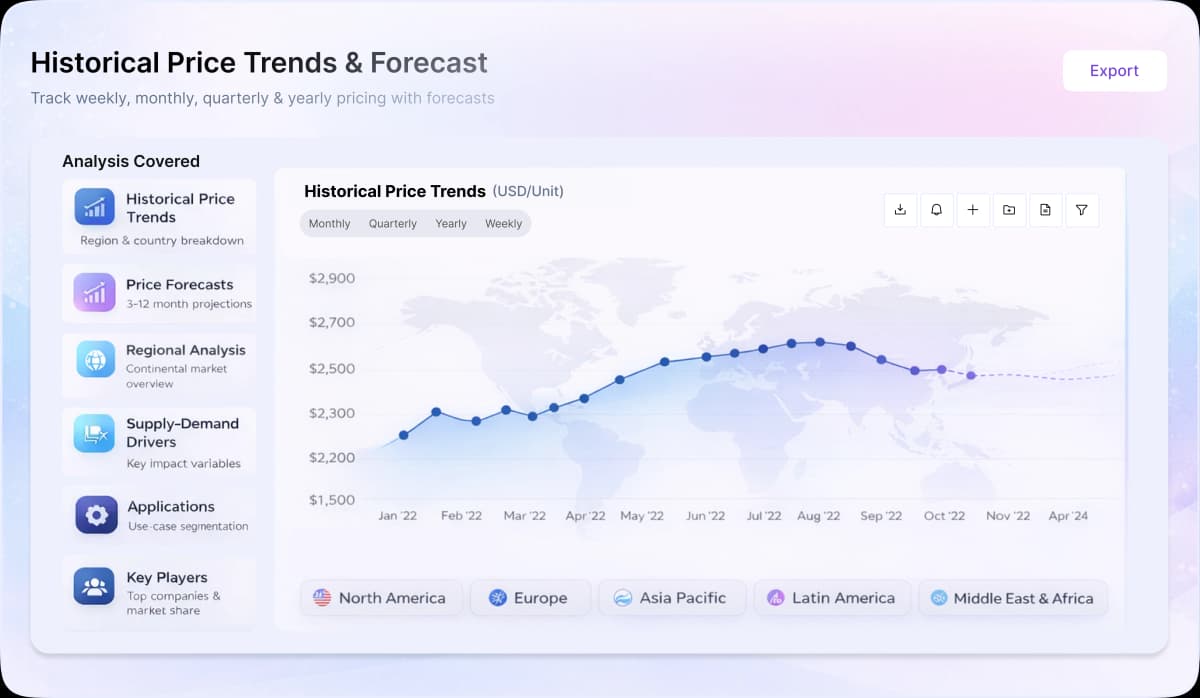
Turn price intelligence into action with the Procurement Resource Database. Log in or subscribe to unlock live price trends, historical charts, supplier databases, cost curves, and analyst-backed insights across chemicals, agriculture, energy, packaging, and more. Use these tools to benchmark your contracts, plan budgets with confidence, and stay ahead of market moves on every product you buy.

0

+

Products

0

+

Regions

0

+

Subscriptions

About Gallium

Gallium is a soft, silvery metal that does not occur freely in nature but is found in trace amounts in bauxite and zinc ores. It is primarily recovered as a by product of alumina refining, where it accumulates in Bayer process liquor and is later extracted and refined. The metal is essential in high technology applications due to its unique electronic and thermal properties.


Gallium Product Detail

Hs Code
8112
Chemical Formula

Ga

Cas Number
7440 55 3
Molecular Weight
69.72 g/mol
Supplier Database

China Aluminum Corporation (Chalco), Dowa Holdings Co., Ltd., Neo Performance Materials ,American Elements ,Vital Materials

Regional Coverage

Asia Pacific

China, India, Indonesia, Pakistan, Bangladesh, Japan, Philippines, Vietnam, Iran, Thailand, South Korea, Iraq, Saudi Arabia, Malaysia, Nepal, Taiwan, Sri Lanka, UAE, Israel, Hongkong, Singapore, Oman, Kuwait, Qatar, Australia, and New Zealand

Europe

Germany, France, United Kingdom, Italy,Spain, Russia, Turkey, Netherlands, Poland, Sweden, Belgium, Austria, Ireland Switzerland, Norway, Denmark, Romania, Finland, Czech Republic, Portugal and Greece

North America

United States and Canada

Latin America

Brazil, Mexico, Argentina, Columbia, Chile, Ecuador, and Peru

Africa

South Africa, Nigeria, Egypt, Algeria, Morocco

CurrencyUS$ (Data can also be provided in local currency)

Supplier Database AvailabilityYes

Customization ScopeThe report can be customized as per the requirements of the customer

Post-Sale Analyst Support360-degree analyst support after report delivery

Note: Our supplier search experts can assist your procurement teams in compiling and validating a list of suppliers indicating they have products, services, and capabilities that meet your company's needs.

Production Process

Gallium Production by: product of bauxite (alumina) refining through the Bayer process, where it dissolves into caustic liquor and is later concentrated and recovered. A smaller portion is recovered from zinc smelting residues. The recovery involves fractional precipitation, electrochemical deposition, and solvent extraction to produce refined gallium ready for high purity applications.

Gallium Industrial Uses

Gallium finds extensive use in semiconductors for devices such as GaAs and GaN chips, which power 5G communications, RF circuits, and LEDs. It is also used in photodetectors, laser diodes, and integrated circuits. In addition to electronics, gallium compounds serve in medical imaging and specialized alloys with low melting points.

Frequently Asked Questions

During Q1 2026, gallium prices remained firm, especially outside China, as export licensing and supply-chain restrictions continued to shape availability. The market did not behave like a normal bulk metal market. China’s domestic material traded on a different basis from Western spot material, where buyers faced higher premiums due to supply uncertainty, logistics risk, and limited alternative supply.
The gallium outlook for 2026 remains tight but more stable than the previous disruption phase. Demand from compound semiconductors, power electronics, LEDs, aerospace, telecommunications, and defense applications is expected to support consumption. However, the market will remain sensitive to China’s export licensing system, Western stockbuilding, and the slow pace of new primary recovery projects outside China.
Export control risk was the main factor affecting gallium prices in Q1 2026. Although some restrictions were eased, licensing requirements continued to influence buyer confidence and shipment timing. Demand from gallium arsenide and gallium nitride applications also supported the market. At the same time, limited non-Chinese production kept Western buyers exposed to higher delivery premiums.
China dominates the gallium market by a wide margin. USGS data shows that China produced about 900,000 kilograms of primary low-purity gallium in 2025 and accounted for 99% of global primary low-purity output. Japan and Russia were the only other listed primary producers, with about 3,000 kilograms and 6,000 kilograms, respectively. This makes gallium one of the most supply-concentrated critical materials.
In May 2026, METLEN Energy & Metals PLC received ministerial approval in Greece for a €300 million gallium production capacity expansion project. This will expand local processing tied to bauxite mining and alumina refining, making it one of the first large scale, non Chinese gallium production initiatives in Europe and aligning with EU critical raw material policy objectives.
Gallium is not usually mined as a standalone metal. It occurs in small concentrations in bauxite and zinc ores, then is recovered mainly as a by-product of alumina refining or zinc processing. USGS reported that global primary low-purity gallium production reached about 990,000 kilograms in 2025, while global production capacity was estimated at ~1.7 million kilograms.
Gallium demand is mainly driven by compound semiconductors. Gallium arsenide is used in integrated circuits and optoelectronic devices, including LEDs, laser diodes, photodetectors, and solar cells. Gallium nitride is used in integrated circuits, power electronics, telecommunications equipment, defense systems, and high-performance computing. These high-value applications make gallium strategically important despite its relatively small physical market size.
Gallium buyers face risk because supply is concentrated and many high-purity grades depend on specialized refining. Any disruption in Chinese export licensing, bauxite processing, alumina refining, or high-purity conversion can affect availability. Buyers in semiconductor and defense applications often maintain qualified suppliers and inventories because switching material sources can require technical validation, purity checks, and customer approval.
Gallium contracts are usually structured around grade, purity, delivery basis, and end-use qualification. Standard material may be sold as 4N gallium, while higher-purity grades such as 6N or above are often negotiated separately. Contracts may reference China ex-works, Europe CIF, or warehouse-based Western spot assessments. Long-term buyers often use monthly averages, fixed premiums, licensing clauses, and purity specifications to manage price and supply risk.
Procurement Resource employs a structured methodology combining primary research, secondary market data, analytical models, and validation processes to assess gallium prices and trends. Price evaluations incorporate supply-demand dynamics, trade flows, and value chain analysis, supported by continuous market monitoring to ensure accurate and reliable insights.

Our Price Analysis Methodology

About the Author

Rakesh Nandi profile photo

Rakesh Nandi

Team Lead - Market Research

Leading procurement-focused market intelligence across chemicals, composites, advanced materials, aerospace & defense, and energy, delivering commodity forecasts, supply chain analysis, and competitive benchmarking to support sourcing decisions.

Schedule Demo

Schedule a demo

Experience how Procurement Resource transforms raw material price data into clear, decision ready intelligence. Optimise your performance with reliable, expert market data and analysis. Schedule your demo today to experience a live walk-through where our experts will showcase interactive price charts, forecasted prices, and insights driving the prices for your key commodities, tailored to your workflows. Contact us now!

Our Team will be happy to assist you

We are just a text away

+1

Still Need Help?

Europe & Africa

+44 7573 171117

Sales@procurementresource.com

USA & Canada

+1 307 363 1045

Sales@procurementresource.com

APAC

+91 8850629517

Sales@procurementresource.com

Unlock full access to Procurement Resource's price databases, interactive charts, and short-term forecasts for thousands of commodities. Elevate your sourcing decisions by comparing prices across regions, downloading historical data, and layering in analyst-backed insights, all with our flexible plans that scale as your portfolio grows.

Still have any Questions

Contact Us
Mastercard
Wire
VISA
Stripe

Why Procurement Database

Commodity Market Intelligence

Commodity Market Intelligence

Track prices, market movements, supply-demand dynamics, and industry developments across hundreds of commodities through a centralized intelligence platform built for informed procurement decisions.

Price Forecasts & Market Outlooks

Price Forecasts & Market Outlooks

Understand market fluctuations using analyst-backed forecasts, historical pricing patterns, and evolving industry trends to strengthen sourcing strategies and budget planning.

Cost & Procurement Optimization

Cost & Procurement Optimization

Leverage cost models, pricing benchmarks, and procurement insights to evaluate purchasing opportunities, improve negotiations, and enhance operational efficiency.

Global & Regional Market Insights

Global & Regional Market Insights

Access region-specific price trends, trade activities, capacity changes, and supply chain developments influencing commodity markets worldwide.

1/4