Udeesha Tomar
AVP - Strategy and Solutions
Leading procurement research solutions across chemicals, materials, and food & beverages, with expertise in price forecasting and market analytics.
| Product | Category | Region | Price | Last Updated Month |
| Isobutene | Chemicals | India | 1739 USD/MT | October 2025 |
| Isobutene | Chemicals | India | 1740 USD/MT | December 2025 |
Asia
During the fourth quarter, India's isobutene market exhibited mixed trends, with prices showing variability across the period as competing forces shaped market dynamics. The prices were about 1739 USD/MT (CIF) in October and around 1740 USD/MT in December. Higher crude oil imports in October lifted refinery operating rates, supporting C4 stream generation and ensuring comfortable availability of isobutane for isobutene production during the early part of the quarter.
This initial strength was tempered as festive and election-linked LPG demand absorbed a larger share of refinery output, constraining the incremental flow of isobutane into chemical conversion. Market participants navigated shifting conditions as downstream demand from MTBE and rubber segments fluctuated, with buying activity alternating between periods of firmness and softness.
The easing of fuel blending requirements after seasonal peaks introduced additional volatility, creating a mixed pricing environment through year-end. Across the broader Asian region, similar fluctuations were observed, with ample refinery supply counterbalanced by variable derivative demand, resulting in inconsistent market sentiment.
Europe
European isobutene markets experienced a comparable trajectory during the quarter, beginning with moderate firmness before trending lower as the period progressed. Early quarter stability was supported by steady refinery operations and adequate feedstock flows, maintaining balanced supply conditions. However, softening demand from key downstream applications, particularly MTBE for gasoline blending and various polymer intermediates, weighed on market sentiment.
Seasonal factors also played a role, as reduced industrial activity ahead of the year-end holidays diminished consumption patterns. The weakening energy complex further contributed to the downward price drift, as lower production costs translated into reduced support for derivative pricing.
North America
North American isobutene markets mirrored global trends, with prices peaking in the early quarter before moderating through the remainder of the period. Initial strength was attributed to stable refinery activity and balanced supply-demand fundamentals, with healthy feedstock availability from domestic crude processing supporting isobutene production.
As the quarter advanced, derivative demand softened across gasoline additives and specialty chemical applications, prompting buyers to reduce procurement activity. Additionally, easing energy costs influenced production economics, allowing for more flexible pricing structures. The combination of adequate supply and subdued end-user demand created conditions for gradual price erosion.
Analyst Insight
According to Procurement Resource, looking ahead, isobutene prices are expected to remain under pressure as weak downstream demand persists across major consuming sectors. However, any tightening in refinery throughput or seasonal demand recovery could provide modest support.
Related Report
Get real-time price assessments, periodic trends, forecasts and price driver insights across key global markets.
Unlock Price Insights NowOur Clients

Turn price intelligence into action with the Procurement Resource Database. Log in or subscribe to unlock live price trends, historical charts, supplier databases, cost curves, and analyst-backed insights across chemicals, agriculture, energy, packaging, and more. Use these tools to benchmark your contracts, plan budgets with confidence, and stay ahead of market moves on every product you buy.

0
+Products
0
+Regions
0
+Subscriptions
Asia
In the third quarter, isobutene prices in Asia moved lower as market conditions stayed weak. Demand from both households and industries remained soft, especially in China where industrial activity slowed and port congestion limited import movement. The summer season also meant less need for heating fuels, which reduced overall consumption.
On the supply side, steady shipments from major exporters like the Middle East and the US led to an oversupplied market. Even though isobutene didn’t trade as actively as some other LPG products, its prices still dropped in line with the overall fall in LPG values across the region.

Europe
European isobutene prices also stayed under pressure during the third quarter. The petrochemical industry, a major consumer of isobutene, operated at low capacity, and demand from crackers remained weak. As a result, there were fewer spot deals, and sellers often had to offer cargoes at lower prices to attract buyers. With other feedstocks available at better rates, isobutene became less attractive for refiners. Seasonal demand stayed limited, and a steady inflow of global supply only added to the sluggish market conditions.
North America
In North America, isobutene prices were affected by strong domestic supply and weak export demand. US refineries and gas plants produced more than the market needed, and with fewer international buyers, more product remained within the region. Seasonal demand for blending in gasoline was not strong enough to support prices. The result was a market with high availability and limited demand, keeping prices under pressure throughout the quarter.


Analyst Insight
According to Procurement Resource, Isobutene prices may continue to face challenges unless there’s a pickup in demand or a slowdown in global supply. Future trends will largely depend on petrochemical demand and fuel blending needs.
Isobutene belonging to the class of alkenes, has a four-carbon branched chain. It is one of the four isomers of butene. Isobutene is a highly flammable, colorless gas with a gasoline-like smell. It is characterized as a health hazard as prolonged exposure may cause damage to the central nervous system, and some carcinogenic activity is also indicated. It is used in the production of high-octane gasoline fuel. It is shipped as a liquefied gas and coming in contact with it can cause frostbite.
C4H8
Polymers, Zeolite Catalysts, Antioxidants, Resins, Gasoline fuel
2-Methylprop-1-ene, 2-Methylpropene, Isobutylene, 2-Methylpropylene, Methylpropene
BASF, Evonik, LyondellBasell Industries., Global Bioenergies, ExxonMobil
CurrencyUS$ (Data can also be provided in local currency)
Supplier Database AvailabilityYes
Customization ScopeThe report can be customized as per the requirements of the customer
Post-Sale Analyst Support360-degree analyst support after report delivery
Note: Our supplier search experts can assist your procurement teams in compiling and validating a list of suppliers indicating they have products, services, and capabilities that meet your company's needs.
Isobutene is obtained by catalytic dehydrogenation of isobutane in the presence of a suitable catalyst. This being a highly endothermic and equilibrium-limited process requires relatively high temperature and low pressure to achieve a high yield of Isobutene.
Udeesha Tomar
AVP - Strategy and Solutions
Leading procurement research solutions across chemicals, materials, and food & beverages, with expertise in price forecasting and market analytics.
Our Price Analysis Methodology

Experience how Procurement Resource transforms raw material price data into clear, decision ready intelligence. Optimise your performance with reliable, expert market data and analysis. Schedule your demo today to experience a live walk-through where our experts will showcase interactive price charts, forecasted prices, and insights driving the prices for your key commodities, tailored to your workflows. Contact us now!
Our Team will be happy to assist you
We are just a text away
Still Need Help?
This report shows the cost structure of isobutene production from the extraction process using crude C4s stream.
Unlock full access to Procurement Resource's price databases, interactive charts, and short-term forecasts for thousands of commodities. Elevate your sourcing decisions by comparing prices across regions, downloading historical data, and layering in analyst-backed insights, all with our flexible plans that scale as your portfolio grows.
Still have any Questions
Contact Us


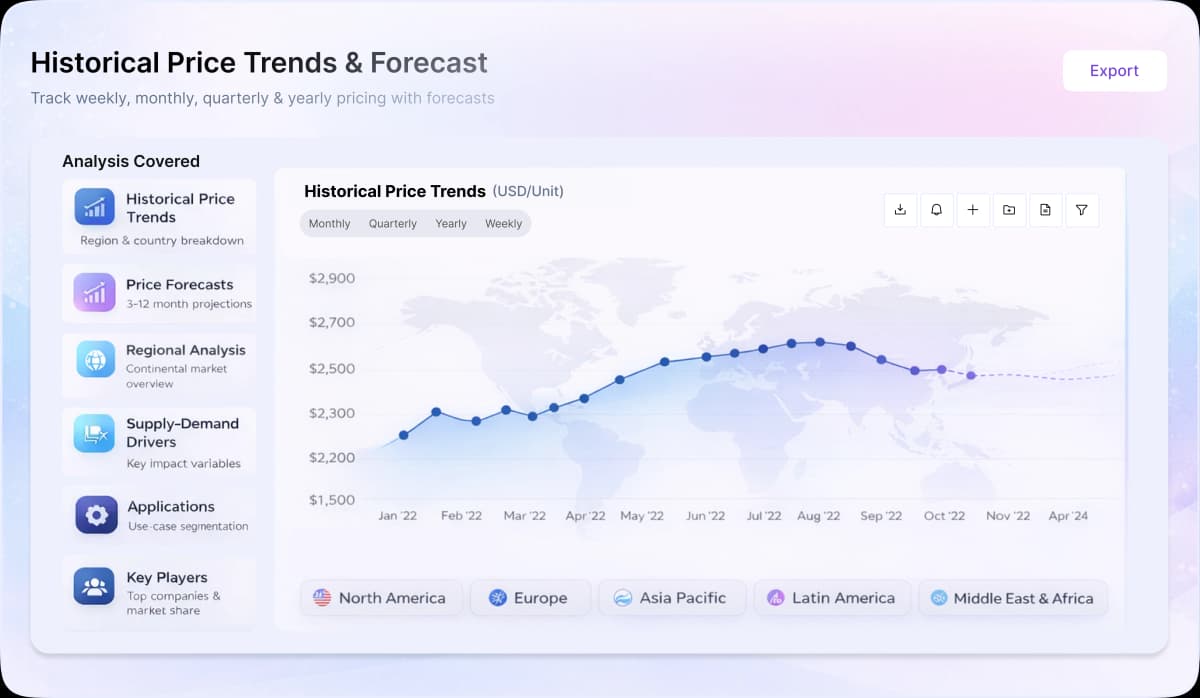
Price Trend Dashboard - What's Included
Price trends across a diverse portfolio of categories and products, spanning board to niche chemicals
Coverage extendable to grade-specific chemicals based on procurement requirements
Regular price tracking supported by robust historical datasets
News, policy updates, and key market drivers impacting price movements
Short-term and long-term price outlooks and forecasts
Supply-demand dynamics and capacity-driven market analysis