Lavender Oil Price Trend Analysis 2026: Supply Demand Analysis, Historical Prices, Market Insights, Latest News & Price Drivers

Procurement Resource Database

Laptop screen

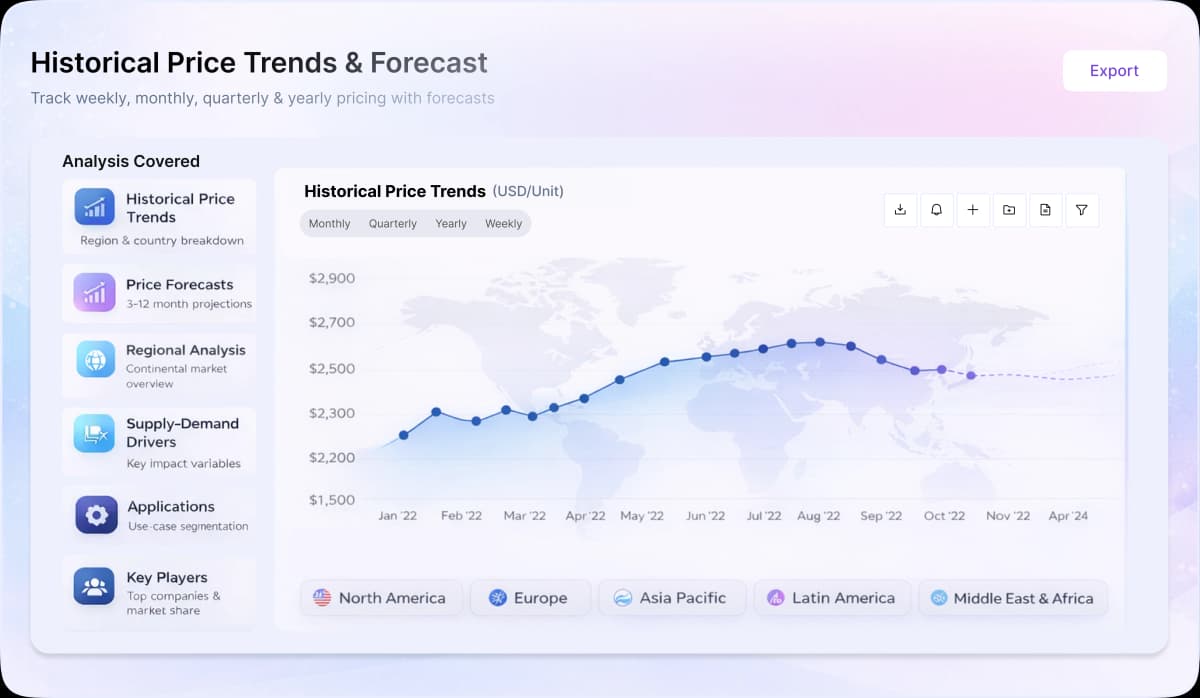
Turn price intelligence into action with the Procurement Resource Database. Log in or subscribe to unlock live price trends, historical charts, supplier databases, cost curves, and analyst-backed insights across chemicals, agriculture, energy, packaging, and more. Use these tools to benchmark your contracts, plan budgets with confidence, and stay ahead of market moves on every product you buy.

0

+

Products

0

+

Regions

0

+

Subscriptions

With the tightening supplies the lavender oil prices experienced a gradual incline in prices during the first half of 2025. A major crop decline in the previous year, estimated at 25%, led to a notable supply deficit as existing stocks were nearly depleted. While the state of Uttar Pradesh maintained relatively stable production levels in 2024, the limited carryover stock was insufficient to alleviate the emerging shortfall.

The combination of reduced availability and steady industrial demand exerted upward pressure on prices. In the Pacific Northwest, lavender acreage continued to decline, with an approximate 8% reduction compared to the previous growing season. Additionally, erratic climatic conditions in key growing regions adversely affected both the yield and the quality of the oil. A significant portion of the oil available during this period was reported to be of lower quality, making high-grade lavender oil increasingly scarce.

Internationally, alternative producing regions faced similar constraints, which contributed to a decline in the availability of quality supplies and a corresponding firming of prices. As the market adjusted to these supply-side challenges, buyers were observed securing their requirements in advance to safeguard against potential shortages. Establishing reliable relationships with growers in critical areas particularly the Pacific Northwest proved essential in managing limited supply and ensuring a consistent flow of quality oil.


About Lavender Oil

Lavender oil, extracted from the flowers of the Lavandula angustifolia plant, is one of the most versatile and widely used essential oils. Known for its calming floral aroma, it is used extensively in the fragrance, cosmetics, and skincare industries. Lavender oil is celebrated for its therapeutic properties, such as reducing stress, anxiety, and promoting better sleep. It also has antibacterial, antifungal, and anti-inflammatory effects, making it a valuable addition to personal care products. Additionally, lavender oil is used in aromatherapy, massage therapies, and as a natural remedy for various ailments, making it a beloved oil in both wellness and beauty sectors.

Lavender Oil Product Detail

Hs Code
33012990
Supplier Database

Givaudan International SA, Biolandes SAS, Symrise AG, Enio Bonchev Production Ltd., International Flavours and Fragrances Inc.

Regional Coverage

Asia Pacific

China, India, Indonesia, Pakistan, Bangladesh, Japan, Philippines, Vietnam, Iran, Thailand, South Korea, Iraq, Saudi Arabia, Malaysia, Nepal, Taiwan, Sri Lanka, UAE, Israel, Hongkong, Singapore, Oman, Kuwait, Qatar, Australia, and New Zealand

Europe

Germany, France, United Kingdom, Italy,Spain, Russia, Turkey, Netherlands, Poland, Sweden, Belgium, Austria, Ireland Switzerland, Norway, Denmark, Romania, Finland, Czech Republic, Portugal and Greece

North America

United States and Canada

Latin America

Brazil, Mexico, Argentina, Columbia, Chile, Ecuador, and Peru

Africa

South Africa, Nigeria, Egypt, Algeria, Morocco

CurrencyUS$ (Data can also be provided in local currency)

Supplier Database AvailabilityYes

Customization ScopeThe report can be customized as per the requirements of the customer

Post-Sale Analyst Support360-degree analyst support after report delivery

Note: Our supplier search experts can assist your procurement teams in compiling and validating a list of suppliers indicating they have products, services, and capabilities that meet your company's needs.

Lavender Oil Industrial Uses

Lavender oil, derived from the lavender plant (Lavandula angustifolia), has a wide range of industrial applications due to its soothing fragrance and therapeutic properties. In the cosmetics industry, it is a key ingredient in skincare products, including lotions, shampoos, and soaps, valued for its calming, anti-inflammatory, and antibacterial effects. Lavender oil is also used in aromatherapy, where it helps reduce stress and promote relaxation. In the fragrance industry, it is popular in perfumes and air fresheners. Additionally, lavender oil finds use in cleaning products for its antimicrobial properties and as a natural insect repellent.

Frequently Asked Questions

The lavender oil outlook for 2025 points to firm price levels, as feedstock supply recovery is expected to remain gradual across key origins. Supply constraints from production setbacks in major growing regions, combined with elevated input costs for fuel, agricultural materials and transportation, are likely to keep upward pressure on prices. Sustained seasonal demand provides further support. A meaningful shift would require a swift recovery in feedstock availability, a significant drop in input costs, or a notable softening in downstream demand.
Lavender oil prices are driven mainly by harvest outcomes and input costs. Because the oil is distilled from freshly cut Lavandula angustifolia flowers grown in a small number of European origins, growing-season weather, including rainfall, drought and heat during flowering, directly affects both flower volume and oil yield, and therefore spot availability. When the harvestable crop tightens, distillers compete more aggressively for feedstock. Input costs add a second layer: energy for steam distillation, farm labour and transport raise the landed cost of the oil, reinforcing firm pricing when supply is constrained.
Lavender oil is an agricultural product supplied by many farms and distilleries concentrated in a few origins: Bulgaria and France are the principal producers of lavender and the higher-yielding hybrid lavandin, with growing cultivation in China and smaller output elsewhere. The large fragrance and flavour houses, such as Givaudan, Symrise and International Flavors & Fragrances, are major downstream buyers and formulators rather than growers, while specialist distillers such as Bulgaria's Enio Bonchev and France's Biolandes produce and supply the oil. Because output is origin-concentrated, harvest conditions in these regions strongly influence global availability.

Lavender oil is sourced from the flowering tops of Lavandula angustifolia plants. The production route begins with harvesting freshly cut flowering tops, which are then processed through steam distillation to extract the essential oil. The resulting pale-yellow liquid is rich in linalool (25-38%) and linalyl acetate (25-45%), giving it a soft floral aroma. The finished oil is stored in aluminium or lined steel drums, away from light and heat, and is supplied to fragrance houses and personal-care manufacturers for use in cosmetics, skincare, aromatherapy, and wellness products.
Fragrance houses, personal-care manufacturers, and aromatherapy and wellness brands drive lavender oil demand. Fragrance houses use its linalool and linalyl acetate content for soft floral aromas in fine fragrance and functional scents. Personal-care manufacturers incorporate it into natural cosmetics, soaps, and skincare, responding to consumer preference for plant-based ingredients. Aromatherapy and wellness brands use essential oil blends and diffuser products. Together, these consumer-facing sectors keep demand for lavender oil steady across personal care, cosmetics, and wellness.
Lavender oil quality is governed by the international standard ISO 3515:2002 (Oil of lavender, Lavandula angustifolia Mill.), which sets specifications for the oil's marker compounds (principally linalool and linalyl acetate), a limit on camphor, and physical properties such as relative density, refractive index, optical rotation and solubility in ethanol. Commercial quality is further differentiated by lavender species, growing regions, chemotypes, and organic certification. Buyers typically verify each batch by its gas chromatography profile and conformity to the standard, since composition determines suitability for fragrance and personal-care formulations.


Procurement Resource assesses lavender oil prices through a structured, data-driven methodology combining primary engagement with producers, suppliers and traders, secondary market data, monitoring of feedstock and input costs, trade-flow and inventory tracking, and exchange or spot benchmarks. These inputs are validated and translated into a transparent price assessment and outlook. The detailed methodology is available on the Procurement Resource website.

Our Price Analysis Methodology

About the Author

Prakhar Panchbhaiya profile photo

Prakhar Panchbhaiya

Assistant Manager: Business Insights and Content

Supporting procurement teams with category intelligence, market research, price trends, supply-demand analysis, and strategic sourcing insights across key industries.

Schedule Demo

Schedule a demo

Experience how Procurement Resource transforms raw material price data into clear, decision ready intelligence. Optimise your performance with reliable, expert market data and analysis. Schedule your demo today to experience a live walk-through where our experts will showcase interactive price charts, forecasted prices, and insights driving the prices for your key commodities, tailored to your workflows. Contact us now!

Our Team will be happy to assist you

We are just a text away

+1

Still Need Help?

Europe & Africa

+44 7573 171117

Sales@procurementresource.com

USA & Canada

+1 307 363 1045

Sales@procurementresource.com

APAC

+91 8850629517

Sales@procurementresource.com

Unlock full access to Procurement Resource's price databases, interactive charts, and short-term forecasts for thousands of commodities. Elevate your sourcing decisions by comparing prices across regions, downloading historical data, and layering in analyst-backed insights, all with our flexible plans that scale as your portfolio grows.

Still have any Questions

Contact Us
Mastercard
Wire
VISA
Stripe

Why Procurement Database

Commodity Market Intelligence

Commodity Market Intelligence

Track prices, market movements, supply-demand dynamics, and industry developments across hundreds of commodities through a centralized intelligence platform built for informed procurement decisions.

Price Forecasts & Market Outlooks

Price Forecasts & Market Outlooks

Understand market fluctuations using analyst-backed forecasts, historical pricing patterns, and evolving industry trends to strengthen sourcing strategies and budget planning.

Cost & Procurement Optimization

Cost & Procurement Optimization

Leverage cost models, pricing benchmarks, and procurement insights to evaluate purchasing opportunities, improve negotiations, and enhance operational efficiency.

Global & Regional Market Insights

Global & Regional Market Insights

Access region-specific price trends, trade activities, capacity changes, and supply chain developments influencing commodity markets worldwide.

1/4