Damaged Hydrofluoric Acid Container Disrupts Port Operations
A damaged container carrying hydrofluoric acid caused operational setbacks at the Port of Antwerp-Bruges, tightening local supply and likely supporting higher prices.

A damaged container carrying hydrofluoric acid caused operational setbacks at the Port of Antwerp-Bruges, tightening local supply and likely supporting higher prices.
| Product | Region | Incoterm Basis | Price | Last Updated Month |
|---|---|---|---|---|
| Lithium Fluoride | China | FOB | USD 33,356.92/MT | August 2026 |
| Lithium Fluoride | India | CIF | USD 33,447.92/MT | August 2026 |
| Lithium Fluoride | Germany | CIF | USD 33,470.92/MT | August 2026 |
| Lithium Fluoride | Australia | CIF | USD 33,451.92/MT | August 2026 |
| Lithium Fluoride | Brazil | CIF | USD 33,498.92/MT | August 2026 |
| Lithium Fluoride | China | FOB | USD 34,481.10/MT | July 2026 |
| Lithium Fluoride | India | CIF | USD 34,587.91/MT | July 2026 |
| Lithium Fluoride | Germany | CIF | USD 34,614.73/MT | July 2026 |
| Lithium Fluoride | Australia | CIF | USD 34,579.56/MT | July 2026 |
| Lithium Fluoride | Brazil | CIF | USD 34,652.71/MT | July 2026 |
Stay updated with the latest Lithium Fluoride prices, historical data, and tailored regional analysis
The first quarter of 2024 witnessed a general positive pricing environment for lithium fluoride in the Asian markets. The said period was characterized by increasing prices driven by low supplies and higher raw material costs. China experienced an optimistic curve; the overall market dynamics were riddled since the driving factors provided both upward and downward pushes to lithium fluoride prices.
Low inventories and rising production costs spurred by an incline in crude oil prices pushed the market affirmatively. However, the demands from the downstream sectors were still weak. Therefore, the suppliers controlled supply quantities by limiting the capacity utilizations.
This contrasted with the situation in Europe, where the primary challenges the market faced were oversupply and sluggish demands, particularly from the lithium-ion battery manufacturing sector, leading to a downward pressure on prices. Additionally, Chinese dominance in the electric vehicle (EV) market impacted European and U.S. manufacturers, further contributing to a bearish sentiment in these regions.
Analyst Insight
According to Procurement Resource, the market prices of Lithium Fluoride are likely to oscillate in a similar manner in the coming months given the current market fundamentals and global dynamics.
Related Report
Need Latest Lithium Fluoride Prices?
Get real-time price assessments, periodic trends, forecasts and price driver insights across key global markets.
Our Clients































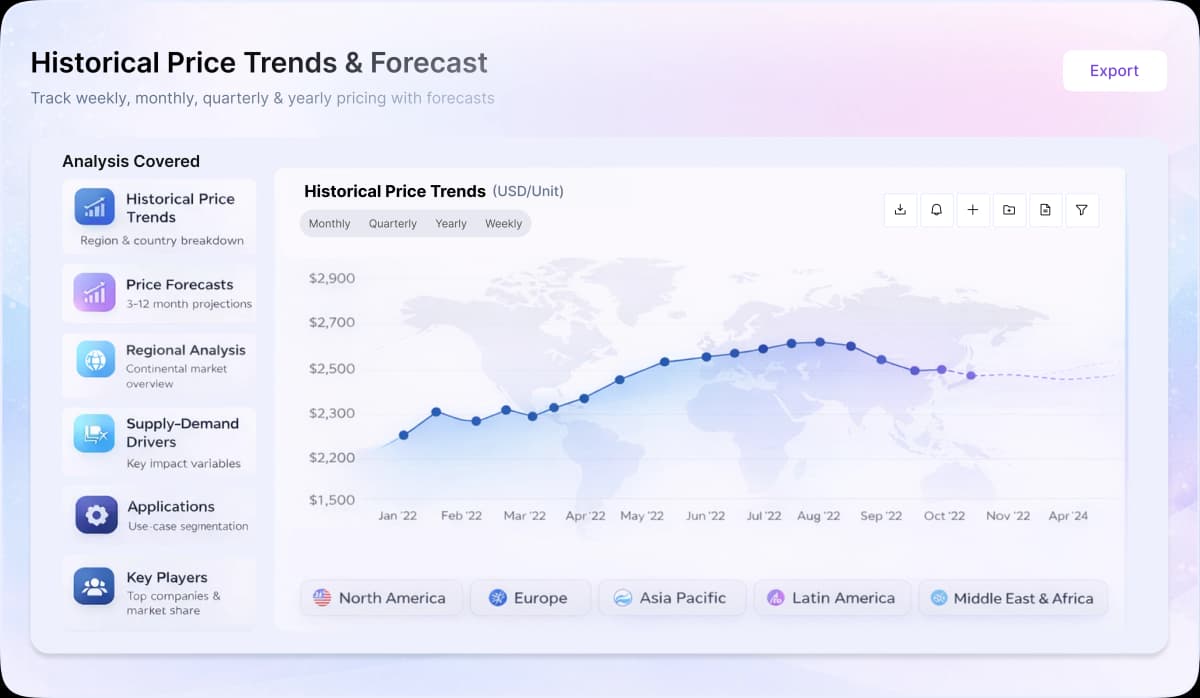
Turn price intelligence into action with the Procurement Resource Database. Log in or subscribe to unlock live price trends, historical charts, supplier databases, cost curves, and analyst-backed insights across chemicals, agriculture, energy, packaging, and more. Use these tools to benchmark your contracts, plan budgets with confidence, and stay ahead of market moves on every product you buy.
0
+Products
0
+Regions
0
+Subscriptions
Lithium fluoride (LiF) is a white, crystalline compound known for its high melting point and wide-ranging industrial applications. It is primarily used in the glass and ceramics industry to increase the durability and refractive index of optical materials. In nuclear reactors, LiF serves as a neutron absorber and coolant due to its excellent thermal stability. It is also crucial as an electrolyte in lithium-ion batteries, enhancing their performance and safety. Additionally, Lithium fluoroide finds use in organic synthesis as a fluorinating agent and in metallurgy as a flux for refining metals.
LiF
Nuclear Reactors, Glass and Ceramics Industry, Electrolytes in Batteries, Fluorinating Agent in Organic Synthesis, Optical Coatings, Flux in Metallurgy, Catalyst
Fluorolithium
SQM, FMC Corporation, Sigma-Aldrich, Albemarle Corporation, Jiangxi Ganfeng Lithium Co. Ltd.
CurrencyUS$ (Data can also be provided in local currency)
Supplier Database AvailabilityYes
Customization ScopeThe report can be customized as per the requirements of the customer
Post-Sale Analyst Support360-degree analyst support after report delivery
Note: Our supplier search experts can assist your procurement teams in compiling and validating a list of suppliers indicating they have products, services, and capabilities that meet your company's needs.
The synthesis begins with the chemical reaction between lithium hydroxide and hydrogen fluoride. The reaction results in the formation of Lithium fluoride as the resultant, along with water as the byproduct. The resultant is further heated under specific temperatures to obtain anhydrous lithium fluoride as the final product.
Our Price Analysis Methodology

Senior Business Insights Analyst
Delivering price trend analysis and procurement market insights at Procurement Resource, with expertise in identifying commodity patterns, supporting purchasing strategies, and improving cost efficiency through actionable market intelligence.
Experience how Procurement Resource transforms raw material price data into clear, decision ready intelligence. Optimise your performance with reliable, expert market data and analysis. Schedule your demo today to experience a live walk-through where our experts will showcase interactive price charts, forecasted prices, and insights driving the prices for your key commodities, tailored to your workflows. Contact us now!
Our Team will be happy to assist you
We are just a text away
Still Need Help?
Unlock full access to Procurement Resource's price databases, interactive charts, and short-term forecasts for thousands of commodities. Elevate your sourcing decisions by comparing prices across regions, downloading historical data, and layering in analyst-backed insights, all with our flexible plans that scale as your portfolio grows.
Still have any Questions
Contact Us



Price Trend Dashboard - What's Included
Price trends across a diverse portfolio of categories and products, spanning board to niche chemicals
Coverage extendable to grade-specific chemicals based on procurement requirements
Regular price tracking supported by robust historical datasets
News, policy updates, and key market drivers impacting price movements
Short-term and long-term price outlooks and forecasts
Supply–demand dynamics and capacity-driven market analysis

Track prices, market movements, supply-demand dynamics, and industry developments across hundreds of commodities through a centralized intelligence platform built for informed procurement decisions.

Understand market fluctuations using analyst-backed forecasts, historical pricing patterns, and evolving industry trends to strengthen sourcing strategies and budget planning.

Leverage cost models, pricing benchmarks, and procurement insights to evaluate purchasing opportunities, improve negotiations, and enhance operational efficiency.
Access region-specific price trends, trade activities, capacity changes, and supply chain developments influencing commodity markets worldwide.
