Need latest Mild Steel Angle prices?
Get real-time price assessments, periodic trends, forecasts and price driver insights across key global markets.
Unlock Price Insights NowOur Clients
In 2025, mild steel angle prices showed a mixed and fluctuating trend throughout the year. At the start of the year, prices were fairly stable as industrial demand remained slow, especially in construction, automotive, and machinery sectors. Seasonal slowdowns and cautious buying kept market activity subdued.
European prices moved lower initially because of high inventories and weak demand, while producers’ attempts to push prices up had little effect. North American markets remained relatively steady, with occasional price increases supported by trade protections and early year strength in vehicle production. Asian markets faced oversupply, and low domestic demand pushed prices down, though seasonal demand and fiscal-year stock replenishment gave some temporary support. In India, low prices forced many small mills to halt production, showing the challenge of maintaining profitability amid global oversupply and cheap imports.
During the third quarter, prices in Europe began to recover as tighter import regulations and new trade measures were expected. Domestic producers announced price hikes, and improving demand in countries like Germany and Italy added support. Asian prices remained mixed, with some producers raising rates due to higher raw material costs, while cautious buying limited sharp rises. Towards the end of the year, markets stabilized, with prices moving moderately higher in regions where supply tightened and demand slowly improved.
Analyst Insight
According to Procurement Resource, Mild Steel Angle prices are expected to remain somewhat volatile in 2026, with gradual upward movement if supply constraints persist and industrial demand strengthens.
Related Report
Get real-time price assessments, periodic trends, forecasts and price driver insights across key global markets.
Unlock Price Insights NowOur Clients

Turn price intelligence into action with the Procurement Resource Database. Log in or subscribe to unlock live price trends, historical charts, supplier databases, cost curves, and analyst-backed insights across chemicals, agriculture, energy, packaging, and more. Use these tools to benchmark your contracts, plan budgets with confidence, and stay ahead of market moves on every product you buy.

0
+Products
0
+Regions
0
+Subscriptions
In the second half of 2024, mild steel angle prices showed mixed trends across regions. In Asia, prices faced downward pressure due to weak domestic demand, particularly in construction and manufacturing sectors. China’s surplus production and competitive exports contributed to lower local prices, while India saw domestic prices drop to multi-year lows. Falling raw material costs helped producers maintain margins despite the price declines.
In Europe, mild steel angle prices recovered slightly after earlier lows. Price increases for hot-rolled coils by major producers, combined with rising raw material costs, supported the market. However, weak demand from the automotive sector and ongoing trade tensions limited major gains. Imported steel from Asia added competitive pressure, keeping price growth moderate.
North America saw early signs of stabilization. Domestic demand from construction and industrial sectors improved, helping prices recover somewhat, although potential tariff announcements created short-term uncertainty. Tight steel scrap availability and seasonal fluctuations also influenced prices, causing occasional short-term swings.
Mild steel angles are widely used in a variety of sectors due to their strength, malleability, and longevity. They are crucial parts of structural frames, supports, and reinforcements in the building. They are used in the manufacturing sector for equipment supports, conveyor systems, and machinery frames.

Mild steel angles are used in metal fabrication companies to create specialized parts like racks and brackets. Because of their robustness, automotive applications involve vehicle chassis and structural components. They are also used in technical domains, including railroads and shipbuilding, where they offer reinforcement and structural support in a variety of industrial environments.

Construction, Manufacturing, Metal Fabrication, Automotive, Engineering, Agricultural Machinery
HBIS Group, NSSMC Group, POSCO, Shagang Group, Ansteel Group, JFE Steel Corporation, Tata Steel Group, Hyundai Steel Company
CurrencyUS$ (Data can also be provided in local currency)
Supplier Database AvailabilityYes
Customization ScopeThe report can be customized as per the requirements of the customer
Post-Sale Analyst Support360-degree analyst support after report delivery
Note: Our supplier search experts can assist your procurement teams in compiling and validating a list of suppliers indicating they have products, services, and capabilities that meet your company's needs.
Our Price Analysis Methodology

Experience how Procurement Resource transforms raw material price data into clear, decision ready intelligence. Optimise your performance with reliable, expert market data and analysis. Schedule your demo today to experience a live walk-through where our experts will showcase interactive price charts, forecasted prices, and insights driving the prices for your key commodities, tailored to your workflows. Contact us now!
Our Team will be happy to assist you
We are just a text away
Still Need Help ?
Unlock full access to Procurement Resource's price databases, interactive charts, and short-term forecasts for thousands of commodities. Elevate your sourcing decisions by comparing prices across regions, downloading historical data, and layering in analyst-backed insights, all with our flexible plans that scale as your portfolio grows.
Still have any Questions
Contact Us


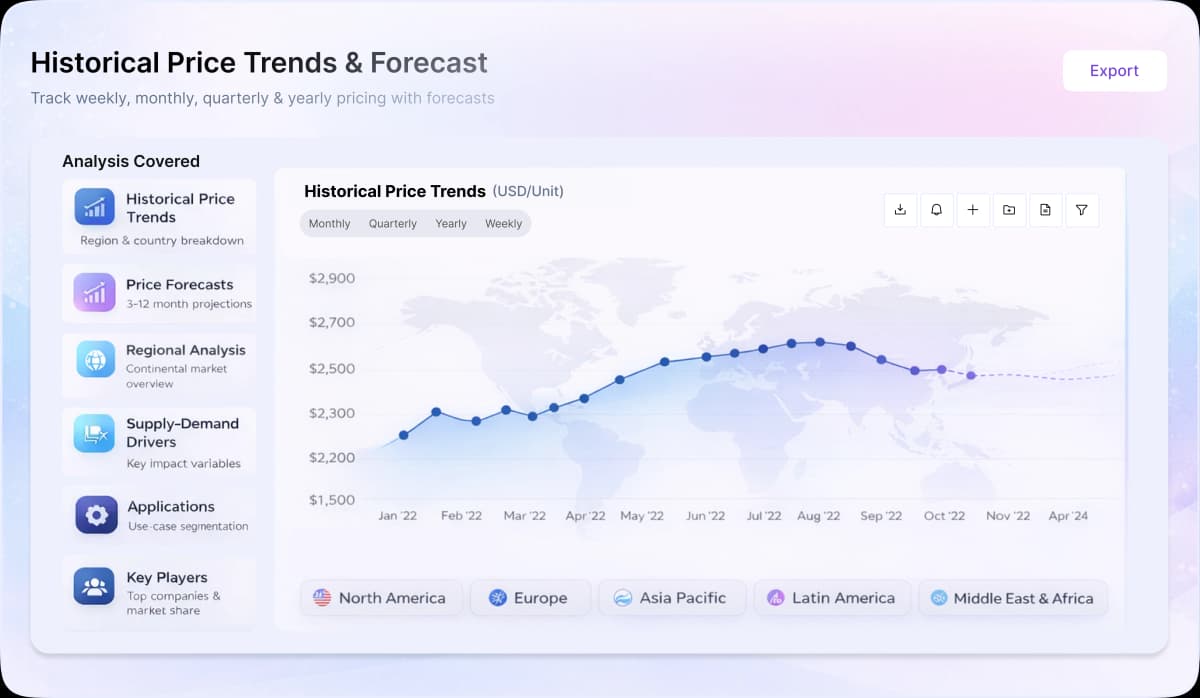
Price Trend Dashboard - What's Included
Price trends across a diverse portfolio of categories and products, spanning board to niche chemicals
Coverage extendable to grade-specific chemicals based on procurement requirements
Regular price tracking supported by robust historical datasets
News, policy updates, and key market drivers impacting price movements
Short-term and long-term price outlooks and forecasts
Supply–demand dynamics and capacity-driven market analysis