Udeesha Tomar
AVP - Strategy and Solutions
Leading procurement research solutions across chemicals, materials, and food & beverages, with expertise in price forecasting and market analytics.
Asia
In Asia, the Nylon Filament Yarn market moved mostly downward throughout 2025. Demand stayed weak from the start of the year as textile, apparel, and automotive buyers reduced orders. Feedstock costs eased, which removed cost support and encouraged sellers to adjust their offers lower. A short-term improvement appeared when some mills restocked and crude oil firmed, but this rebound did not last. By mid-year, oversupply and slower export activity added pressure, especially as regional textile markets struggled with soft orders and high inventories. In the second half, the market weakened further. New production, muted consumption in clothing and engineering plastics, and persistent stock levels at factories kept sentiment low. Overall, Asia saw a year of long and steady decline with only brief and limited periods of stability.
Europe
Europe followed a similar trend. The year began with a slight lift as producers attempted to raise margins, but real buying interest stayed limited. Costs of upstream materials were lower, while imports from Asia intensified competition. European converters, dealing with low industrial activity and reduced automotive operating rates, kept purchases cautious. Through the second half of the year, economic uncertainty, moderate manufacturing performance, and slow downstream demand continued to weigh on prices. Inventory pressure also grew as consumption stayed below expectations. As a result, NFY prices in Europe slid gently but consistently over the course of 2025.
North America
North America also experienced a mostly downward pattern. Early in the year, the market saw a short period of stability supported by restocking, but this faded once more capacity returned and demand from sectors like construction and automotive stayed moderate. Raw-material softness added to the weak tone. Broader economic concerns limited buyers’ willingness to build inventory, and as the year progressed, sellers faced increasing difficulty holding offers firm. By year-end, the region broadly mirrored global conditions steady oversupply, slow offtake, and a clear downward price path.
Analyst Insight
According to Procurement Resource, Nylon Filament Yarn prices are expected to stay soft unless demand improves or supply tightens given the current market fundamentals.
Related Report
Get real-time price assessments, periodic trends, forecasts and price driver insights across key global markets.
Unlock Price Insights NowOur Clients

Turn price intelligence into action with the Procurement Resource Database. Log in or subscribe to unlock live price trends, historical charts, supplier databases, cost curves, and analyst-backed insights across chemicals, agriculture, energy, packaging, and more. Use these tools to benchmark your contracts, plan budgets with confidence, and stay ahead of market moves on every product you buy.

0
+Products
0
+Regions
0
+Subscriptions
Asia
In Asia, the nylon filament yarn market experienced fluctuations throughout Q4’24. Early in the quarter, prices saw a slight increase due to rising feedstock costs, particularly as oil prices gained traction. However, as the month progressed, demand from downstream sectors such as textiles remained weak, especially in regions like Jiangsu and Zhejiang.
Weaving enterprises maintained a cautious approach, and many had sufficient raw material inventory, leading to reduced buying activity. Despite slight upticks in prices driven by cost pressures, the market was generally sluggish. Additionally, the increased supply of PTA in China put further downward pressure on prices, limiting substantial upward movement in nylon filament yarn prices.
Europe
In Europe, the market followed a similar pattern, with mild price increases initially in response to higher raw material costs. The situation was compounded by subdued demand from both domestic and export markets. While export figures showed slight improvements in some sectors, the overall demand for nylon filament yarn remained unenthusiastic. Market sentiment was cautious, with many manufacturers refraining from aggressive price hikes due to the overall weakness in textile orders. There was little incentive for manufacturers to push for higher prices given the subdued consumption in the region.
North America
In North America, the nylon filament yarn market mirrored trends seen in Europe and Asia. Prices were influenced by rising feedstock costs, but the overall market sentiment was dominated by weak demand in the textile sector. Although some industries saw marginal demand growth, particularly for spring season orders, the market as a whole showed little sign of significant recovery. Manufacturers continued to offer discounts to move inventory, and the cautious approach taken by downstream buyers kept the market relatively stable.
Nylon filament yarn is a synthetic fiber made from polymerizing nylon resins into long, continuous filaments. It exhibits excellent strength, durability, and elasticity, making it ideal for various applications, including textiles, apparel, and industrial products.
Its high tensile strength ensures longevity and resistance to wear and tear, while its lightweight and smooth texture offer comfort and versatility. Nylon filament yarn possesses good heat resistance, moisture-wicking capabilities, and dyeability, allowing for vibrant colors and easy maintenance. Additionally, it has low water absorption, enhancing its dimensional stability. These properties make nylon filament yarn a popular choice for a wide range of consumer and industrial goods.


Packaging, Sewing threads, Electrical insulation, Industrial belts, Geotextiles, Seat belts
ASF SE, LANXESS, UBE INDUSTRIES LTD, Ensinger, Century Enka Limited, CELANESE CORPORATION, Radici Group, Formosa Chemical and Fibre Corporation, JCT Limited, East India Textile Technology Limited
CurrencyUS$ (Data can also be provided in local currency)
Supplier Database AvailabilityYes
Customization ScopeThe report can be customized as per the requirements of the customer
Post-Sale Analyst Support360-degree analyst support after report delivery
Note: Our supplier search experts can assist your procurement teams in compiling and validating a list of suppliers indicating they have products, services, and capabilities that meet your company's needs.
This method involves polymerizing caprolactam to create nylon-6 polymer, which is then melted to create nylon chips. To remove impurities, these chips are cleaned, dried, and then remelted for spinning. Finally, to create filaments, chips are introduced into a cooling chamber via a spinneret.

Udeesha Tomar
AVP - Strategy and Solutions
Leading procurement research solutions across chemicals, materials, and food & beverages, with expertise in price forecasting and market analytics.
Our Price Analysis Methodology

Experience how Procurement Resource transforms raw material price data into clear, decision ready intelligence. Optimise your performance with reliable, expert market data and analysis. Schedule your demo today to experience a live walk-through where our experts will showcase interactive price charts, forecasted prices, and insights driving the prices for your key commodities, tailored to your workflows. Contact us now!
Our Team will be happy to assist you
We are just a text away
Still Need Help?
Europe & Africa
+44 7573 171117
Sales@procurementresource.com
USA & Canada
+1 307 363 1045
Sales@procurementresource.com
APAC
+91 8850629517
Sales@procurementresource.com
Unlock full access to Procurement Resource's price databases, interactive charts, and short-term forecasts for thousands of commodities. Elevate your sourcing decisions by comparing prices across regions, downloading historical data, and layering in analyst-backed insights, all with our flexible plans that scale as your portfolio grows.
Still have any Questions
Contact Us


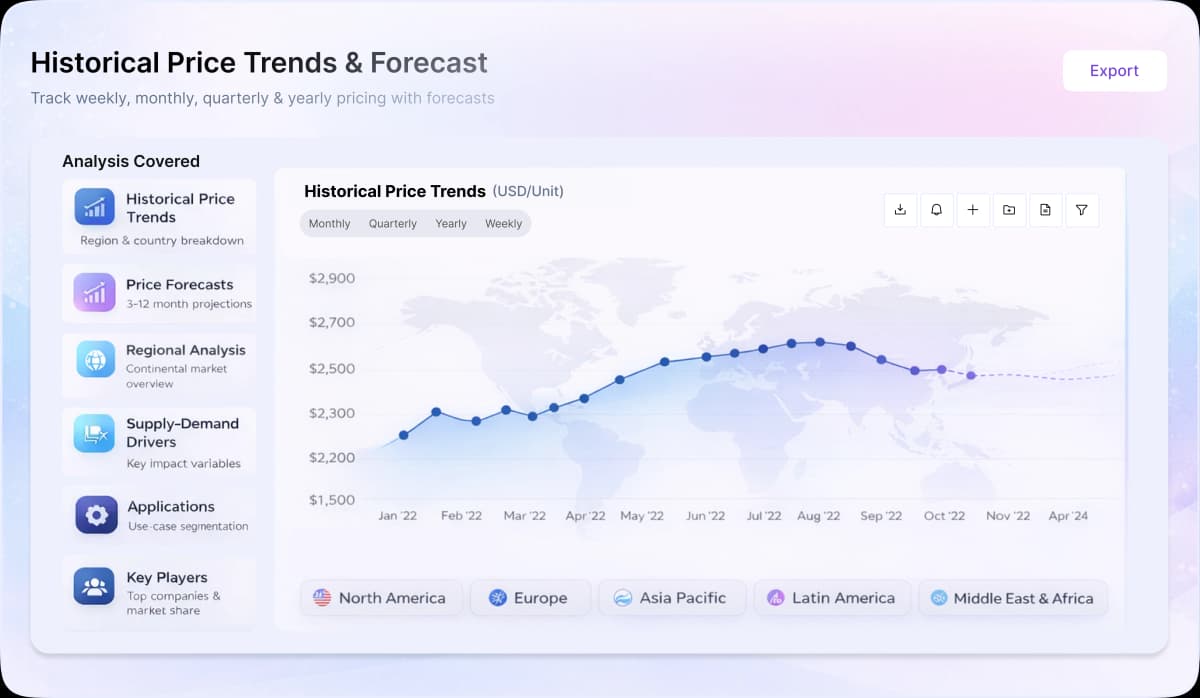
Price Trend Dashboard - What's Included
Price trends across a diverse portfolio of categories and products, spanning board to niche chemicals
Coverage extendable to grade-specific chemicals based on procurement requirements
Regular price tracking supported by robust historical datasets
News, policy updates, and key market drivers impacting price movements
Short-term and long-term price outlooks and forecasts
Supply-demand dynamics and capacity-driven market analysis