

Udeesha Tomar
AVP - Strategy and Solutions
Leading procurement research solutions across chemicals, materials, and food & beverages, with expertise in price forecasting and market analytics.

| Product | Category | Region | Price | Last Updated Month |
| OSB | Packaging | China | USD 445/MT | September 2025 |
Stay updated with the latest Oriented Strand Board, historical data, and tailored regional analysis
OSB prices moved slowly but with steady improvement across the said year. The market started the year on weak footing because overall wood product demand had been soft through 2024. High interest rates and slow renovation activity also kept buyers cautious. But as the year went on, several forces helped OSB find firmer ground.
Housing activity stayed surprisingly resilient, especially in the single-family market, where builders continued using incentives to support sales. Even though mortgage rates stayed above comfortable levels, they eased bit by bit through the year as economic uncertainty cooled. This supported a gradual pickup in construction and helped lift demand for OSB. Repair and remodelling work also inched higher as consumers gained confidence and income growth stayed positive.
On the supply side, earlier mill closures in softwood lumber signaled the broader pressure the industry had faced, but OSB capacity stayed tighter and more disciplined. Projects like the proposed OSB plant in Prince Albert showed that long-term interest in OSB production remained, though investment slowed because of tariff concerns. This balance of cautious supply and slowly rising demand helped OSB prices trend upward through the year, though gains stayed modest.
Analyst Insight
According to Procurement Resource, OSB prices are likely to keep steady and show slow improvement in the coming months, supported by steady housing demand and disciplined mill output.
Need Latest OSB (Oriented Strand Board) Prices?
Get real-time price assessments, periodic trends, forecasts and price driver insights across key global markets.
Our Clients































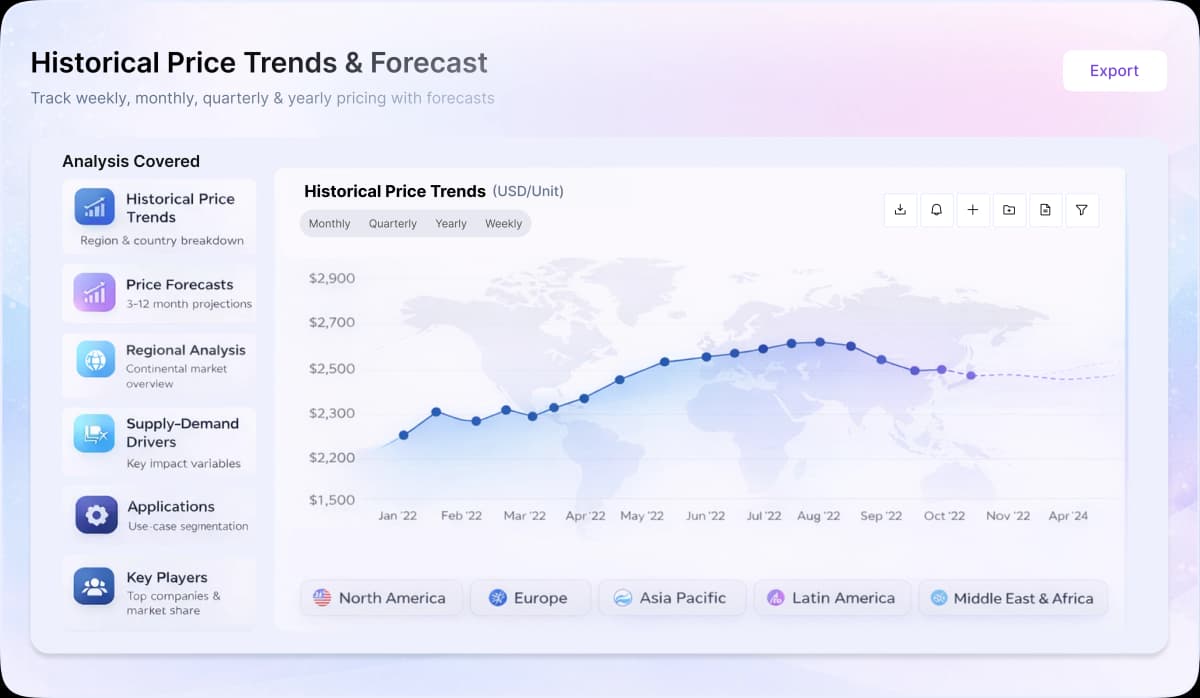
Turn price intelligence into action with the Procurement Resource Database. Log in or subscribe to unlock live price trends, historical charts, supplier databases, cost curves, and analyst-backed insights across chemicals, agriculture, energy, packaging, and more. Use these tools to benchmark your contracts, plan budgets with confidence, and stay ahead of market moves on every product you buy.
0
+Products
0
+Regions
0
+Subscriptions
OSB prices in 2024 moved lower for most of the year as global and regional markets slowed. International trade in wood-based panels dropped, and overall demand weakened because of slower economic growth and higher interest rates. Many countries saw reduced activity in construction and renovation,
which kept buyers cautious and pushed OSB prices down from the strong levels seen in 2021–2022. The decline in global trade happened faster than the drop in volumes, which showed that prices had softened across many wood products, including OSB.
Producers also felt pressure. Companies in Europe and North America reported lower demand for OSB and other panel products, and markets such as Ireland, the UK, and the EU saw price reductions. Even though a few regions, like Asia-Pacific, increased panel output slightly, this was not enough to lift global pricing. At the same time, some planned OSB projects in Canada slowed because of tariff concerns, which kept future supply uncertain but did not prevent prices from falling in 2024.
Later in the year, some North American analysts noted early signs of firmer OSB markets as mills reduced shipments and order files lengthened, but this improvement came only near the end of 2024.
Oriented Strand Board (OSB) is an engineered wood panel made by compressing thin wood strands arranged in specific orientations and bonded with synthetic resins. It provides high strength, dimensional stability, and load-bearing capacity. OSB is widely used as an alternative to plywood in construction applications due to its durability, cost efficiency, and consistent performance
Oriented Strand Board, OSB Panel, Wood Strand Board, Structural Wood Panel
West Fraser Timber Co. Ltd., Louisiana-Pacific Corporation, Kronospan Limited, Weyerhaeuser Company, EGGER Group, Norbord Inc. (West Fraser)
CurrencyUS$ (Data can also be provided in local currency)
Supplier Database AvailabilityYes
Customization ScopeThe report can be customized as per the requirements of the customer
Post-Sale Analyst Support360-degree analyst support after report delivery
Note: Our supplier search experts can assist your procurement teams in compiling and validating a list of suppliers indicating they have products, services, and capabilities that meet your company's needs.
OSB production involves wood strand preparation, resin application, mat forming, hot pressing, and panel finishing. Manufacturers control strand size, resin content, pressing conditions, and panel density to achieve required mechanical strength, moisture resistance, and dimensional stability for construction and industrial applications.
OSB is mainly used in residential and commercial construction for wall sheathing, roof decking, flooring, and structural panels. It is also used in furniture, packaging, temporary structures, and interior applications. Its strength and moisture-resistant grades make it suitable for building systems requiring reliable structural performance.
Our Price Analysis Methodology
AVP - Strategy and Solutions
Leading procurement research solutions across chemicals, materials, and food & beverages, with expertise in price forecasting and market analytics.
Experience how Procurement Resource transforms raw material price data into clear, decision ready intelligence. Optimise your performance with reliable, expert market data and analysis. Schedule your demo today to experience a live walk-through where our experts will showcase interactive price charts, forecasted prices, and insights driving the prices for your key commodities, tailored to your workflows. Contact us now!
Our Team will be happy to assist you
We are just a text away
Still Need Help?
Unlock full access to Procurement Resource's price databases, interactive charts, and short-term forecasts for thousands of commodities. Elevate your sourcing decisions by comparing prices across regions, downloading historical data, and layering in analyst-backed insights, all with our flexible plans that scale as your portfolio grows.
Still have any Questions
Contact Us



Price Trend Dashboard - What's Included
Price trends across a diverse portfolio of categories and products, spanning board to niche chemicals
Coverage extendable to grade-specific chemicals based on procurement requirements
Regular price tracking supported by robust historical datasets
News, policy updates, and key market drivers impacting price movements
Short-term and long-term price outlooks and forecasts
Supply–demand dynamics and capacity-driven market analysis

Track prices, market movements, supply-demand dynamics, and industry developments across hundreds of commodities through a centralized intelligence platform built for informed procurement decisions.

Understand market fluctuations using analyst-backed forecasts, historical pricing patterns, and evolving industry trends to strengthen sourcing strategies and budget planning.

Leverage cost models, pricing benchmarks, and procurement insights to evaluate purchasing opportunities, improve negotiations, and enhance operational efficiency.
Access region-specific price trends, trade activities, capacity changes, and supply chain developments influencing commodity markets worldwide.