Udeesha Tomar
AVP - Strategy and Solutions
Leading procurement research solutions across chemicals, materials, and food & beverages, with expertise in price forecasting and market analytics.
Asia
During the second half of 2025, oxalic acid prices in Asia followed a mixed but overall softer trajectory, largely influenced by fluctuations in corn, a key feedstock used in its fermentation-based production. In the third quarter, prices declined steadily as corn values weakened across the region, reducing input costs for producers and encouraging lower offer levels. This softer cost environment led downstream buyers in textiles, pharmaceuticals, and metal treatment to adopt cautious, need-based procurement strategies. In the fourth quarter, the market remained soft initially as corn prices continued to ease and inventories at major Chinese producers stayed comfortable. However, prices gradually recovered later in the period as export inquiries improved, spot availability tightened modestly, and demand from leather treatment and rust removal applications lent some support. Overall, the Asian market closed H2 in a more balanced but still range-bound position.
Europe
In Europe, oxalic acid prices during H2 2025 largely mirrored Asian trends. Q3 witnessed a decline as easing corn-linked production costs and softer global feedstock markets reduced pricing pressure. Demand from cleaning compounds, leather processing, textile dyeing, and pharmaceutical intermediates remained steady but not strong enough to prevent the downward correction. In Q4, prices softened further in the early phase due to lower Asian import offers before stabilizing and recovering moderately as distributor restocking improved and feedstock economics firmed.
North America
North American oxalic acid prices also reflected a similar pattern in H2 2025. Q3 pricing weakened under pressure from lower corn costs and balanced supply conditions, while demand from rare earth processing, automotive cleaning, and specialty chemicals remained stable. In Q4, competitive imports and comfortable inventories initially weighed on prices, but firmer replacement costs and selective replenishment helped the market recover modestly by year-end.
Analyst Insight
According to Procurement Resource, oxalic acid future price trends are likely to remain tied to corn cost movements and downstream industrial demand.
Related Report
Get real-time price assessments, periodic trends, forecasts and price driver insights across key global markets.
Unlock Price Insights NowOur Clients

Turn price intelligence into action with the Procurement Resource Database. Log in or subscribe to unlock live price trends, historical charts, supplier databases, cost curves, and analyst-backed insights across chemicals, agriculture, energy, packaging, and more. Use these tools to benchmark your contracts, plan budgets with confidence, and stay ahead of market moves on every product you buy.

0
+Products
0
+Regions
0
+Subscriptions
Asia
Asia's oxalic acid market followed a patchy trend in Q2 2025. The quarter started on a firm note, with buying activity staying moderate and downstream applications such as rare earth processing and pharma seeing steady but unimpressive demand. As time went on, however, changes in the upstream markets of formic acid and nitric acid induced mixed cost of production.
Producers had raised prices occasionally to cope with these increases, but price aggression by a few regional players brought in occasional softening in certain markets. Negotiations were short-term and reactive, and players in the market stayed away from long-term commitments. The consequence was a pricing environment characterized by inconsistency, where single transactions represented fleeting changes in supply and cost structure rather than any apparent directional trend.
Europe
Oxalic acid prices in Europe painted a mixed picture during the second quarter. The initial market was weak, mainly because of high stocks and risk-averse buying in downstream applications. Feedstock prices, particularly for formic acid, slowly trended upwards, leading to some price increases during mid-quarter. This trend, however, was moderated by lackluster offtake from downstream consumers and sporadic pricing pressure from importers, particularly Asian exporters with more competitive short-term offers.
Purchasers tended to postpone buying to evaluate additional market activity, which resulted in unbalanced transaction volumes. At the end of the period, the market had not hardened or softened completely but rather stabilized at a mid-point that indicated the confusion and mixed signals both from upstream and downstream markets.
North America
The North American oxalic acid market experienced a fluctuating trend in Q2. Activity began with average transactions, with buyers consistently interested in utilizing current inventory. As the quarter progressed, increasing costs in lead feedstocks, particularly nitric acid, played a role in elevating offers from domestic producers.
Demand, however, was sporadically weak, especially in industrial end-use markets impacted by wider economic uncertainty and changing regulatory policy. Tariff negotiations and changing input prices created layers of uncertainty, and purchasers often adjusted their buying schedules. This created episodic price spikes, punctuated by brief periods of adjustment. The market was without a direction, and sentiment changed often in response to cost dynamics and outside events.
Oxalic acid is an alpha, omega-dicarboxylic acid with carboxyl groups at positions 1 and 2 substituting for ethane. It performs functions as an algal, a plant, and a human metabolite. It is an oxalate(1-) and oxalate conjugate acid.
C2H2O4
Used to remove ink stains from laundry, Dilution of chemicals, Sterilizing agent
Aktisal, Aquisal
Mudanjiang Fengda Chemical Co., Ltd., Oxaquim, Merck KGaA, UBE Industries Ltd., Clariant International Limited
CurrencyUS$ (Data can also be provided in local currency)
Supplier Database AvailabilityYes
Customization ScopeThe report can be customized as per the requirements of the customer
Post-Sale Analyst Support360-degree analyst support after report delivery
Note: Our supplier search experts can assist your procurement teams in compiling and validating a list of suppliers indicating they have products, services, and capabilities that meet your company's needs.

In this process, oxalic acid is produced by the reaction of nitric acid with glucose/ sugar. In the presence of a catalyst, oxidation reaction takes place in order to produce oxalic acid.

Udeesha Tomar
AVP - Strategy and Solutions
Leading procurement research solutions across chemicals, materials, and food & beverages, with expertise in price forecasting and market analytics.
Our Price Analysis Methodology

Experience how Procurement Resource transforms raw material price data into clear, decision ready intelligence. Optimise your performance with reliable, expert market data and analysis. Schedule your demo today to experience a live walk-through where our experts will showcase interactive price charts, forecasted prices, and insights driving the prices for your key commodities, tailored to your workflows. Contact us now!
Our Team will be happy to assist you
We are just a text away
Still Need Help?
Unlock full access to Procurement Resource's price databases, interactive charts, and short-term forecasts for thousands of commodities. Elevate your sourcing decisions by comparing prices across regions, downloading historical data, and layering in analyst-backed insights, all with our flexible plans that scale as your portfolio grows.
Still have any Questions
Contact Us


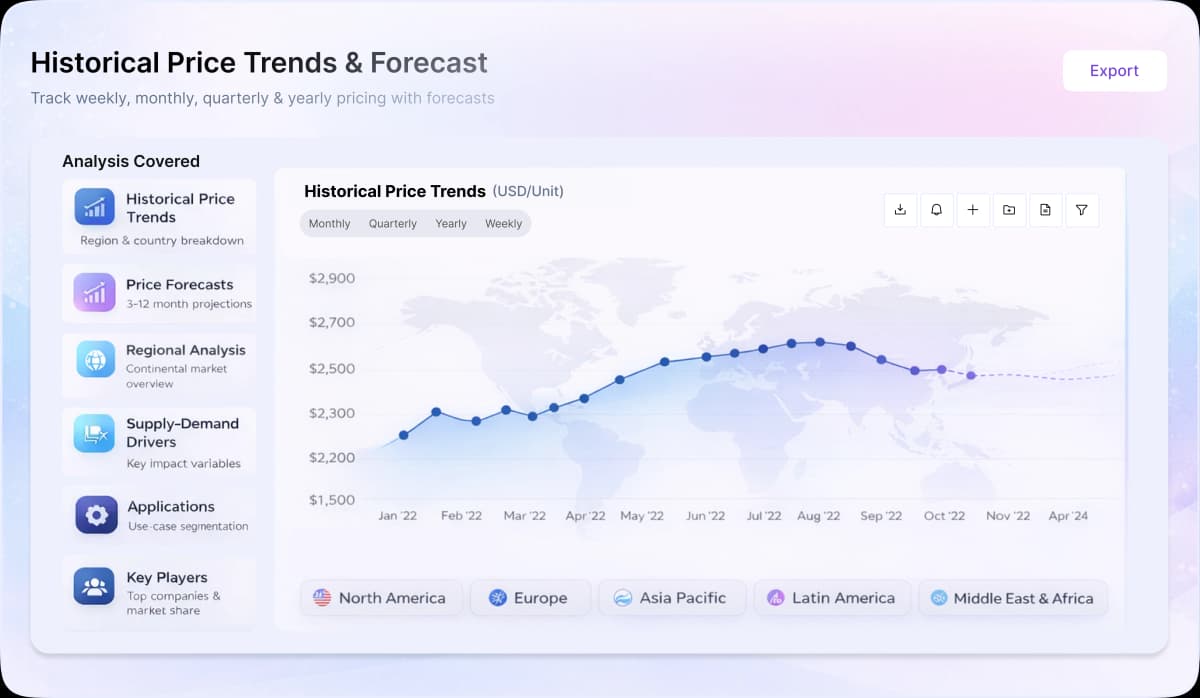
Price Trend Dashboard - What's Included
Price trends across a diverse portfolio of categories and products, spanning board to niche chemicals
Coverage extendable to grade-specific chemicals based on procurement requirements
Regular price tracking supported by robust historical datasets
News, policy updates, and key market drivers impacting price movements
Short-term and long-term price outlooks and forecasts
Supply-demand dynamics and capacity-driven market analysis