Prakhar Panchbhaiya
Assistant Manager: Business Insights and Content
Supporting procurement teams with category intelligence, market research, price trends, supply-demand analysis, and strategic sourcing insights across key industries.

In 2025, the price of Paprika Oleoresin (ORP) increased significantly due to a combination of supply and trade challenges. A new U.S. antidumping and countervailing duty case targeting Indian imports created uncertainty for importers, making costs unpredictable.
Companies that relied on Indian ORP faced the risk of additional duties, which put pressure on supply chains and contributed to rising prices. At the same time, global production issues added to the strain. Hungary, a key producer of paprika, experienced economic problems and lower harvests, while India, another major supplier, faced potential tariffs and trade uncertainties.
Weather conditions, including unpredictable rainfall and higher costs for labor and transportation, also affected paprika harvests, reducing available supply. Importers and specialty food companies struggled to secure consistent quantities, which further pushed prices upward.
The combined effect of these factors led to a noticeable increase in the cost of Paprika Oleoresin throughout the year. Market participants had to navigate both regulatory and environmental pressures while meeting demand for this widely used spice.
Related Report
Need Latest Paprika Oleoresin Prices?
Get real-time price assessments, periodic trends, forecasts and price driver insights across key global markets.
Our Clients































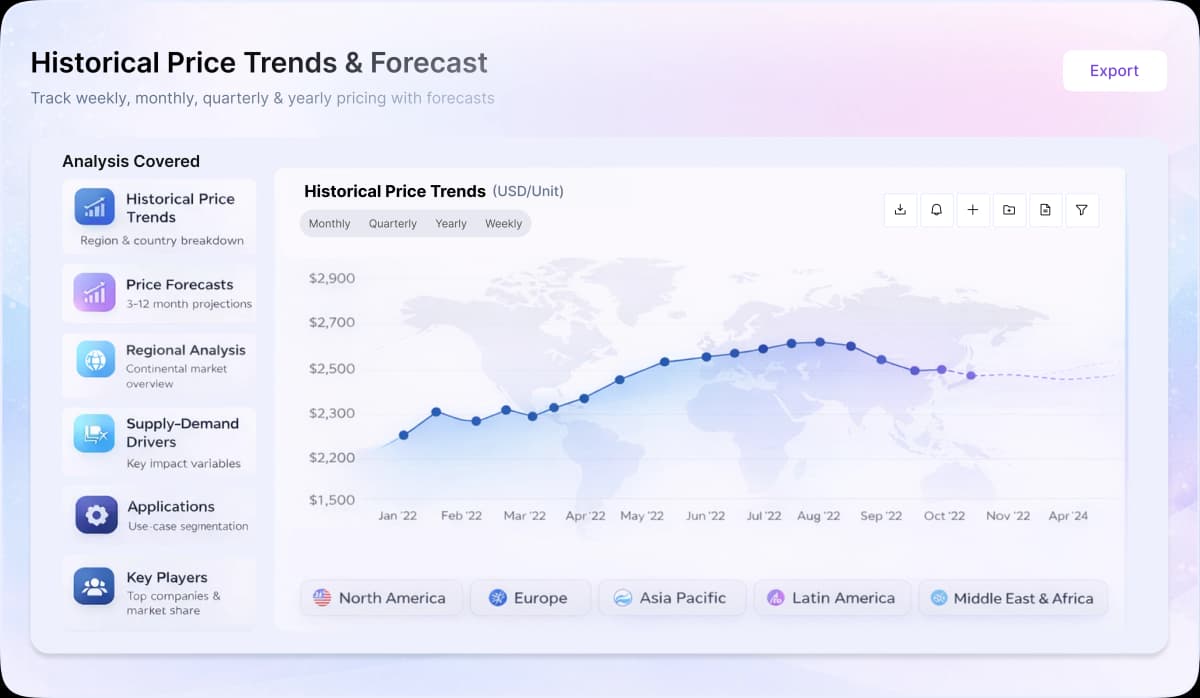
Turn price intelligence into action with the Procurement Resource Database. Log in or subscribe to unlock live price trends, historical charts, supplier databases, cost curves, and analyst-backed insights across chemicals, agriculture, energy, packaging, and more. Use these tools to benchmark your contracts, plan budgets with confidence, and stay ahead of market moves on every product you buy.
0
+Products
0
+Regions
0
+Subscriptions
The prices of Paprika Oleoresin followed a fluctuating trajectory in H2’24, closely aligning with the trends of its primary feedstock, paprika peppers. Extracted from paprika peppers, Paprika Oleoresin imparts a spicy flavor to food and is widely used in culinary and food processing industries. However, the limited availability of high-quality paprika varieties posed challenges for downstream sectors. In India, severe weather conditions and heavy monsoon rains significantly impacted paprika cultivation, necessitating replantation in certain areas. While medium-grade paprika remained readily available, the supply of IPM-grade paprika was constrained.
Globally, variable production outputs in China affected trade flows to key importers such as Spain and the United States. In Mexico and South Africa, reduced export volumes due to fluctuations in paprika harvests added pressure on global prices. These combined factors contributed to price fluctuations in Paprika Oleoresin, with notable regional variations.
Paprika Oleoresin, a reddish viscous liquid, is known as an oil-soluble extract derived from the fruits of Capsicum annuum or Capsicum frutescens. It is mainly utilised as a colouring and/or flavouring agent in food products. The product is much milder as compared to capsicum oleoresin, usually containing no capsaicin at all.
Spice, Flavouring, Colouring
Oleoresin paprika, 84625-29-6, Paprika extract, Paprika colour
Synthite Industries Ltd, Akay Group Ltd, Plant Lipids, Universal Oleoresins, BOS Natural Flavours (P) Limited
CurrencyUS$ (Data can also be provided in local currency)
Supplier Database AvailabilityYes
Customization ScopeThe report can be customized as per the requirements of the customer
Post-Sale Analyst Support360-degree analyst support after report delivery
Note: Our supplier search experts can assist your procurement teams in compiling and validating a list of suppliers indicating they have products, services, and capabilities that meet your company's needs.
It is manufactured by solvent extraction of the dried capsicum pods. Moreover, the extraction takes place by percolating volatile solvents like Hexane via dried paprika, followed by the removal of solvent traces.
Our Price Analysis Methodology
Assistant Manager: Business Insights and Content
Supporting procurement teams with category intelligence, market research, price trends, supply-demand analysis, and strategic sourcing insights across key industries.
Experience how Procurement Resource transforms raw material price data into clear, decision ready intelligence. Optimise your performance with reliable, expert market data and analysis. Schedule your demo today to experience a live walk-through where our experts will showcase interactive price charts, forecasted prices, and insights driving the prices for your key commodities, tailored to your workflows. Contact us now!
Our Team will be happy to assist you
We are just a text away
Still Need Help?
This report provides the cost structure of paprika oleoresin production by the extraction process. The extraction is done by percolation of the volatile solvent such as hexane through dried paprika.
Unlock full access to Procurement Resource's price databases, interactive charts, and short-term forecasts for thousands of commodities. Elevate your sourcing decisions by comparing prices across regions, downloading historical data, and layering in analyst-backed insights, all with our flexible plans that scale as your portfolio grows.
Still have any Questions
Contact Us



Price Trend Dashboard - What's Included
Price trends across a diverse portfolio of categories and products, spanning board to niche chemicals
Coverage extendable to grade-specific chemicals based on procurement requirements
Regular price tracking supported by robust historical datasets
News, policy updates, and key market drivers impacting price movements
Short-term and long-term price outlooks and forecasts
Supply–demand dynamics and capacity-driven market analysis

Track prices, market movements, supply-demand dynamics, and industry developments across hundreds of commodities through a centralized intelligence platform built for informed procurement decisions.

Understand market fluctuations using analyst-backed forecasts, historical pricing patterns, and evolving industry trends to strengthen sourcing strategies and budget planning.

Leverage cost models, pricing benchmarks, and procurement insights to evaluate purchasing opportunities, improve negotiations, and enhance operational efficiency.
Access region-specific price trends, trade activities, capacity changes, and supply chain developments influencing commodity markets worldwide.