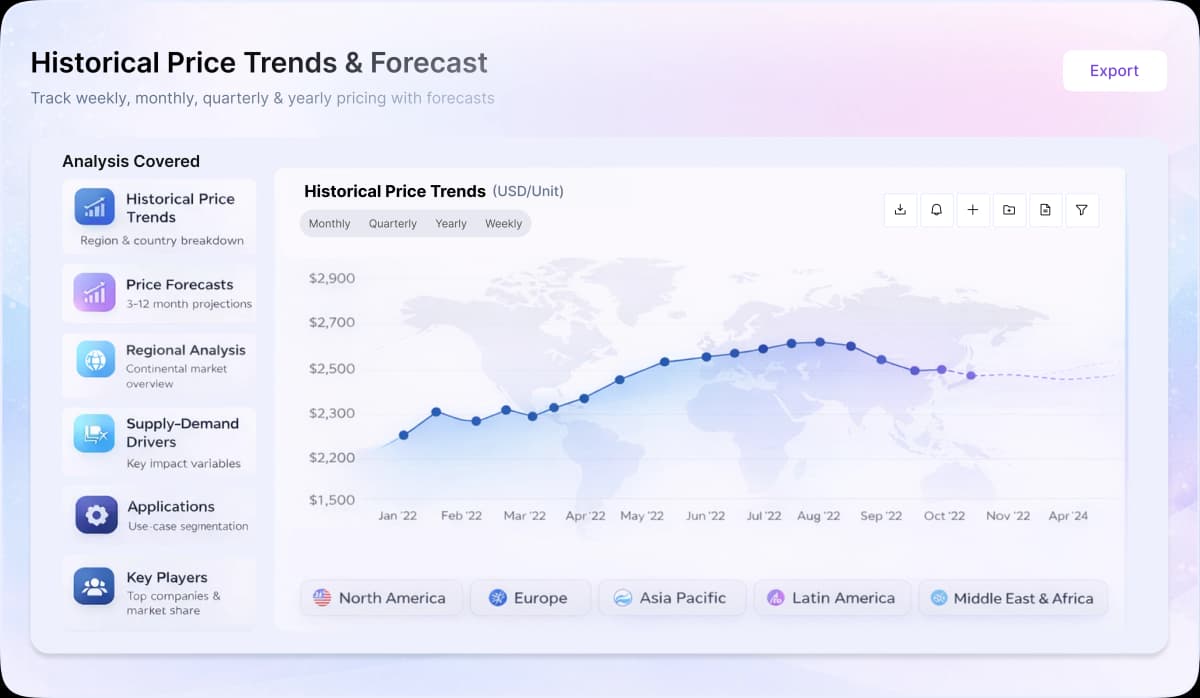
Pectin Price Trend Analysis 2026: Latest News, Price Drivers, Supply Demand Analysis, Historical Prices & Market Insights

Siddharth David profile photo
Written BySiddharth David

Procurement Resource Database

Laptop screen

Turn price intelligence into action with the Procurement Resource Database. Log in or subscribe to unlock live price trends, historical charts, supplier databases, cost curves, and analyst-backed insights across chemicals, agriculture, energy, packaging, and more. Use these tools to benchmark your contracts, plan budgets with confidence, and stay ahead of market moves on every product you buy.

0

+

Products

0

+

Regions

0

+

Subscriptions

About Pectin

Pectin is a natural polysaccharide found in the cell walls of fruits and vegetables, playing a crucial role in maintaining their structure. It is commonly used as a gelling agent in food production, particularly in jams, jellies, and fruit preserves, due to its ability to form a gel when combined with sugar and acid. Pectin is also valued for its health benefits, as it can aid digestion, lower cholesterol levels, and stabilize blood sugar. Additionally, it is often used in dietary supplements for its prebiotic properties.

Pectin Product Detail

HS Code
13022000
Chemical Formula

C6H12O6

CAS Number
9000-69-5
Industrial Uses

Food Industry (thickening and gelling agent), Confectionery (jams and jellies), Dairy Products (yogurts and desserts), Beverages (fruit juices and smoothies), Bakery Products (glazes and fillings), Nutraceuticals (dietary supplements), Pharmaceuticals (stabilizer and excipient), Cosmetics (emulsifier and thickener)

Supplier Database

Cargill Incorporated, Royal DSM, Herbstreith and Fox Corporate Group, International Flavors & Fragrances, JM Huber Corporation

Regional Coverage

Asia Pacific

China, India, Indonesia, Pakistan, Bangladesh, Japan, Philippines, Vietnam, Iran, Thailand, South Korea, Iraq, Saudi Arabia, Malaysia, Nepal, Taiwan, Sri Lanka, UAE, Israel, Hongkong, Singapore, Oman, Kuwait, Qatar, Australia, and New Zealand

Europe

Germany, France, United Kingdom, Italy,Spain, Russia, Turkey, Netherlands, Poland, Sweden, Belgium, Austria, Ireland Switzerland, Norway, Denmark, Romania, Finland, Czech Republic, Portugal and Greece

North America

United States and Canada

Latin America

Brazil, Mexico, Argentina, Columbia, Chile, Ecuador, and Peru

Africa

South Africa, Nigeria, Egypt, Algeria, Morocco

CurrencyUS$ (Data can also be provided in local currency)

Supplier Database AvailabilityYes

Customization ScopeThe report can be customized as per the requirements of the customer

Post-Sale Analyst Support360-degree analyst support after report delivery

Note: Our supplier search experts can assist your procurement teams in compiling and validating a list of suppliers indicating they have products, services, and capabilities that meet your company's needs.

Pectin Production Processes

Pectin Production by acid extraction method. The preparation of pectin, an organic compound, is carried out by the acid extraction method. In this process, raw materials such as apple pomace and citrus peels are treated within an acidic medium. Acids such as sulfuric acid or hydrochloric acid are used to extract the resultant from the organic wastes in the form of precipitates and later filtered to obtain pectin as the final product.

Frequently Asked Questions

Pectin prices are expected to remain stable in the near term, with neither supply disruptions nor demand surges anticipated to shift pricing direction. Demand is driven by food processing activity, consumer packaged goods output, and downstream food and beverage consumption across jams, jellies, confectionery, bakery, and dairy applications. Supply depends on feedstock availability from citrus peel and apple pomace, with consistent processing activity maintaining range-bound pricing unless feedstock or consumption patterns change materially.

Pectin prices are shaped by feedstock availability and downstream demand. Citrus peel and apple pomace supply, which depends on fruit-processing output, sets raw material costs, while acid and energy inputs add to extraction expenses. On the demand side, the shift toward clean-label and plant-based formulations supports pectin consumption in confectionery, bakery, dairy and fruit preparations. When fruit-processing volumes are tight or food production runs rise, prices firm; ample peel supply and softer buying ease them.

Pectin production is led by Cargill, CP Kelco, Herbstreith & Fox, Ceamsa, and Yantai Andre Pectin, with manufacturing concentrated in Europe, the Americas, and China. Major consuming regions include Asia Pacific, Europe, and North America. Derived from citrus peels and apple pomace, which are by-products of the juice and cider industries, supply is tied to fruit processing output, making the fruit-processing belts of Europe, the Americas, and Asia critical to availability.

Pectin is sourced from fruit-processing byproducts: apple pomace and citrus peels serve as the primary raw materials, with sulfuric acid or hydrochloric acid used as processing agents. In the acid extraction method, these feedstocks are treated in an acidic medium to dissolve pectin, which is then filtered and precipitated to yield the final product. The finished pectin is used as a gelling and thickening agent in jams, jellies, dairy products, beverages, and bakery items, and also serves pharmaceutical and cosmetic applications.

Pectin demand is driven primarily by the confectionery, dairy, beverages, and bakery sectors. In confectionery, it is essential for jams and jellies as a gelling agent. Dairy processors use it to stabilise yogurts and desserts, while beverage makers rely on it for texture in fruit juices and smoothies. Bakery applications include glazes and fillings. As pectin functions as a stabiliser, emulsifier and thickener, demand from these food segments translates directly into procurement volume, with higher production runs in any of these categories tightening supply and supporting firmer pricing.

Pectin supply follows the seasonality of citrus and apple processing, since peel and pomace are by-products of juice and cider production. A poor fruit harvest or lower juice output reduces peel availability and lifts raw material costs, while ample processing volumes ease them. Acid, alcohol and energy used in extraction and precipitation add to input costs. These seasonal and cost shifts pass through to producer offers, and food manufacturers with steady demand for gelling agents absorb them through contract adjustments.

Our Price Analysis Methodology

About the Author

Siddharth David profile photo

Siddharth David

Manager - Market Research

Delivering market research and procurement intelligence at Procurement Resource with a focus on economic forecasting, commodity analysis, and client advisory to help sourcing teams make data-backed purchasing decisions.

Schedule Demo

Schedule A Demo

Experience how Procurement Resource transforms raw material price data into clear, decision ready intelligence. Optimise your performance with reliable, expert market data and analysis. Schedule your demo today to experience a live walk-through where our experts will showcase interactive price charts, forecasted prices, and insights driving the prices for your key commodities, tailored to your workflows. Contact us now!


Our Team will be happy to assist you

We are just a text away

+1

Still Need Help?

Europe & Africa

+44 7573 171117

[email protected]

USA & Canada

+1 254 254 1750

[email protected]

APAC

+91 8850629517

[email protected]

Unlock full access to Procurement Resource's price databases, interactive charts, and short-term forecasts for thousands of commodities. Elevate your sourcing decisions by comparing prices across regions, downloading historical data, and layering in analyst-backed insights, all with our flexible plans that scale as your portfolio grows.

Still have any Questions

Contact Us
Mastercard
Wire
VISA
Stripe

Why Procurement Database

Commodity Market Intelligence

Commodity Market Intelligence

Track prices, market movements, supply-demand dynamics, and industry developments across hundreds of commodities through a centralized intelligence platform built for informed procurement decisions.

Price Forecasts & Market Outlooks

Price Forecasts & Market Outlooks

Understand market fluctuations using analyst-backed forecasts, historical pricing patterns, and evolving industry trends to strengthen sourcing strategies and budget planning.

Cost & Procurement Optimization

Cost & Procurement Optimization

Leverage cost models, pricing benchmarks, and procurement insights to evaluate purchasing opportunities, improve negotiations, and enhance operational efficiency.

Global & Regional Market Insights

Global & Regional Market Insights

Access region-specific price trends, trade activities, capacity changes, and supply chain developments influencing commodity markets worldwide.

1/4