Need latest Polyhydroxy Butyrate (PHB) prices?
Get real-time price assessments, periodic trends, forecasts and price driver insights across key global markets.
Unlock Price Insights NowOur Clients
During the first half of 2025 (H1'25), Polyhydroxybutyrate (PHB) prices showed a steady to slightly firm trend, influenced by both upstream cost dynamics and evolving demand in the bio-based plastics market. PHB, being a biodegradable bioplastic, saw growing interest from sectors seeking sustainable alternatives, especially in packaging and agriculture.
One of the key cost drivers for PHB is biomass-based feedstock. The launch of Compact Syngas Solutions’ bioenergy project in Kenya marked a significant development. Their use of agricultural waste like tea prunings to generate syngas and biochar may have supported cost competitiveness in PHB production, particularly in regions investing in similar gasification or biomass valorization technologies. While this didn’t immediately shift global PHB supply chains, it contributed to a more optimistic market sentiment for sustainable input sources.
Meanwhile, global biofuel and e-fuel activity saw an uptick, particularly in Europe. Projects like Spark e-Fuels and Norsk e-Fuel focused on synthetic fuel production using green hydrogen and CO2. This expansion in demand for bio-feedstocks and hydrogen indirectly influenced competition for renewable carbon sources, adding modest upward pressure on PHB production costs, especially in Europe.
Additionally, government interventions in crops like sugarcane in India raising the fair price for the next season indicated growing support for bioeconomy-linked agriculture, possibly encouraging PHB producers to secure long-term raw material contracts.
Analyst Insight
According to Procurement Resource, PHB prices are expected to stay stable with a slight bullish bias, supported by increasing bioplastics demand and tightening focus on fossil-free supply chains.
Related Report
Get real-time price assessments, periodic trends, forecasts and price driver insights across key global markets.
Unlock Price Insights NowOur Clients

Turn price intelligence into action with the Procurement Resource Database. Log in or subscribe to unlock live price trends, historical charts, supplier databases, cost curves, and analyst-backed insights across chemicals, agriculture, energy, packaging, and more. Use these tools to benchmark your contracts, plan budgets with confidence, and stay ahead of market moves on every product you buy.

0
+Products
0
+Regions
0
+Subscriptions
Polyhydroxy Butyrate (PHB) is a biodegradable polymer produced by microorganisms, offering a range of eco-friendly applications in packaging, agriculture, and healthcare. Its natural breakdown process makes it a desirable option for companies seeking to reduce their carbon footprint. PHB is commonly used for biodegradable films and containers in packaging, as well as for sustainable agricultural films and medical implants.
In 2024, the packaging sector experienced increased demand for PHB. The growth of e-commerce contributed to this trend, as businesses sought sustainable packaging materials. As online shopping became more prevalent, PHB and other biodegradable materials gained popularity due to their natural decomposition capabilities, which leave no harmful residues. Companies aiming to reduce plastic waste found PHB an attractive choice.
However, the PHB market faced challenges in 2024. PHB production was affected by delays in agricultural production caused by severe weather conditions, impacting the availability of raw materials like sugarcane bagasse. These delays led to price fluctuations, as supply chain issues made it difficult for manufacturers to stabilize PHB prices. Despite these challenges, demand continued to rise while market prices fluctuated due to the reliance on agricultural yields.
Polyhydroxy Butyrate (PHB) is a thermoplastic polyester which can be easily thermoformed. It is a biopolymer that can be decomposed naturally like other organic wastes. PHB is a biopolymer obtained from certain microorganisms due to carbon assimilation (from glucose and starch). The most common type of polyhydroxy butyrate is poly-3-hydroxybutyrate or P3HB. PHB has many industrial applications due to its biocompatible nature, high tensile strength, and good resistance to UV light.
(C4H6O2)n
Pharmaceuticals, Drug delivery, Food Packaging, Plastic Tableware
PHB, Poly[oxy(1-methyl-3-oxo-1,3-propanediyl)], (R,S)-ß-butyrolactone homopolymer
Kaneka Corporation, Biome Technologies PLC, BASF SE, PolyFerm Canada, Tianjin GreenBio Materials Co., Ltd
CurrencyUS$ (Data can also be provided in local currency)
Supplier Database AvailabilityYes
Customization ScopeThe report can be customized as per the requirements of the customer
Post-Sale Analyst Support360-degree analyst support after report delivery
Note: Our supplier search experts can assist your procurement teams in compiling and validating a list of suppliers indicating they have products, services, and capabilities that meet your company's needs.
In this process, gasification of products like switchgrass and sugarcane bagasse to synthesis gas (syngas) takes place, which is fermented to PHB. The syngas containing CO2 and H2 are the critical sources for microorganisms like Ralstonia eutropha to produce PHB.
Our Price Analysis Methodology

Experience how Procurement Resource transforms raw material price data into clear, decision ready intelligence. Optimise your performance with reliable, expert market data and analysis. Schedule your demo today to experience a live walk-through where our experts will showcase interactive price charts, forecasted prices, and insights driving the prices for your key commodities, tailored to your workflows. Contact us now!


Our Team will be happy to assist you
We are just a text away
Still Need Help ?
Unlock full access to Procurement Resource's price databases, interactive charts, and short-term forecasts for thousands of commodities. Elevate your sourcing decisions by comparing prices across regions, downloading historical data, and layering in analyst-backed insights, all with our flexible plans that scale as your portfolio grows.
Still have any Questions
Contact Us


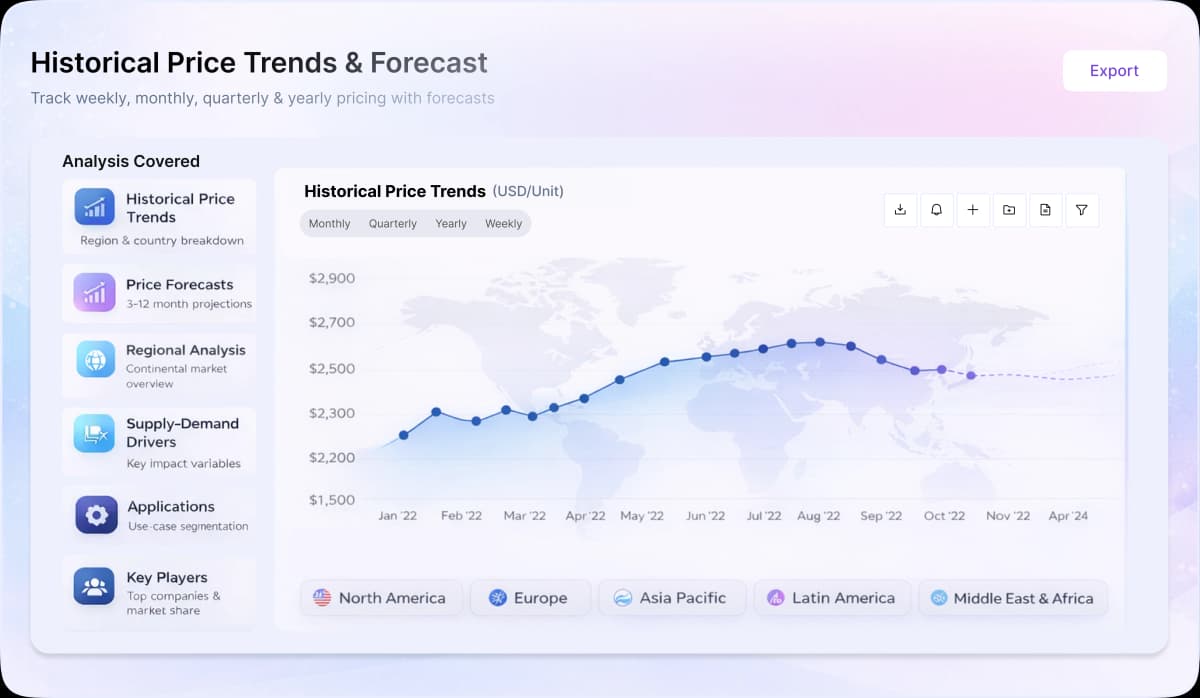
Price Trend Dashboard - What's Included
Price trends across a diverse portfolio of categories and products, spanning board to niche chemicals
Coverage extendable to grade-specific chemicals based on procurement requirements
Regular price tracking supported by robust historical datasets
News, policy updates, and key market drivers impacting price movements
Short-term and long-term price outlooks and forecasts
Supply–demand dynamics and capacity-driven market analysis