Udeesha Tomar
AVP - Strategy and Solutions
Leading procurement research solutions across chemicals, materials, and food & beverages, with expertise in price forecasting and market analytics.
| Product | Region | Incoterm Basis | Price | Time Period |
|---|---|---|---|---|
| Polyol | China | FOB | USD 4,196.76/MT | April 2026 |
| Polyol | USA | FOB | USD 4,283.76/MT | April 2026 |
| Polyol | Germany | FOB | USD 4,322.76/MT | April 2026 |
| Polyol | India | CIF | USD 4,246.76/MT | April 2026 |
| Polyol | Japan | CIF | USD 4,238.76/MT | April 2026 |
| Polyol | China | FOB | USD 4,177.00/MT | March 2026 |
| Polyol | USA | FOB | USD 4,264.00/MT | March 2026 |
| Polyol | Germany | FOB | USD 4,259.00/MT | March 2026 |
| Polyol | India | CIF | USD 4,233.00/MT | March 2026 |
| Polyol | Japan | CIF | USD 4,213.00/MT | March 2026 |
Stay updated with the latest Polyol prices, historical data, and tailored regional analysis
During Q1’26, polyol prices in Asia moved upward in line with stronger feedstock market conditions and rising production costs. In China, the market strengthened during January as downstream polyurethane and foam manufacturers increased procurement ahead of the Lunar New Year holidays. Elevated crude linked feedstock costs and post-holiday restocking activity continued supporting the market in February, although sufficient supply and weaker downstream buying later softened momentum temporarily. By March, geopolitical uncertainty and disruptions linked to Middle East tensions increased upstream cost pressure and logistics expenses, resulting in firmer producer pricing strategies. Trade flows across Asia also faced higher freight and insurance costs due to Strait of Hormuz disruptions, tightening regional supply conditions and increasing landed costs for imported materials.
Analyst Insight
According to Procurement Resource, polyol prices are expected to remain firm due to sustained upstream cost support and controlled producer inventories, although cautious downstream demand may limit stronger upward momentum in the coming quarter.
Related Report
Get real-time price assessments, periodic trends, forecasts and price driver insights across key global markets.
Unlock Price Insights NowOur Clients

Turn price intelligence into action with the Procurement Resource Database. Log in or subscribe to unlock live price trends, historical charts, supplier databases, cost curves, and analyst-backed insights across chemicals, agriculture, energy, packaging, and more. Use these tools to benchmark your contracts, plan budgets with confidence, and stay ahead of market moves on every product you buy.

0
+Products
0
+Regions
0
+Subscriptions
The Polyol market experienced a predominantly downward trajectory throughout 2025, influenced by feedstock cost dynamics and evolving demand patterns across key downstream applications. The year commenced with prices at elevated levels during the first quarter, supported by initial firmness in adipic acid costs and steady consumption from polyurethane foam, coatings, and adhesive manufacturing sectors. Prices continued their descent through the second quarter, reaching lower levels as the market adjusted to reduced procurement activity from the furniture, automotive, and construction industries. Polyurethane flexible foam manufacturers adopted cautious buying strategies amid an uncertain demand outlook, while rigid foam producers for insulation applications maintained measured consumption. The feedstock cost relief provided some margin support for polyol producers, though weak end-market conditions limited any meaningful price recovery.
The second half witnessed range-bound fluctuations at lower price levels compared to the year's opening. The third quarter saw prices oscillating within a narrow band as supply and demand found temporary equilibrium. However, the fourth quarter brought renewed weakness as market sentiment deteriorated further. Demand from bedding, automotive seating, and construction insulation applications remained subdued, while inventory levels stayed adequate across the supply chain. By year-end, prices had declined significantly from their early-year peaks, reflecting softer fundamentals throughout the polyol value chain.
Polyol, a type of sugar alcohol, is a versatile compound widely used in the production of polyurethane foams, both flexible and rigid, which are essential for automotive seats, mattresses, and thermal insulation. In the pharmaceutical industry, polyols serve as excipients and sweeteners. They are also prevalent in food products, offering sweetness with lower caloric content than traditional sugars. Additionally, polyols are used in personal care products, adhesives, and surface coatings, valued for their hygroscopic and non-toxic properties.


(C3H6O)nH2O
Flexible Foam Production, Rigid Foam Insulation, Pharmaceutical Formulations, Food Industry as Sweeteners, Personal Care Products, Adhesives and Sealants, Surface Coatings
The Dow Chemical Company, BASF SE, Covestro AG, Huntsman Corporation, Shell Chemicals
CurrencyUS$ (Data can also be provided in local currency)
Supplier Database AvailabilityYes
Customization ScopeThe report can be customized as per the requirements of the customer
Post-Sale Analyst Support360-degree analyst support after report delivery
Note: Our supplier search experts can assist your procurement teams in compiling and validating a list of suppliers indicating they have products, services, and capabilities that meet your company's needs.
The multifunctional carboxylic acids can be adipic acid, phthalic acid, succinic acid, or maleic acid, and the polyhydroxyl compounds such as ethylene glycol, propylene glycol, or 1,4- butanediol. The manufacturing process of polyol (polyester polyol) involves the condensation reaction of multifunctional carboxylic acids and polyhydroxyl compounds. This condensation reaction is conducted under controlled conditions which proceeds through an esterification reaction that facilitates the formation of polyester chains and the release of water as a byproduct. After which the final product polyol (polyester polyol) is obtained.

AVP - Strategy and Solutions
Leading procurement research solutions across chemicals, materials, and food & beverages, with expertise in price forecasting and market analytics.
Our Price Analysis Methodology

Experience how Procurement Resource transforms raw material price data into clear, decision ready intelligence. Optimise your performance with reliable, expert market data and analysis. Schedule your demo today to experience a live walk-through where our experts will showcase interactive price charts, forecasted prices, and insights driving the prices for your key commodities, tailored to your workflows. Contact us now!
Our Team will be happy to assist you
We are just a text away
Still Need Help?
Unlock full access to Procurement Resource's price databases, interactive charts, and short-term forecasts for thousands of commodities. Elevate your sourcing decisions by comparing prices across regions, downloading historical data, and layering in analyst-backed insights, all with our flexible plans that scale as your portfolio grows.
Still have any Questions
Contact Us


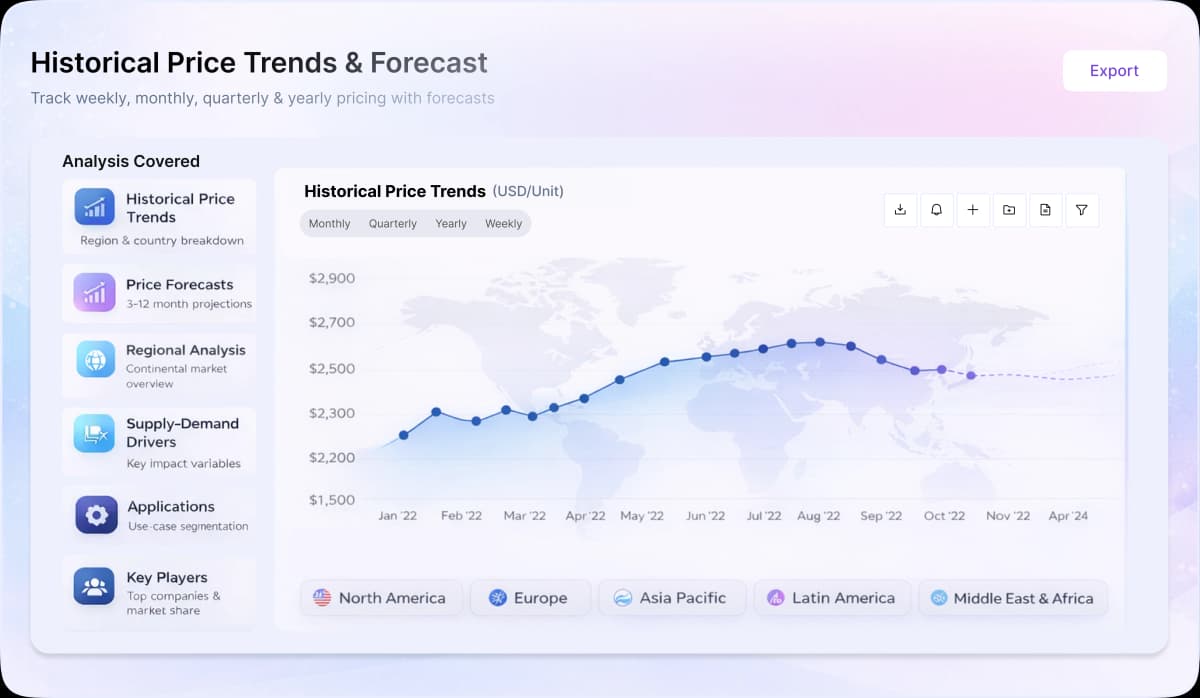
Price Trend Dashboard - What's Included
Price trends across a diverse portfolio of categories and products, spanning board to niche chemicals
Coverage extendable to grade-specific chemicals based on procurement requirements
Regular price tracking supported by robust historical datasets
News, policy updates, and key market drivers impacting price movements
Short-term and long-term price outlooks and forecasts
Supply-demand dynamics and capacity-driven market analysis