Udeesha Tomar
AVP - Strategy and Solutions
Leading procurement research solutions across chemicals, materials, and food & beverages, with expertise in price forecasting and market analytics.
Asia
In Asia, POP prices showed a mixed trend during the first half of 2025. Prices were mostly stable in the early part of Q1, even with temporary supply disruptions caused by a power outage at a major South Korean facility. In April, prices rose slightly as several plants underwent maintenance, tightening supply across the region. At the same time, feedstock costs increased, which added pressure on pricing.
Automotive demand continued to offer some support, particularly in key markets like China. However, demand from other sectors such as construction and general manufacturing remained slow, limiting overall market momentum. Even though shipping conditions improved, that alone wasn't enough to spark stronger buying interest.
Europe
European POP prices declined early in the year due to weak demand, especially from the construction industry. The automotive sector remained subdued as well, despite a slight improvement in March. Lower ethylene prices and cautious purchasing behaviour led to softer spot pricing through Q1.
However, by Q2, prices began to edge up, supported by firmer ethylene costs, tighter production schedules, and better logistics. Still, broader demand remained restrained due to ongoing inflation and uncertain economic conditions. Although there were signs of mild recovery in packaging and electrical applications, buyers remained conservative in their procurement strategies.
North America
In North America, POP prices softened slightly during H1’25. Supply remained steady due to stable feedstock availability, but logistics issues like port congestion and proposed increases in shipping fees created uncertainty across the supply chain. While the automotive and construction sectors showed moderate demand, it wasn’t strong enough to lift overall market sentiment.
Rising logistical costs further dampened supplier confidence and pushed prices down in April. In addition, high borrowing costs and cautious consumer spending led to reduced activity in packaging and consumer goods, contributing to a quieter market.
Analyst Insight
According to Procurement Resource, Polyolefin Plastomer (POP) prices are likely to remain stable in the near term unless there’s a noticeable rebound in demand or a significant improvement in logistics conditions.
Related Report
Get real-time price assessments, periodic trends, forecasts and price driver insights across key global markets.
Unlock Price Insights NowOur Clients

Turn price intelligence into action with the Procurement Resource Database. Log in or subscribe to unlock live price trends, historical charts, supplier databases, cost curves, and analyst-backed insights across chemicals, agriculture, energy, packaging, and more. Use these tools to benchmark your contracts, plan budgets with confidence, and stay ahead of market moves on every product you buy.

0
+Products
0
+Regions
0
+Subscriptions
Asia
In Asia, POP prices saw a slight downward trend during the fourth quarter of 2024. The market remained well-supplied, with import levels staying stable throughout the period. Demand was mixed across sectors. The automotive industry, especially in China, showed strong performance toward the end of the year, which helped support POP demand to some extent.
However, sluggish activity in the construction sector and only moderate demand from packaging and consumer goods put some pressure on overall consumption. Smooth logistics helped keep supply chains efficient, but global trade uncertainties and cautious buyer behaviour limited any chance for price improvement. As a result, the market remained steady but under mild downward pressure.
Europe
POP prices in Europe moved lower over Q4’24 due to soft demand and falling input costs. Ethylene, a key raw material, became cheaper, which reduced production costs for POP manufacturers. Supply was steady, and improved logistics helped ensure consistent product availability. However, economic challenges and regional political issues led to weak buyer sentiment.
The automotive market was inconsistent, and construction activities remained subdued across many countries. These factors combined to keep demand on the lower side, encouraging a cautious market tone and contributing to a gradual price decline over the quarter.
North America
In North America, POP prices declined slightly in the last quarter of 2024. The market saw weaker demand from the construction and packaging sectors, which outweighed the positive contribution from steady automotive sales late in the year. Supply remained balanced, with producers managing inventory carefully.
While some logistical issues persisted, they didn’t cause major supply disruptions. The overall market tone stayed cautious, with limited buying activity putting downward pressure on prices, although sharp declines were avoided.
Polyolefin plastomer combines the qualities of plastics and elastomers and belongs to the same family as polyethylene and polypropylene. The unique combination of flexibility, toughness, and processability that polyolefin plastomers possess makes them ideal for applications requiring elasticity, sealing, and impact resistance. They are valuable in sectors including packaging, automotive, and consumer products because they have a semi-crystalline structure and perform better than traditional elastomers.

Packaging, Toys and sports equipment, Automotive industry, Adhesives and sealants, Wires and cables
Dow, Mitsui Chemical, ExxonMobil Chemical, SABIC SK Nexlene Company, LG Chemical
CurrencyUS$ (Data can also be provided in local currency)
Supplier Database AvailabilityYes
Customization ScopeThe report can be customized as per the requirements of the customer
Post-Sale Analyst Support360-degree analyst support after report delivery
Note: Our supplier search experts can assist your procurement teams in compiling and validating a list of suppliers indicating they have products, services, and capabilities that meet your company's needs.
In this process, the monomers such as but-1-ene, oct-1-ene, hex-1-ene, etc., in the presence of metallocene catalyst polymerizes. The ratio of monomers decides whether the polymer will be a polyolefin elastomer or polyolefin plastomer.

AVP - Strategy and Solutions
Leading procurement research solutions across chemicals, materials, and food & beverages, with expertise in price forecasting and market analytics.
Our Price Analysis Methodology

Experience how Procurement Resource transforms raw material price data into clear, decision ready intelligence. Optimise your performance with reliable, expert market data and analysis. Schedule your demo today to experience a live walk-through where our experts will showcase interactive price charts, forecasted prices, and insights driving the prices for your key commodities, tailored to your workflows. Contact us now!
Our Team will be happy to assist you
We are just a text away
Still Need Help?
Unlock full access to Procurement Resource's price databases, interactive charts, and short-term forecasts for thousands of commodities. Elevate your sourcing decisions by comparing prices across regions, downloading historical data, and layering in analyst-backed insights, all with our flexible plans that scale as your portfolio grows.
Still have any Questions
Contact Us


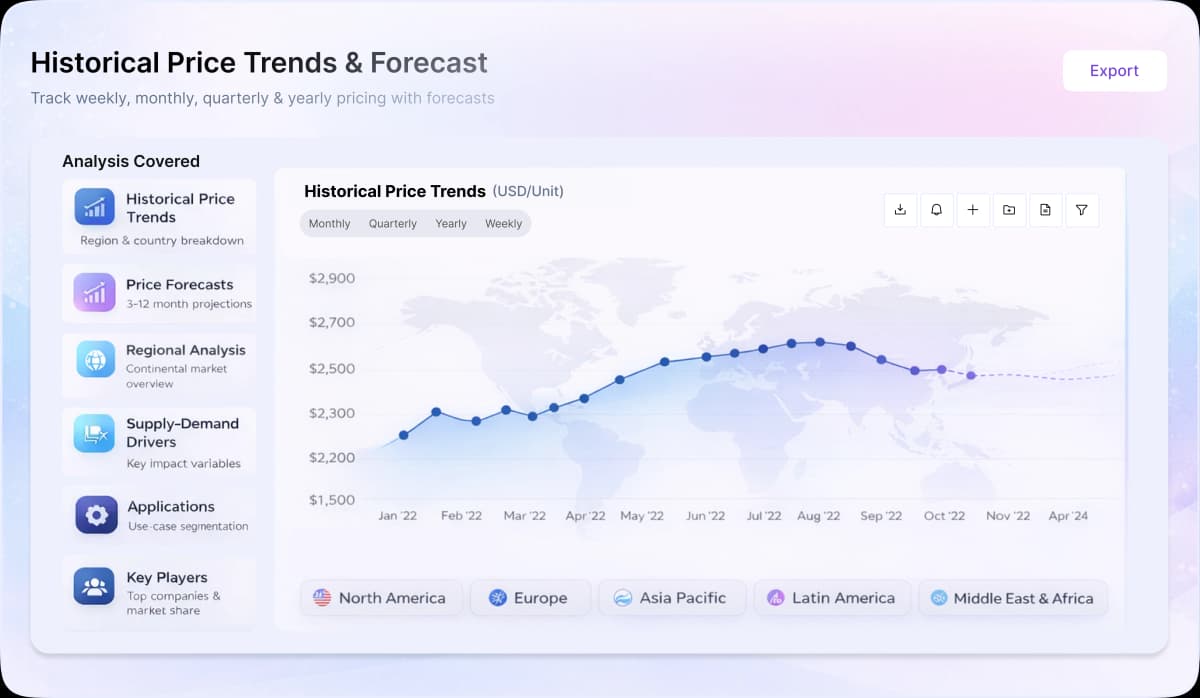
Price Trend Dashboard - What's Included
Price trends across a diverse portfolio of categories and products, spanning board to niche chemicals
Coverage extendable to grade-specific chemicals based on procurement requirements
Regular price tracking supported by robust historical datasets
News, policy updates, and key market drivers impacting price movements
Short-term and long-term price outlooks and forecasts
Supply-demand dynamics and capacity-driven market analysis