Polypropylene Glass Filled (PPGF) Price Trend Analysis 2026: Market Insights, Historical Prices, Supply Demand Analysis, Price Drivers & Latest News

Udeesha Tomar profile photo
Written ByUdeesha Tomar

Procurement Resource Database

Laptop screen

Turn price intelligence into action with the Procurement Resource Database. Log in or subscribe to unlock live price trends, historical charts, supplier databases, cost curves, and analyst-backed insights across chemicals, agriculture, energy, packaging, and more. Use these tools to benchmark your contracts, plan budgets with confidence, and stay ahead of market moves on every product you buy.

0

+

Products

0

+

Regions

0

+

Subscriptions

Product Category Region Price Last Updated Month
Polypropylene (glass filled) Packaging United Kingdom 1705 USD/MT July 2024
Polypropylene (glass filled) Packaging United Kingdom 1668 USD/MT December 2024

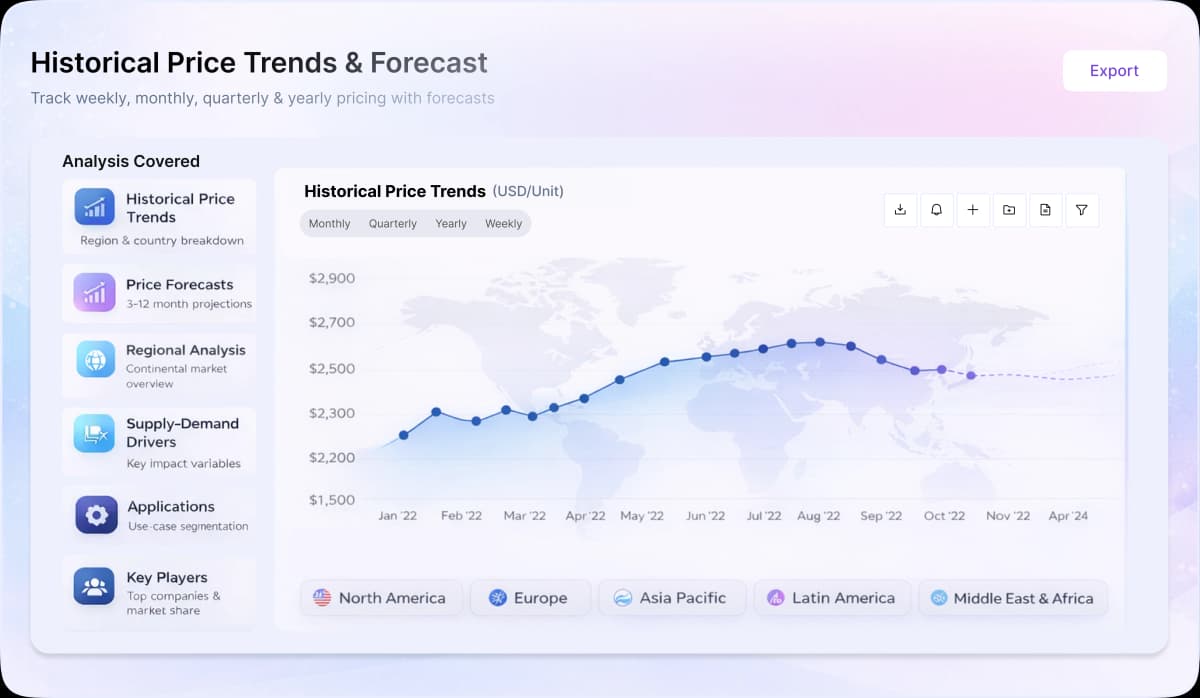
Stay updated with the latest Polypropylene (Glass Filled) prices, historical data, and tailored regional analysis

The Polypropylene (glass-filled) price graph exhibited fluctuating trends during the latter half of 2024. Polypropylene (glass-filled) is an enhanced version of polypropylene, offering greater durability and strength. Due to these properties, it is widely utilized in industries such as automotive and electrical. As a result, demand for the commodity remained primarily influenced by these sectors.

Initially, demand in the automotive sector was subdued, with minimal new sales, particularly in Europe. However, towards the end of the year, sales improved, leading to a moderate recovery in demand. This growth contributed to positive market sentiment, driven by increased consumer purchasing activity. The prices were approximately 1705 USD/MT (CIF) in July and around 1668 USD/MT in December in the United Kingdom. Overall, Polypropylene (glass-filled) prices fluctuated throughout the second half of 2024.


About Polypropylene Glass Filled (PPGF)

Polypropylene glass filled (PPGF) is a composite material made by reinforcing polypropylene with glass fibers. This combination enhances the mechanical properties of polypropylene, improving its strength, stiffness, and heat resistance. PPGF is lightweight yet durable, making it ideal for a range of applications in various industries, including automotive, aerospace, and electronics. The glass fibers provide added structural integrity, allowing PPGF to withstand higher loads and resist deformation under stress. Making it a versatile choice for manufacturing components that require enhanced performance and durability.

Polypropylene Glass Filled (PPGF) Product Detail

Supplier Database

SABIC, Repsol S.A, RTP Company, Mitsui Chemicals Inc, Washington Penn Plastic Co. Inc, Asahi Kasei Plastics North America, Avient Corporation, The Plastics Group of America,Borealis AG, Sumitomo Chemicals

Regional Coverage

Asia Pacific

China, India, Indonesia, Pakistan, Bangladesh, Japan, Philippines, Vietnam, Iran, Thailand, South Korea, Iraq, Saudi Arabia, Malaysia, Nepal, Taiwan, Sri Lanka, UAE, Israel, Hongkong, Singapore, Oman, Kuwait, Qatar, Australia, and New Zealand

Europe

Germany, France, United Kingdom, Italy,Spain, Russia, Turkey, Netherlands, Poland, Sweden, Belgium, Austria, Ireland Switzerland, Norway, Denmark, Romania, Finland, Czech Republic, Portugal and Greece

North America

United States and Canada

Latin America

Brazil, Mexico, Argentina, Columbia, Chile, Ecuador, and Peru

Africa

South Africa, Nigeria, Egypt, Algeria, Morocco

CurrencyUS$ (Data can also be provided in local currency)

Supplier Database AvailabilityYes

Customization ScopeThe report can be customized as per the requirements of the customer

Post-Sale Analyst Support360-degree analyst support after report delivery

Note: Our supplier search experts can assist your procurement teams in compiling and validating a list of suppliers indicating they have products, services, and capabilities that meet your company's needs.

Polypropylene Glass Filled (PPGF) Industrial Uses

Polypropylene glass filled (PPGF) is widely used across various industrial applications due to its enhanced mechanical properties and stiffness. In the automotive sector, PPGF is utilized to manufacture interior components, structural parts, and under-the-hood applications, contributing to weight reduction and improved fuel efficiency. In aerospace, it provides a lightweight yet strong alternative for components, helping to meet stringent performance criteria. Electrical and electronic industries benefit from PPGF's excellent insulation properties, making it suitable for housings and connectors. Additionally, PPGF is employed in consumer products, packaging, and industrial applications, offering durability and resistance to impact, chemicals, and heat.

Frequently Asked Questions

In the United Kingdom, PPGF prices stood at approximately 1,783 USD/MT in January 2025 and rose to around 1,836 USD/MT by February, gaining roughly 3% across the first two months of the quarter. The increase was driven by higher propylene feedstock costs and tighter regional availability, as supply disruptions from Asia and the Middle East reduced import options. Sellers held firm quotations amid constrained supply, though the pace of gains slowed toward quarter-end as import flows began to recover and downstream demand stayed subdued.
The PPGF outlook for 2025 points toward price normalization in the coming months, as weak downstream demand and rising inventories offset earlier supply pressures. The packaging sector provided relative stability through Q1, but subdued construction and automotive demand continues to weigh on the market. A sustained recovery in import flows from Asia and the Middle East, combined with stable propylene feedstock costs, would reinforce the normalization path. Conversely, renewed supply disruptions or further feedstock cost increases could delay the adjustment.
PPGF prices are driven mainly by polypropylene resin (and hence propylene) feedstock costs, which track crude oil and naphtha, plus the cost of glass fibre and the compounding step. Regional supply availability and freight matter, since disruptions to imports from Asia and the Middle East can tighten European stocks and lift landed costs. Demand from automotive, construction, electronics and packaging provides the pull. Firmer propylene or tight supply against steady demand lifts prices, while ample imports or soft automotive and construction demand eases them.
The PPGF market spans Asia Pacific, Europe and North America, with supply chains reaching Latin America and Africa. Major producers and compounders include SABIC (Saudi Arabia), Repsol (Spain), Borealis (Austria), Mitsui Chemicals and Sumitomo Chemical (Japan), Asahi Kasei Plastics North America, RTP Company, Washington Penn Plastic, Avient and The Plastics Group of America (United States). Because compounding capacity is spread across many suppliers, buyers select by grade, glass-fibre loading and region rather than by a single dominant producer.
During Q1 2025, PPGF prices in the United Kingdom rose from approximately 1,783 USD/MT in January to around 1,836 USD/MT in February, driven by rising propylene feedstock costs and supply disruptions from Asia and the Middle East that reduced import options into European markets. Sellers held firm quotations amid tight regional availability, though weak demand in construction and automotive sectors limited upside. By quarter-end, recovering import supplies began easing shortages and slowing price increases, with prices expected to normalize ahead on higher inventories and subdued downstream demand.
The PPGF value chain begins with propylene, a petrochemical feedstock processed into polypropylene resin. Separately, glass fibers are produced from raw glass materials and cut to length. These two inputs are then compounded together, with glass fibers reinforced into the polypropylene matrix to form PPGF pellets or granules. The finished composite is supplied to molders and converters for use in automotive interior and structural parts, aerospace components, and electronic enclosures.
End-user demand for PPGF comes mainly from automotive (interior and structural parts), construction, electrical and electronics, and packaging, which use it for its stiffness, strength and thermal resistance. Automotive lightweighting is a key structural driver. Because demand is tied to durable-goods and packaging output, PPGF consumption is moderately cyclical, so prices move with propylene feedstock costs and the balance between available supply and this downstream pull.
In Q1 2025, UK PPGF prices rose from 1,783 USD/MT in January to 1,836 USD/MT in February, a 3.0% gain, with the quarter averaging 1,810 USD/MT versus 1,668 USD/MT in Q4 2024, up 8.5%. Rising propylene feedstock prices lifted resin production costs, while supply disruptions from Asia and the Middle East pushed freight costs higher and forced buyers onto costlier routes. Together, these drivers compressed converter margins and passed through to end-market PPGF pricing, even as downstream construction and automotive demand remained subdued.
Procurement Resource assesses PPGF price trends through a structured methodology combining primary engagement with producers, suppliers and traders, secondary market data, monitoring of feedstock and input costs, trade-flow and inventory tracking, and exchange or spot benchmarks. These inputs are validated and translated into a transparent price assessment and outlook. The detailed methodology is available on the Procurement Resource website.

Our Price Analysis Methodology

About the Author

Udeesha Tomar profile photo

Udeesha Tomar

AVP - Strategy and Solutions

Leading procurement research solutions across chemicals, materials, and food & beverages, with expertise in price forecasting and market analytics.

Schedule Demo

Schedule A Demo

Experience how Procurement Resource transforms raw material price data into clear, decision ready intelligence. Optimise your performance with reliable, expert market data and analysis. Schedule your demo today to experience a live walk-through where our experts will showcase interactive price charts, forecasted prices, and insights driving the prices for your key commodities, tailored to your workflows. Contact us now!

Our Team will be happy to assist you

We are just a text away

+1

Still Need Help?

Europe & Africa

+44 7573 171117

[email protected]

USA & Canada

+1 307 363 1045

[email protected]

APAC

+91 8850629517

[email protected]

Other Related Reports

Polypropylene Glycol Production Cost Breakup from Propylene Oxide

This study analyzes Polypropylene Glycol Production from Propylene Oxide, covering manufacturing, process flow, operating expenses, and financial considerations.

Float Glass Production From Molten Sand

The Study Offers a Detailed Cost Analysis of Float Glass Production From Molten Sand. In Addition, the Report Incorporates the Manufacturing Process With Detailed Process and Material Flow, Operating Costs Along With Financial Expenses and Depreciation Charges.

Polystyrene Production from Polymerization

This report provides the cost structure of polystyrene production by the polymerization method.

Polypropylene Glycol Manufacturing Plant Project Report 2026: Cost Analysis, ROI, and Feasibility Insights

Polypropylene Glycol Manufacturing Plant Project Report thoroughly focuses on every detail that encompasses the cost of manufacturing. Our extensive cost model meticulously covers breaking down expenses around raw materials, labour, technology, and manufacturing expenses. This enables precise cost structure optimization and helps in identifying effective strategies to reduce the overall cash cost of manufacturing.

Unlock full access to Procurement Resource's price databases, interactive charts, and short-term forecasts for thousands of commodities. Elevate your sourcing decisions by comparing prices across regions, downloading historical data, and layering in analyst-backed insights, all with our flexible plans that scale as your portfolio grows.

Still have any Questions

Contact Us
Mastercard
Wire
VISA
Stripe

Related News

View All

Why Procurement Database

Commodity Market Intelligence

Commodity Market Intelligence

Track prices, market movements, supply-demand dynamics, and industry developments across hundreds of commodities through a centralized intelligence platform built for informed procurement decisions.

Price Forecasts & Market Outlooks

Price Forecasts & Market Outlooks

Understand market fluctuations using analyst-backed forecasts, historical pricing patterns, and evolving industry trends to strengthen sourcing strategies and budget planning.

Cost & Procurement Optimization

Cost & Procurement Optimization

Leverage cost models, pricing benchmarks, and procurement insights to evaluate purchasing opportunities, improve negotiations, and enhance operational efficiency.

Global & Regional Market Insights

Global & Regional Market Insights

Access region-specific price trends, trade activities, capacity changes, and supply chain developments influencing commodity markets worldwide.

1/4