

Udeesha Tomar
AVP - Strategy and Solutions
Leading procurement research solutions across chemicals, materials, and food & beverages, with expertise in price forecasting and market analytics.

Potassium Bromide is predominantly manufactured via raw materials, potassium hydroxide, and bromine, therefore its market price is closely tied to the performance of the latter.
In the first quarter of 2024, the market for potassium bromide showed a downturn across several regions due to reduced demand from chemical, industrial, and pharmaceutical sectors. In Asia, notably China and India, there was a noticeable decrease in domestic prices from January through March, with market trends generally pointing downwards. This was influenced by geopolitical uncertainties affecting global trade.
Similarly, in Europe, the conflict between Russia and Ukraine disrupted trade, leading to decreased demand in the downstream sectors and causing prices to fluctuate and generally trend downwards due to adequate existing stock levels.
In North America, the market saw a sharp decline in prices at the beginning of the quarter, followed by a gradual stabilization towards the end as demands started to align better with supply, influenced by the variations in potassium hydroxide prices. The North American market thus ended the quarter with mixed sentiments, reflecting an initial slump but later showing signs of recovery as inventory moved and market dynamics began to improve.
Analyst Insight
According to Procurement Resource, Potassium Bromide prices are expected to continue wavering in a similar manner going forward; a sluggish market performance is expected.
Related Report
Need Latest Potassium Bromide Prices?
Get real-time price assessments, periodic trends, forecasts and price driver insights across key global markets.
Our Clients































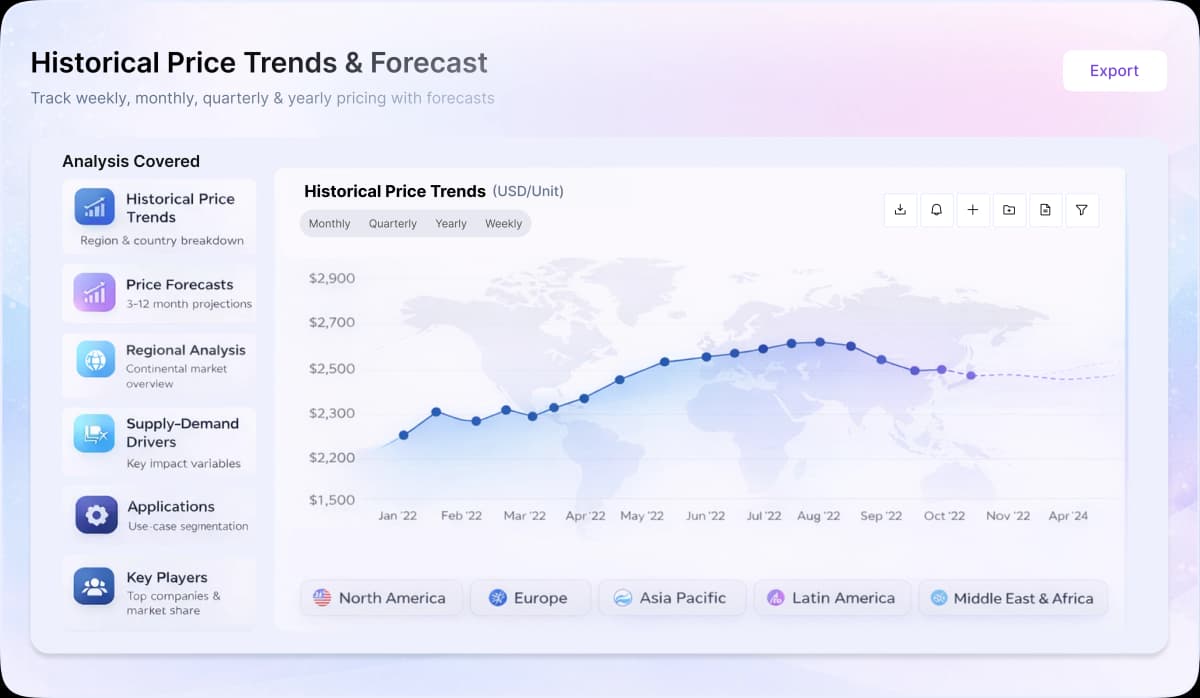
Turn price intelligence into action with the Procurement Resource Database. Log in or subscribe to unlock live price trends, historical charts, supplier databases, cost curves, and analyst-backed insights across chemicals, agriculture, energy, packaging, and more. Use these tools to benchmark your contracts, plan budgets with confidence, and stay ahead of market moves on every product you buy.
0
+Products
0
+Regions
0
+Subscriptions
Potassium bromide (KBr) is a chemical compound used extensively as a sedative and anticonvulsant in veterinary medicine. It is also employed in photographic processing, where it helps form images on films and plates. Additionally, potassium bromide is utilized in optical applications to enhance the properties of optical glass, and in fire retardants for improving the safety of plastics and textiles. In the laboratory, it serves as a reagent in chemical synthesis and as a calibration standard in spectroscopy.
KBr
Photography, Pharmaceuticals, Fire Retardants, Optical Applications, Chemical Synthesis, Flame Spectroscopy, Drilling Fluids
Perekop Bromine, Nantong Guangrong, Weifang YuKai, Shandong Sinobrom Albemarle, Twin International, Shouguang Honghai, Dongying Bromate, Suzhou Yingke Biotechnology, Dongying Ruineng, Weifang Binhai Geruite
CurrencyUS$ (Data can also be provided in local currency)
Supplier Database AvailabilityYes
Customization ScopeThe report can be customized as per the requirements of the customer
Post-Sale Analyst Support360-degree analyst support after report delivery
Note: Our supplier search experts can assist your procurement teams in compiling and validating a list of suppliers indicating they have products, services, and capabilities that meet your company's needs.
The production begins with the chemical reaction between a hot potassium hydroxide solution and elemental bromine, which results in the formation of potassium bromide as the end product.
Our Price Analysis Methodology
AVP - Strategy and Solutions
Leading procurement research solutions across chemicals, materials, and food & beverages, with expertise in price forecasting and market analytics.
Experience how Procurement Resource transforms raw material price data into clear, decision ready intelligence. Optimise your performance with reliable, expert market data and analysis. Schedule your demo today to experience a live walk-through where our experts will showcase interactive price charts, forecasted prices, and insights driving the prices for your key commodities, tailored to your workflows. Contact us now!
Our Team will be happy to assist you
We are just a text away
Still Need Help?
Unlock full access to Procurement Resource's price databases, interactive charts, and short-term forecasts for thousands of commodities. Elevate your sourcing decisions by comparing prices across regions, downloading historical data, and layering in analyst-backed insights, all with our flexible plans that scale as your portfolio grows.
Still have any Questions
Contact Us



Price Trend Dashboard - What's Included
Price trends across a diverse portfolio of categories and products, spanning board to niche chemicals
Coverage extendable to grade-specific chemicals based on procurement requirements
Regular price tracking supported by robust historical datasets
News, policy updates, and key market drivers impacting price movements
Short-term and long-term price outlooks and forecasts
Supply–demand dynamics and capacity-driven market analysis

Track prices, market movements, supply-demand dynamics, and industry developments across hundreds of commodities through a centralized intelligence platform built for informed procurement decisions.

Understand market fluctuations using analyst-backed forecasts, historical pricing patterns, and evolving industry trends to strengthen sourcing strategies and budget planning.

Leverage cost models, pricing benchmarks, and procurement insights to evaluate purchasing opportunities, improve negotiations, and enhance operational efficiency.
Access region-specific price trends, trade activities, capacity changes, and supply chain developments influencing commodity markets worldwide.