Potassium Silicate Price Trend Analysis 2026: Supply Demand Analysis, Market Insights, Historical Prices, Price Drivers & Latest News

Pragati Agarwal profile photo
Written ByPragati Agarwal

Procurement Resource Database

Laptop screen

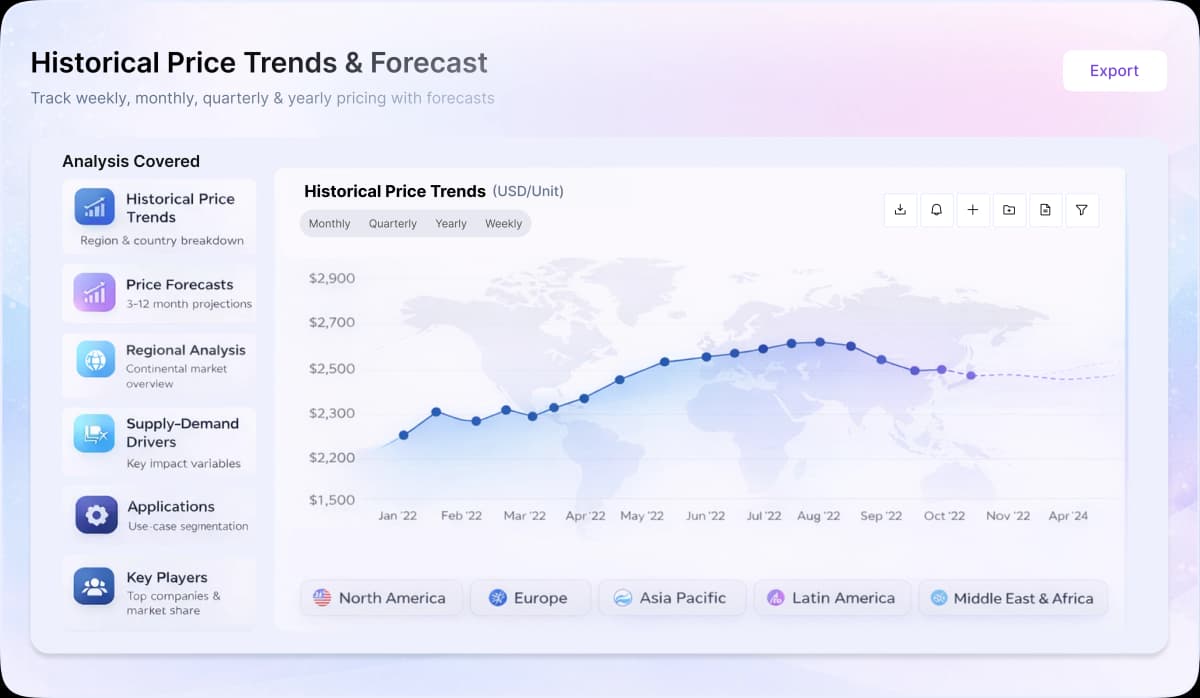
Turn price intelligence into action with the Procurement Resource Database. Log in or subscribe to unlock live price trends, historical charts, supplier databases, cost curves, and analyst-backed insights across chemicals, agriculture, energy, packaging, and more. Use these tools to benchmark your contracts, plan budgets with confidence, and stay ahead of market moves on every product you buy.

0

+

Products

0

+

Regions

0

+

Subscriptions

Asia

In Asia, the Potassium Silicate market maintained its stability in terms of price during Q4’25. The demand for Potassium Silicate from the agricultural sector and other industries such as water treatment and special coatings continued to be steady. The buyers were cautious, and bought only what they needed immediately, keeping the market active but preventing a sudden surge in prices. The supply of Potassium Silicate also benefited from the steady availability of silica sand and other raw materials, which were utilized efficiently, keeping the market steady in terms of price during this period. Although some industries such as the glass and chemical industries showed moderate activity, the demand for Potassium Silicate did not surge much during this period.

Europe

In Europe, the market for Potassium Silicate remained stable. Demand was met by imports from the principal countries of production, while the low level of local supply did not allow for downward pressure on the price. However, the various uses of the product, especially in the industrial, agricultural, and building industries, helped to ensure stable demand, although buyers remained cautious and did not overorder. Supply was not disrupted, and the availability of materials such as silica sand and potassium was not affected. Small variations in energy and transportation costs did not affect the stability of the price.

North America

Potassium Silicate prices in North America were relatively flat in the recent period, with some weakness in the later part of Q4’25. Domestic supply was low, while imports helped maintain the balance. The seasonal slowdown in demand from the industrial and construction sectors meant that end-users preferred to buy in the short term to avoid inventory build-up. The raw material side, including silica sand, was relatively stable in terms of supply, hence no sharp price movements were noted.


About Potassium Silicate

Potassium silicate is commercially obtained from the combination of potassium oxide and silicon dioxide. It is also known as water glass and finds applications in various industrial applications owing to its adhesive and binding properties. In the welding electrodes sector, it is used as a binder, and in several other industries it is employed as a fireproofing agent, an additive in cement and concrete and as a protective coater for surfaces.

Potassium Silicate Product Detail

HS Code
28399000
Chemical Formula

K2SiO3

CAS Number
1312-76-1
Molecular Weight
154.28 g/mol
Industrial Uses

Welding and metal treatment, Adhesive and binder, Soil stabilizer, Corrosion protector, Textile and fabric treatment, Fireproofing and heat resistance

Supplier Database

Occidental Chemical Corporation, Nippon Chemical Industrial Co., Ltd., Alfa Aesar, Nutri Tech Solutions, Nanjing Vital Chemical Co Ltd

Regional Coverage

Asia Pacific

China, India, Indonesia, Pakistan, Bangladesh, Japan, Philippines, Vietnam, Iran, Thailand, South Korea, Iraq, Saudi Arabia, Malaysia, Nepal, Taiwan, Sri Lanka, UAE, Israel, Hongkong, Singapore, Oman, Kuwait, Qatar, Australia, and New Zealand

Europe

Germany, France, United Kingdom, Italy,Spain, Russia, Turkey, Netherlands, Poland, Sweden, Belgium, Austria, Ireland Switzerland, Norway, Denmark, Romania, Finland, Czech Republic, Portugal and Greece

North America

United States and Canada

Latin America

Brazil, Mexico, Argentina, Columbia, Chile, Ecuador, and Peru

Africa

South Africa, Nigeria, Egypt, Algeria, Morocco

CurrencyUS$ (Data can also be provided in local currency)

Supplier Database AvailabilityYes

Customization ScopeThe report can be customized as per the requirements of the customer

Post-Sale Analyst Support360-degree analyst support after report delivery

Note: Our supplier search experts can assist your procurement teams in compiling and validating a list of suppliers indicating they have products, services, and capabilities that meet your company's needs.

Potassium Silicate Production Processes

In calcination, the salt of potassium carbonate and silica sand are heated at approximately 593.32°C under high pressure conditions to give potassium silicate.

Frequently Asked Questions

Potassium silicate prices are expected to remain broadly stable through H2 2026, building on the range-bound tone established in H1. Agricultural demand seasonality and feedstock costs will be the primary levers for any modest price movement. Firm agricultural offtake tied to soil remediation and crop nutrition programmes provides baseline support, while subdued construction and coatings demand caps upside. A meaningful shift would require a supply disruption, a sustained move in silica sand or potassium carbonate costs, or a step-change in agricultural buying patterns.

Potassium silicate prices are shaped by several drivers. Readily available silica sand and potassium carbonate keep feedstock supply comfortable in Asia, limiting cost pressure. Stable energy costs and logistics support predictable pricing. In Europe, import dependence keeps values firmer, though cautious purchasing from industrial and construction users caps upside. In North America, lean buyer inventories and prompt procurement keep trade volumes steady. Subdued construction and coatings demand is partly offset by firm agricultural offtake tied to soil remediation and crop nutrition programmes.

Asia hosts most global potassium silicate capacity, making it the dominant producing and exporting region. North America has modest domestic output supplemented by steady imports, while Europe relies on imports, keeping values firmer relative to producing regions. Established producers include OxyChem, PQ Corporation, and Nippon Chemical Industrial. Asia's concentration of capacity is the key supply-security consideration for buyers.

Potassium silicate is produced via furnace fusion, heating silica sand and potassium carbonate to 1,100 to 1,300°C to form a glass, cooled, crushed, dissolved in water under pressure, and filtered to adjust SiO₂:K₂O ratio before sale as liquid, flaked solid, or spray-dried powder. An alternative hydrothermal route uses potassium hydroxide with quartz at 150 to 300°C for high-clarity grades. Product is used as concrete densifier and fireproofing agent in construction, plant fertilizer in agriculture, binder in welding rods, corrosion inhibitor in metallurgy, and alternative to oil-based drilling fluid in oil and gas wellbore stabilization.

Potassium silicate demand is driven by construction, agriculture, metallurgy, wood processing, and oil and gas. In construction, it serves as a concrete densifier and fire-retardant coating. Agriculture uses it as a soil conditioner and foliar fertiliser, with seasonal buying cycles providing baseline support. Metallurgy relies on it as a flux and corrosion inhibitor, while wood processors use it for fireproofing. The oil and gas sector uses it as a drilling fluid additive for wellbore stabilisation. Agricultural seasonality and construction cycles are the main levers for price movement.

Procurement Resource assesses potassium silicate prices through a structured, data-driven methodology combining primary engagement with producers, suppliers and traders, secondary market data, monitoring of feedstock and input costs, trade-flow and inventory tracking, and exchange or spot benchmarks. The approach is validated and translated into a transparent price assessment and outlook, with the detailed methodology available on the Procurement Resource website.

Our Price Analysis Methodology

About the Author

Pragati Agarwal profile photo

Pragati Agarwal

Senior Business Insights Analyst

Delivering price trend analysis and procurement market insights at Procurement Resource, with expertise in identifying commodity patterns, supporting purchasing strategies, and improving cost efficiency through actionable market intelligence.

Schedule Demo

Schedule A Demo

Experience how Procurement Resource transforms raw material price data into clear, decision ready intelligence. Optimise your performance with reliable, expert market data and analysis. Schedule your demo today to experience a live walk-through where our experts will showcase interactive price charts, forecasted prices, and insights driving the prices for your key commodities, tailored to your workflows. Contact us now!

Our Team will be happy to assist you

We are just a text away

+1

Still Need Help?

Europe & Africa

+44 7573 171117

[email protected]

USA & Canada

+1 254 254 1750

[email protected]

APAC

+91 8850629517

[email protected]

Unlock full access to Procurement Resource's price databases, interactive charts, and short-term forecasts for thousands of commodities. Elevate your sourcing decisions by comparing prices across regions, downloading historical data, and layering in analyst-backed insights, all with our flexible plans that scale as your portfolio grows.

Still have any Questions

Contact Us
Mastercard
Wire
VISA
Stripe

Why Procurement Database

Commodity Market Intelligence

Commodity Market Intelligence

Track prices, market movements, supply-demand dynamics, and industry developments across hundreds of commodities through a centralized intelligence platform built for informed procurement decisions.

Price Forecasts & Market Outlooks

Price Forecasts & Market Outlooks

Understand market fluctuations using analyst-backed forecasts, historical pricing patterns, and evolving industry trends to strengthen sourcing strategies and budget planning.

Cost & Procurement Optimization

Cost & Procurement Optimization

Leverage cost models, pricing benchmarks, and procurement insights to evaluate purchasing opportunities, improve negotiations, and enhance operational efficiency.

Global & Regional Market Insights

Global & Regional Market Insights

Access region-specific price trends, trade activities, capacity changes, and supply chain developments influencing commodity markets worldwide.

1/4