Recovered Carbon Black (Purified) Price Trend Analysis 2026: Price Drivers, Latest News, Historical Prices, Market Insights & Supply Demand Analysis

Pragati Agarwal profile photo
Written ByPragati Agarwal

Procurement Resource Database

Laptop screen

Turn price intelligence into action with the Procurement Resource Database. Log in or subscribe to unlock live price trends, historical charts, supplier databases, cost curves, and analyst-backed insights across chemicals, agriculture, energy, packaging, and more. Use these tools to benchmark your contracts, plan budgets with confidence, and stay ahead of market moves on every product you buy.

0

+

Products

0

+

Regions

0

+

Subscriptions

Product Category Region Price Last Updated Month
Recovered Carbon Black (Purified) Chemicals Germany USD 1950 USD/MT January 2025
Recovered Carbon Black (Purified) Chemicals Germany USD 2285 USD/MT November 2025

Stay updated with the latest Recovered Carbon Black (Purified) prices, historical data, and tailored regional analysis

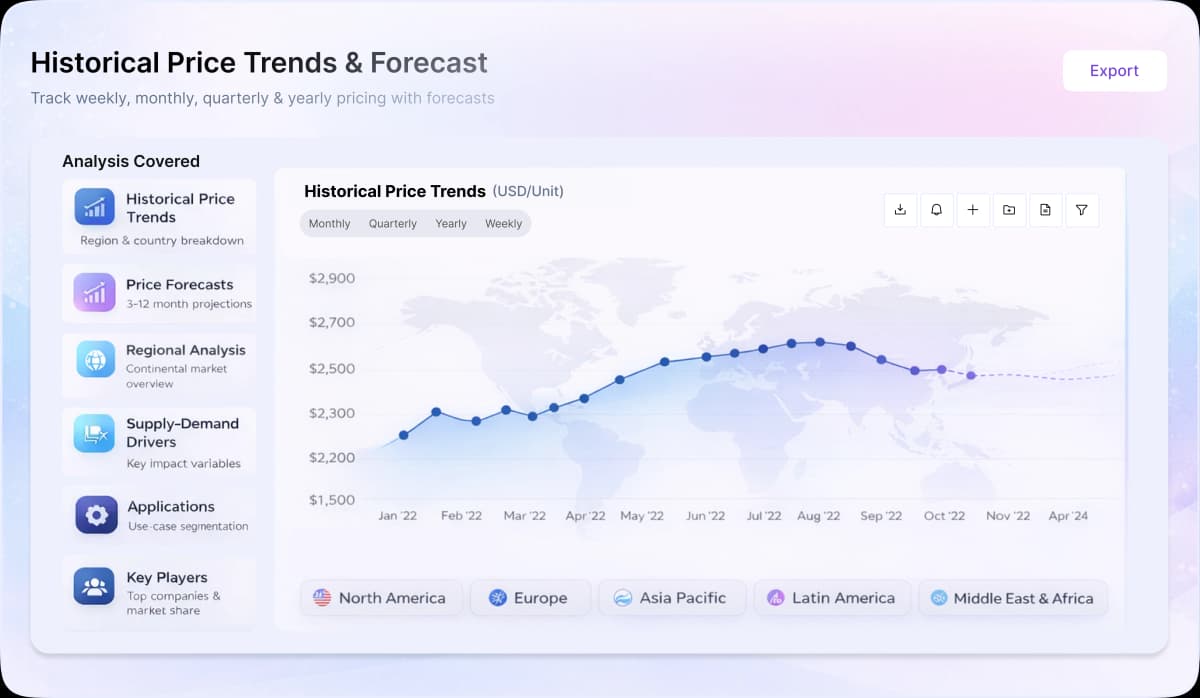
The market for Recovered Carbon Black (Purified) in Germany experienced notable upward momentum during the early months of the year. The prices were about 1950 USD/MT (CIF) in January and around 2285 USD/MT in November. Prices climbed sharply from the beginning, driven by strengthening demand from tire manufacturing and rubber goods sectors as industries recovered from prior year slowdowns. Supply constraints emerged as several pyrolysis facilities operated at reduced capacities due to feedstock availability challenges and maintenance schedules.

The upward trajectory continued through the middle portion of the year, with prices advancing at a more moderate pace. Growing adoption of sustainable materials in automotive and industrial applications supported consistent consumption patterns. Regulatory pressures favouring circular economy practices and stricter environmental standards further boosted market sentiment. Producer margins improved as end-use industries demonstrated willingness to absorb higher input costs.

Market dynamics shifted during the latter months as prices reached their peak before beginning a downward correction. Supply conditions eased as production normalized and new capacity additions came online. Demand signals weakened amid seasonal slowdowns in tire production and cautious procurement from downstream converters. Import competition from other European regions intensified, adding pressure on domestic pricing. The market entered a consolidation phase as buyers delayed purchases anticipating further corrections.


About Recovered Carbon Black (Purified)

Recovered Carbon Black (rCB), when purified, is a high-carbon material obtained from recycling end-of-life tires and rubber products through pyrolysis. It consists primarily of elemental carbon, often represented by the empirical formula C, with minimal ash, sulfur, and volatile residues. The purified form has improved surface area, higher purity, and reduced contaminants compared to raw rCB. Structurally, it is composed of disordered graphitic layers, giving it properties similar to virgin carbon black, making it a sustainable alternative in material applications.

Recovered Carbon Black (Purified) Product Detail

Hs Code
2803
Cas Number
1333-86-4
Supplier Database

Pyrolyx, Delta-Energy Group, Black Bear Carbon, Scandinavian Enviro Systems AB, Klean Industries

Regional Coverage

Asia Pacific

China, India, Indonesia, Pakistan, Bangladesh, Japan, Philippines, Vietnam, Iran, Thailand, South Korea, Iraq, Saudi Arabia, Malaysia, Nepal, Taiwan, Sri Lanka, UAE, Israel, Hongkong, Singapore, Oman, Kuwait, Qatar, Australia, and New Zealand

Europe

Germany, France, United Kingdom, Italy,Spain, Russia, Turkey, Netherlands, Poland, Sweden, Belgium, Austria, Ireland Switzerland, Norway, Denmark, Romania, Finland, Czech Republic, Portugal and Greece

North America

United States and Canada

Latin America

Brazil, Mexico, Argentina, Columbia, Chile, Ecuador, and Peru

Africa

South Africa, Nigeria, Egypt, Algeria, Morocco

CurrencyUS$ (Data can also be provided in local currency)

Supplier Database AvailabilityYes

Customization ScopeThe report can be customized as per the requirements of the customer

Post-Sale Analyst Support360-degree analyst support after report delivery

Note: Our supplier search experts can assist your procurement teams in compiling and validating a list of suppliers indicating they have products, services, and capabilities that meet your company's needs.

Recovered Carbon Black (Purified) Industrial Uses

Purified Recovered Carbon Black (rCB) is widely used across industries as a sustainable substitute for virgin carbon black. In the rubber and tire sector, it is applied as a reinforcing filler to enhance durability and performance. In plastics, it provides pigmentation, conductivity, and strength. The ink, coatings, and paints industries utilize it as a cost-effective black pigment with stable dispersion properties. Additionally, it is employed in construction materials, batteries, and polymer composites, supporting circular economy practices while reducing environmental impact.

Frequently Asked Questions

During H1 2026, recovered carbon black (purified) traded at softer levels across Europe, Asia Pacific and North America following the corrective phase of late 2025. European prices held broadly stable as pyrolysis operators maintained steady output and tire collection volumes remained adequate. Asia Pacific saw modest cost pressure from plastics and coatings buyers seeking sustainable inputs, while North American pricing reflected decarbonisation commitments among major tire and rubber buyers. Ample pyrolysis capacity across all regions prevented any sharp upward movement, keeping price gains measured through the first half.
The outlook for purified recovered carbon black in 2026 is cautiously firmer heading into H2, supported by recovering automotive production schedules, sustained circular economy mandates, and growing demand from plastics and coatings manufacturers in Asia Pacific and decarbonisation commitments among North American tire buyers. However, expanding pyrolysis capacity and steady tire collection volumes will likely temper any sharp price gains, keeping the recovery measured rather than aggressive.
Recovered carbon black (purified) prices are driven mainly by feedstock availability from end-of-life tyres and by pyrolysis capacity, so tyre-collection volumes and operator run-rates set supply, with energy and the purification step adding to costs. Regulation is a structural demand support, as extended-producer-responsibility and sustainability mandates oblige buyers to use recycled content. Demand from tyre and rubber manufacturing, plastics, inks and coatings provides the pull, positioning rCB as a substitute for virgin carbon black. Ample pyrolysis capacity caps prices, while firmer automotive and sustainability-driven demand lifts them.
The recovered carbon black (purified) market is served by specialist pyrolysis operators Pyrolyx, Delta-Energy Group, Black Bear Carbon, Scandinavian Enviro Systems AB, and Klean Industries, with production centred in Europe and North America. Asia Pacific, led by China, India, Indonesia, and Southeast Asia, is the primary consumption and import base, driven by tire manufacturing, plastics, and coatings demand. North American buyers are also significant consumers, motivated by decarbonisation commitments.
The feedstock for purified recovered carbon black is end-of-life tires and rubber products, which are collected and processed through pyrolysis to produce raw rCB. The raw material then undergoes a purification step that removes ash, sulfur, and volatile residues, yielding a high-purity carbon product with improved surface area. The finished purified rCB serves as a reinforcing filler in tires and rubber goods, and provides pigmentation, conductivity, and strength in plastics, inks, and coatings, functioning as a sustainable substitute for virgin carbon black.
Procurement Resource assesses recovered carbon black (purified) prices through a structured, data-driven methodology combining primary engagement with producers, suppliers and traders, secondary market data, monitoring of feedstock and input costs, trade-flow and inventory tracking, and exchange or spot benchmarks. These inputs are validated and translated into a transparent price assessment and outlook. The detailed methodology is available on the Procurement Resource website.

Our Price Analysis Methodology

About the Author

Pragati Agarwal profile photo

Pragati Agarwal

Senior Business Insights Analyst

Delivering price trend analysis and procurement market insights at Procurement Resource, with expertise in identifying commodity patterns, supporting purchasing strategies, and improving cost efficiency through actionable market intelligence.

Schedule Demo

Schedule a demo

Experience how Procurement Resource transforms raw material price data into clear, decision ready intelligence. Optimise your performance with reliable, expert market data and analysis. Schedule your demo today to experience a live walk-through where our experts will showcase interactive price charts, forecasted prices, and insights driving the prices for your key commodities, tailored to your workflows. Contact us now!

Our Team will be happy to assist you

We are just a text away

+1

Still Need Help?

Europe & Africa

+44 7573 171117

[email protected]

USA & Canada

+1 307 363 1045

[email protected]

APAC

+91 8850629517

[email protected]

Other Related Reports

Carbon Black Production by Lampblack Method

The study offers a detailed cost analysis of Carbon Black Production by Lampblack Method. In addition, the report incorporates the manufacturing process with detailed process and material flow, operating costs along with financial expenses and depreciation charges.

Carbon Black Production by Channel Method

The study offers a detailed cost analysis of Carbon Black Production by Channel Method. In addition, the report incorporates the manufacturing process with detailed process and material flow, operating costs along with financial expenses and depreciation charges.

Carbon Tetrabromide Manufacturing Plant Project Report 2026: Cost Analysis, ROI, and Feasibility Insights

Carbon Tetrabromide Manufacturing Plant Project Report thoroughly focuses on every detail that encompasses the cost of manufacturing. Our extensive cost model meticulously covers breaking down expenses around raw materials, labour, technology, and manufacturing expenses. This enables precise cost structure optimization and helps in identifying effective strategies to reduce the overall cash cost of manufacturing.

Unlock full access to Procurement Resource's price databases, interactive charts, and short-term forecasts for thousands of commodities. Elevate your sourcing decisions by comparing prices across regions, downloading historical data, and layering in analyst-backed insights, all with our flexible plans that scale as your portfolio grows.

Still have any Questions

Contact Us
Mastercard
Wire
VISA
Stripe

Related News

View All

Why Procurement Database

Commodity Market Intelligence

Commodity Market Intelligence

Track prices, market movements, supply-demand dynamics, and industry developments across hundreds of commodities through a centralized intelligence platform built for informed procurement decisions.

Price Forecasts & Market Outlooks

Price Forecasts & Market Outlooks

Understand market fluctuations using analyst-backed forecasts, historical pricing patterns, and evolving industry trends to strengthen sourcing strategies and budget planning.

Cost & Procurement Optimization

Cost & Procurement Optimization

Leverage cost models, pricing benchmarks, and procurement insights to evaluate purchasing opportunities, improve negotiations, and enhance operational efficiency.

Global & Regional Market Insights

Global & Regional Market Insights

Access region-specific price trends, trade activities, capacity changes, and supply chain developments influencing commodity markets worldwide.

1/4