Udeesha Tomar
AVP - Strategy and Solutions
Leading procurement research solutions across chemicals, materials, and food & beverages, with expertise in price forecasting and market analytics.
Asia
Asian precipitated silica prices strengthened toward the end of Q1’26, mainly due to higher sodium silicate and soda ash-linked costs. China’s tire sector supported rubber-grade silica demand, with rubber tire exports reaching 2.35 million tons in Q1’26, up 5.0% year-on-year. New pneumatic rubber tire exports reached 2.26 million tons, up 4.8%, supporting demand from tire reinforcement and low-rolling-resistance formulations. Higher freight and fuel costs after the Hormuz disruption added pressure to export and feedstock logistics.
Europe
European precipitated silica prices were stable-to-firm, supported by energy and processing costs but limited by weak demand. Germany’s SiO2 precipitated silica prices had already shown softness earlier, with a quarter-on-quarter decline of 1.93% from Q4 2024 to Q1 2025 and a January-to-March decline of 1.75%. In Q1’26, euro area producer prices rose 3.4% month-on-month in March, while energy increased 11.1%, raising drying, washing, packaging, and transportation costs. Replacement consumer tire sales in Europe rose only 1.0% year-on-year in Q1’26, limiting stronger price recovery.
North America
North American precipitated silica prices remained stable-to-firm in Q1’26. Energy and chemical production costs supported the market, while tire, rubber goods, coatings, and industrial applications maintained steady consumption. Final demand energy rose sharply in March, raising drying and transport costs for silica producers. However, demand was not strong enough to trigger a sharper upward movement.
Analyst Insight
According to Procurement Resource, near term, precipitated silica prices may remain stable-to-firm if energy and freight costs stay elevated. Stronger tire demand would be needed for a more visible price increase.
Related Report
Get real-time price assessments, periodic trends, forecasts and price driver insights across key global markets.
Unlock Price Insights NowOur Clients

Turn price intelligence into action with the Procurement Resource Database. Log in or subscribe to unlock live price trends, historical charts, supplier databases, cost curves, and analyst-backed insights across chemicals, agriculture, energy, packaging, and more. Use these tools to benchmark your contracts, plan budgets with confidence, and stay ahead of market moves on every product you buy.

0
+Products
0
+Regions
0
+Subscriptions
Asia
Precipitated silica prices in Asia followed a mixed trend during Q4 2025, shaped by shifting feedstock cost dynamics and varying downstream demand conditions. The quarter opened with prices easing from their initial levels as sodium silicate feedstock values declined gradually through the first half of the period, reducing production cost support for manufacturers. Downstream buying activity from tire and rubber compounding producers remained cautious, while demand from silicone rubber and toothpaste abrasive applications stayed at baseline levels without generating significant upward momentum. However, from mid-quarter onward, the market direction reversed as feedstock availability tightened and procurement activity from end-use sectors including coatings, agrochemical carriers, and food-grade applications picked up. Prices recovered progressively through the latter portion of the quarter, closing well above mid-quarter lows and reflecting improved supply-demand balance by period-end.
Europe
Precipitated silica prices in Europe displayed a fluctuating pattern during Q4 2025, broadly tracking the direction of feedstock cost movements and import pricing from Asian origins. The quarter opened at relatively firm levels before declining steadily through mid-quarter as sodium silicate values softened and downstream demand from tire manufacturers, specialty rubber processors, and personal care formulators remained restrained. Buyer sentiment was largely cautious, with procurement focused on covering immediate needs rather than building inventory. As feedstock costs began to recover in the latter half of the quarter, precipitated silica prices gradually firmed, recouping a portion of earlier losses. By quarter-end, prices had recovered to near their opening levels, with the overall quarterly movement remaining modest.
North America
Precipitated silica prices in North America followed an oscillating pattern during Q4 2025, consistent with trends observed in other global regions. Early-quarter softness reflected declining sodium silicate feedstock costs and measured demand from tire reinforcement, ink and coatings, and food additive sectors. Prices reached their lowest point at mid-quarter before recovering as feedstock values firmed and restocking activity among downstream buyers gradually increased. Demand from the silicone sealant and rubber processing industries supported the rebound, and prices moved progressively higher through the close of the quarter.
Analyst Insight
According to Procurement Resource, precipitated silica prices are expected to maintain a stable to moderately firmer tone in the near term, supported by the recovery momentum established toward the end of Q4 2025 and gradual improvement in downstream demand.
Sio2 (also known as Precipitated Silica) is a synthetic amorphous form of silicon dioxide that belongs to the Silanol group. It is largely employed as a preliminary stage in the production of ceramic products in the industrial sector. It's also utilised in the culinary, pharmaceutical, rubber, and plastics sectors as a cleaning, thickening, performance improvement, and polishing agent.
SiO2
Filler, softeners, or performance enhancers in rubber and plastics., Cleaning and polishing agent in toothpaste for oral health care., Food rheology modifier, Defoamer
Evonik Industries AG, PPG Industries Inc., W.R. Grace & Co., Tosoh Silica Corporation, Solvay SA, Huber Engineered Materials, Oriental Silica Corporation
CurrencyUS$ (Data can also be provided in local currency)
Supplier Database AvailabilityYes
Customization ScopeThe report can be customized as per the requirements of the customer
Post-Sale Analyst Support360-degree analyst support after report delivery
Note: Our supplier search experts can assist your procurement teams in compiling and validating a list of suppliers indicating they have products, services, and capabilities that meet your company's needs.
This technique involves reacting sodium silicate solution with sulphuric acid. To obtain precipitated silica, the produced solution is precipitated, filtered, rinsed, and dried.


AVP - Strategy and Solutions
Leading procurement research solutions across chemicals, materials, and food & beverages, with expertise in price forecasting and market analytics.
Our Price Analysis Methodology

Experience how Procurement Resource transforms raw material price data into clear, decision ready intelligence. Optimise your performance with reliable, expert market data and analysis. Schedule your demo today to experience a live walk-through where our experts will showcase interactive price charts, forecasted prices, and insights driving the prices for your key commodities, tailored to your workflows. Contact us now!
Our Team will be happy to assist you
We are just a text away
Still Need Help?
This report presents a detailed cost structure of precipitated silica production from a sodium silicate solution and sulphuric acid.
Unlock full access to Procurement Resource's price databases, interactive charts, and short-term forecasts for thousands of commodities. Elevate your sourcing decisions by comparing prices across regions, downloading historical data, and layering in analyst-backed insights, all with our flexible plans that scale as your portfolio grows.
Still have any Questions
Contact Us


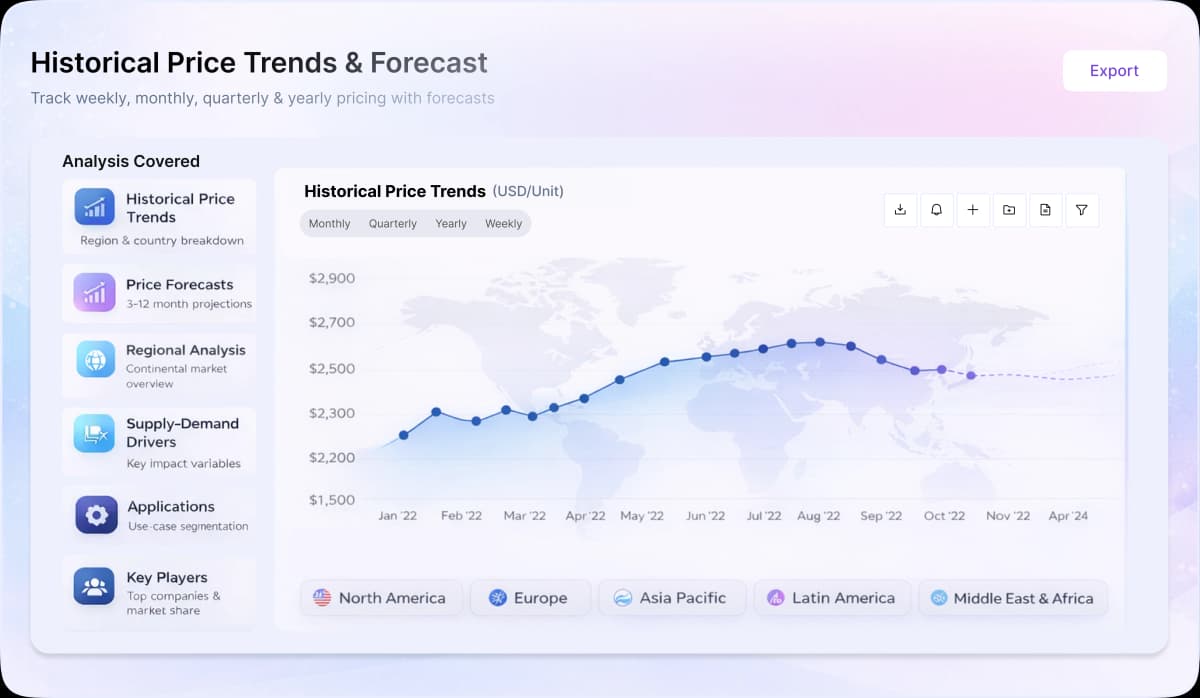
Price Trend Dashboard - What's Included
Price trends across a diverse portfolio of categories and products, spanning board to niche chemicals
Coverage extendable to grade-specific chemicals based on procurement requirements
Regular price tracking supported by robust historical datasets
News, policy updates, and key market drivers impacting price movements
Short-term and long-term price outlooks and forecasts
Supply-demand dynamics and capacity-driven market analysis