Crude Futures Firm on Spot Demand
Crude oil futures firmed amid firm spot demand, with both major global benchmarks edging higher in trade. Increased positioning by market participants reflected continued underlying demand support.
Strait of Hormuz closure continues to constrain global oil supply, with observed output remaining significantly below year-ago levels. IEA revised its demand forecast downward as inventories fell to multi-decade lows, reinforcing upward price pressure and market volatility.
Asia
In Asia, Terephthalic Acid prices followed a firm upward trend during H1’26, led by China, India, and Japan. The rise was mainly driven by higher paraxylene costs, crude-linked naphtha pressure, plant disruptions, and stronger polyester-chain sentiment. China saw the sharpest increase as feedstock costs rose and sellers gained support from tighter regional availability. India also recorded firm movement, supported by steady downstream consumption and its role as a key demand outlet for Chinese PTA supply. Japan followed the regional trend as import replacement costs and freight risk supported offers. Demand from PET packaging, polyester fibers, textiles, and resin applications remained mixed, but stable buying helped absorb higher raw material costs.
Europe
In Europe, prices for Terephthalic Acid rose in H1’26 due to higher import replacement costs and feedstock pressure linked to paraxylene. Logistics pressure following the Iran war provided additional support, considering buyers’ worries about potential delivery problems. Stable demand for PET packaging, polyester fiber, and industrial resins was the underlying factor, although buyers refrained from heavy purchases.
North America
Prices for Terephthalic Acid in North America also rose in H1’26. This price movement had the backing of higher replacement costs, tight feedstock pressure, and rising logistics risk. Demand for downstream products such as PET packaging and polyester was stable.
Analyst Insight
According to Procurement Resource, terephthalic acid prices may stay firm if crude, paraxylene, and freight costs remain elevated. Any easing will depend on smoother trade flows and weaker downstream restocking.
Related Report
Need latest Terephthalic Acid price?
Get real-time price assessments, periodic trends, forecasts and price driver insights across key global markets.
Unlock Price Insights NowOur Clients

Turn price intelligence into action with the Procurement Resource Database. Log in or subscribe to unlock live price trends, historical charts, supplier databases, cost curves, and analyst-backed insights across chemicals, agriculture, energy, packaging, and more. Use these tools to benchmark your contracts, plan budgets with confidence, and stay ahead of market moves on every product you buy.
0
+Products
0
+Regions
0
+Subscriptions
Asia
In Q4’25, the prices of Terephthalic Acid in the Asian market were stable, with mild upward pressure in some markets. Supply from Chinese producers was robust, which help maintain the supply of Terephthalic Acid in the market despite moderate demand from the downstream industry. However, over-supply in the market and intense competition from domestic producers put upward pressure on the prices, particularly in bulk volumes. South Korean and other Asian producers were pushing the volumes to the international market, including Europe, which impacted the prices in the Asian market. Though the demand from the textile and plastic industry was steady, the end-users were cautious in placing the orders and did not allow the prices to move up.
Europe
In the European market, the prices of TA were somewhat volatile in Q4’25, owing to anti-dumping issues. Imports from South Korea and Mexico were on the higher side in the previous months, which led to a problem. European players were already experiencing issues related to plant closures, which resulted in lower capacity utilization. Imports were a problem in the European market as the prices were lower. The European Union was careful about the anti-dumping duties that were imposed on the importers. Prices were somewhat volatile in the European market, though they were strong.
North America
TA prices in North America remained stable during the quarter. There was adequate supply, although the industry had to contend with the effects of imports from Asia. Demand from the PET, polyester, and packaging industry was moderate, with buyers focusing on short-term purchases as opposed to large speculative buys. Prices remained stable, with the market experiencing slight upward movements as a result of supply chain adjustments.
Terephthalic Acid (TPA) is the most important aromatic chemical in the petrochemical industry. It is benzenedicarboxylic acid carrying carboxy groups and 1 and 4 positions of the carbon ring. TPA is used in the production of polyester PET (Polyethylene Terephthalate). PET owing to its highly versatile properties, is widely used in packaging industries; hence several million tons of TPA are produced annually to keep up with the demand.
C8H4O4
Polyester Films/Fibres, Plasticizers, Pharmaceuticals, Paints
Benzene-1,4-dicarboxylic acid, para-Phthalic acid, TPA
BP, China Petrochemical (Sinopec Group), Mitsubishi Chemical Holdings, Reliance Industries, Eastman
CurrencyUS$ (Data can also be provided in local currency)
Supplier Database AvailabilityYes
Customization ScopeThe report can be customized as per the requirements of the customer
Post-Sale Analyst Support360-degree analyst support after report delivery
Note: Our supplier search experts can assist your procurement teams in compiling and validating a list of suppliers indicating they have products, services, and capabilities that meet your company's needs.

Purified Terephthalic Acid (PTA) is produced via the catalytic oxidation of p-Xylene. This process involves using a cobalt-manganese-bromide catalyst, which serves as the source of free radicals, acetic acid as solvent and compressed air as the oxidant. This reaction mixture is fed to a reactor where the p-xylene is converted to p-toluic acid which on further oxidation gives the desired terephthalic acid.

Our Price Analysis Methodology

Senior Business Insights Analyst
Delivering price trend analysis and procurement market insights at Procurement Resource, with expertise in identifying commodity patterns, supporting purchasing strategies, and improving cost efficiency through actionable market intelligence.

Experience how Procurement Resource transforms raw material price data into clear, decision ready intelligence. Optimise your performance with reliable, expert market data and analysis. Schedule your demo today to experience a live walk-through where our experts will showcase interactive price charts, forecasted prices, and insights driving the prices for your key commodities, tailored to your workflows. Contact us now!
Our Team will be happy to assist you
We are just a text away
Still Need Help?
Unlock full access to Procurement Resource's price databases, interactive charts, and short-term forecasts for thousands of commodities. Elevate your sourcing decisions by comparing prices across regions, downloading historical data, and layering in analyst-backed insights, all with our flexible plans that scale as your portfolio grows.
Still have any Questions
Contact Us


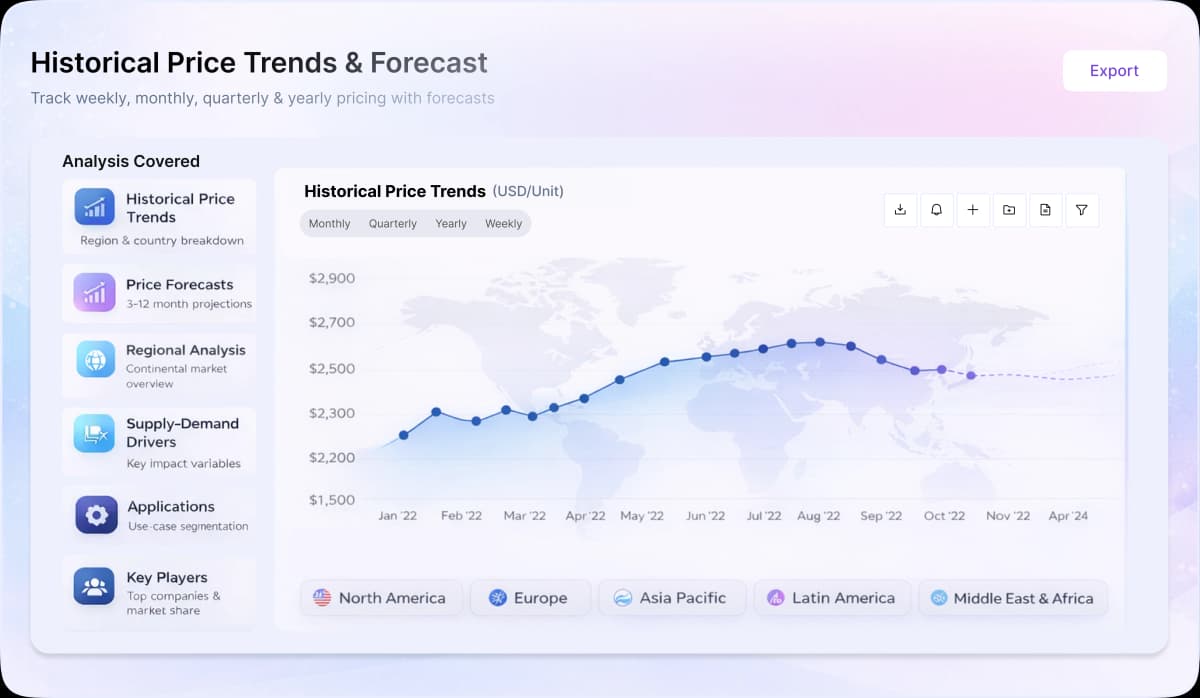
Price Trend Dashboard - What's Included
Price trends across a diverse portfolio of categories and products, spanning board to niche chemicals
Coverage extendable to grade-specific chemicals based on procurement requirements
Regular price tracking supported by robust historical datasets
News, policy updates, and key market drivers impacting price movements
Short-term and long-term price outlooks and forecasts
Supply-demand dynamics and capacity-driven market analysis