Udeesha Tomar
AVP - Strategy and Solutions
Leading procurement research solutions across chemicals, materials, and food & beverages, with expertise in price forecasting and market analytics.
Asia
In Asia, Tetramethylammonium Hydroxide prices trended lower during Q2’25, mainly due to weak demand from the semiconductor and electronics sectors. Key markets like South Korea and Taiwan saw slower chip production, which reduced the need for high-purity chemicals like TMAH.
At the same time, regional supply remained steady, with consistent output from local manufacturers and imports from Japan and China. Even though freight costs across intra-Asia routes rose steadily, their impact on overall pricing was limited due to existing stockpiles and cautious buying behaviour. Toward the end of the quarter, prices showed slight signs of firming as logistical delays at key ports like Singapore began to affect timely deliveries.
Europe
In Europe, TMAH prices fell sharply through the quarter. The primary reason was subdued demand from electronics and industrial cleaning segments, as well as improved domestic production. Large-scale plants resumed operations after earlier slowdowns, and healthy import volumes kept the market well-supplied.
With little seasonal pressure and steady supply chains, buyers avoided large spot purchases and preferred long-term contracts, further pushing down prices. Despite some concerns around supply disruptions from North Africa and Asia, inventories across Western Europe stayed comfortable, helping to prevent any major price spikes.
North America
North America also saw a downward trend in TMAH pricing during Q2’25. After a strong first quarter, demand softened from the semiconductor and precision manufacturing industries, particularly as some production lines paused for scheduled maintenance. Supply remained stable, supported by steady operations at major production hubs and imports from Asia.
While a heatwave in June caused localized power issues in parts of the U.S., it didn’t lead to widespread disruptions. Inventory buildup earlier in the year helped cushion short-term tightness, keeping prices relatively stable through most of the quarter.
Analyst Insight
According to Procurement Resource, Tetramethylammonium Hydroxide prices may become more volatile if freight issues persist or if tech-sector demand picks up sharply in the coming quarter.
Related Report
Get real-time price assessments, periodic trends, forecasts and price driver insights across key global markets.
Unlock Price Insights NowOur Clients

Turn price intelligence into action with the Procurement Resource Database. Log in or subscribe to unlock live price trends, historical charts, supplier databases, cost curves, and analyst-backed insights across chemicals, agriculture, energy, packaging, and more. Use these tools to benchmark your contracts, plan budgets with confidence, and stay ahead of market moves on every product you buy.

0
+Products
0
+Regions
0
+Subscriptions
Asia
In the first quarter of 2025, the price trend for Tetramethylammonium Hydroxide (TMAH) in Asia followed a softening pattern, mainly due to the subdued demand in the region. While feedstock costs were stable, logistics and supply chain disruptions caused by seasonal factors contributed to slight volatility in prices. As ammonia prices were relatively stable, this helped prevent significant price hikes.
However, there was a noticeable slowdown in the downstream sector, as manufacturers took a cautious approach in restocking. The reduced freight costs and improving port conditions in key Asian markets also helped ease supply constraints, allowing for a balanced market. Overall, TMAH prices remained stable, with minor fluctuations attributed to the oversupply in some areas.
Europe
In Europe, the first quarter of 2025 saw a relatively stable price trend for Tetramethylammonium Hydroxide, supported by an improvement in feedstock availability. While ammonia prices had experienced a decline due to lower natural gas costs, this had a limited impact on TMAH production costs as feedstock prices remained in check.
The European market remained steady, with TMAH prices holding stable as demand was steady but not significantly rising. Manufacturers in the region were able to manage production costs effectively, especially after the increased production capacities of key suppliers. This helped maintain price stability throughout the quarter despite some minor fluctuations in demand.
North America
North American TMAH prices in Q1’25 showed some upward pressure due to supply chain challenges and limited feedstock availability. The region had seen disruptions in ammonia and hydrochloric acid supplies, particularly due to rail and natural gas supply issues. These factors contributed to higher production costs for TMAH. Despite this, the market was fairly resilient, and prices for TMAH increased slightly as producers adjusted their rates to reflect these increased costs. With logistical constraints easing towards the end of the quarter, some price stability was expected, but the overall upward trend continued due to continued uncertainties around feedstock availability.
Tetramethylammonium hydroxide is a quaternary ammonium salt that forms a strong alkaline solution on dissolution in water. Naturally, it is a colorless liquid or solid with high deprotonating properties. It can dissolve organic materials and thus is a valuable component in processes like photoresist development and cleaning of silicon wafers in the semiconductor industries.

C4H13NO
Semiconductor manufacturing, Photoresist stripping, Polymer processing, Organic synthesis, Photoengraving
Hantok Chemical, Sachem, Tokuyama, San Fu Chemical, TATVA CHINTAN, Greenda Chem, Zhenfeng Chem
CurrencyUS$ (Data can also be provided in local currency)
Supplier Database AvailabilityYes
Customization ScopeThe report can be customized as per the requirements of the customer
Post-Sale Analyst Support360-degree analyst support after report delivery
Note: Our supplier search experts can assist your procurement teams in compiling and validating a list of suppliers indicating they have products, services, and capabilities that meet your company's needs.
A bipolar membrane is used to convert tetramethyl ammonium chloride to tetramethyl ammonium hydroxide via the process of electrolysis. The conversion efficiency of this bipolar membrane is dependent on the concentration of feedstock material and decreases with the increase in the flow of current.

AVP - Strategy and Solutions
Leading procurement research solutions across chemicals, materials, and food & beverages, with expertise in price forecasting and market analytics.
Our Price Analysis Methodology

Experience how Procurement Resource transforms raw material price data into clear, decision ready intelligence. Optimise your performance with reliable, expert market data and analysis. Schedule your demo today to experience a live walk-through where our experts will showcase interactive price charts, forecasted prices, and insights driving the prices for your key commodities, tailored to your workflows. Contact us now!
Our Team will be happy to assist you
We are just a text away
Still Need Help?
Unlock full access to Procurement Resource's price databases, interactive charts, and short-term forecasts for thousands of commodities. Elevate your sourcing decisions by comparing prices across regions, downloading historical data, and layering in analyst-backed insights, all with our flexible plans that scale as your portfolio grows.
Still have any Questions
Contact Us


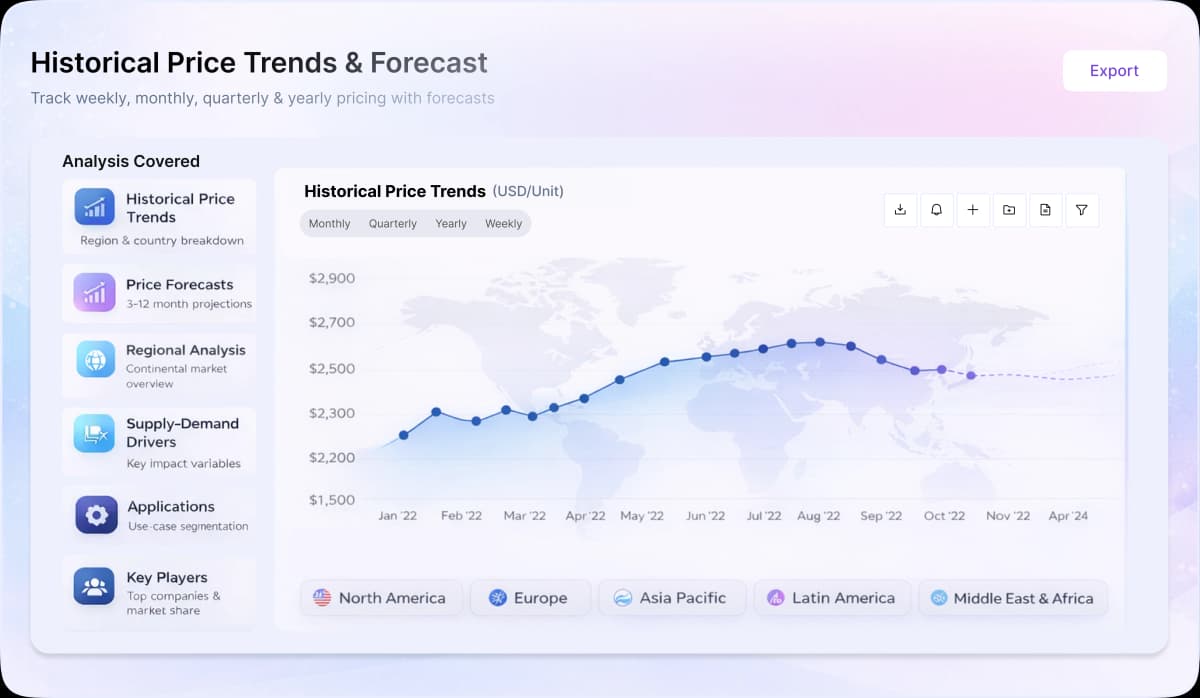
Price Trend Dashboard - What's Included
Price trends across a diverse portfolio of categories and products, spanning board to niche chemicals
Coverage extendable to grade-specific chemicals based on procurement requirements
Regular price tracking supported by robust historical datasets
News, policy updates, and key market drivers impacting price movements
Short-term and long-term price outlooks and forecasts
Supply-demand dynamics and capacity-driven market analysis