Acetonitrile Price Trend Analysis 2026: Historical Prices, Price Drivers, Market Insights, Supply Demand Analysis & Latest News

Shriya Singh profile photo
Written ByShriya Singh

Procurement Resource Database

Laptop screen

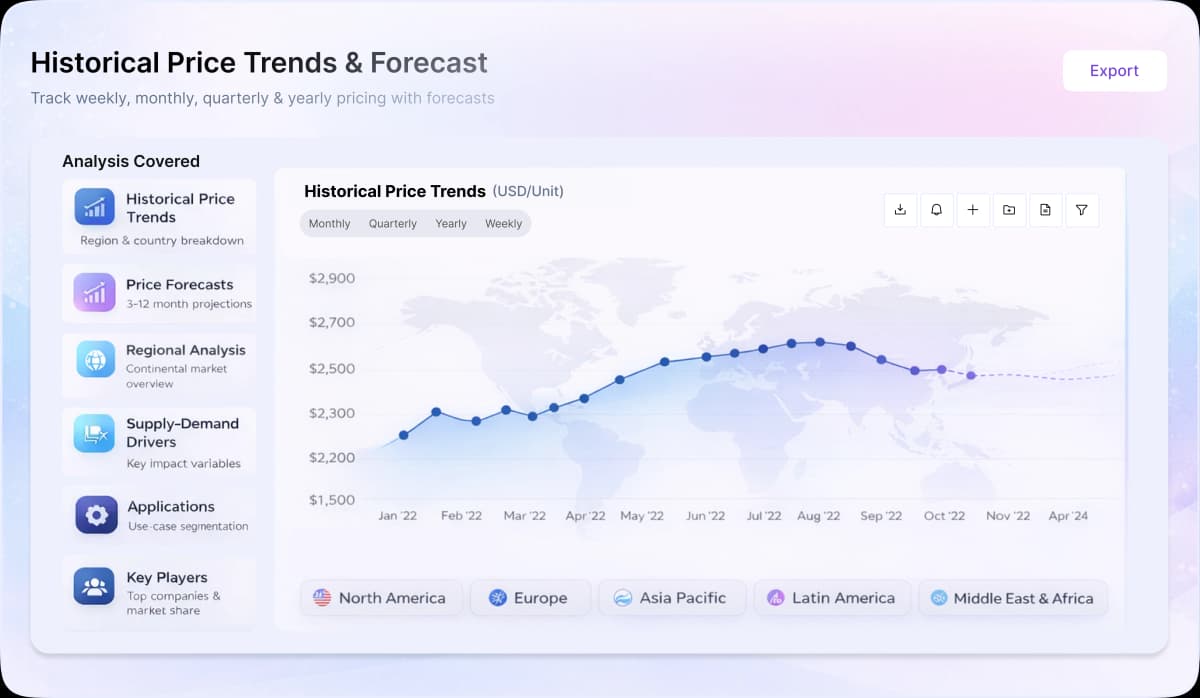
Turn price intelligence into action with the Procurement Resource Database. Log in or subscribe to unlock live price trends, historical charts, supplier databases, cost curves, and analyst-backed insights across chemicals, agriculture, energy, packaging, and more. Use these tools to benchmark your contracts, plan budgets with confidence, and stay ahead of market moves on every product you buy.

0

+

Products

0

+

Regions

0

+

Subscriptions

  • Global acetonitrile prices followed a muted-to-modestly-recovering trajectory in Q1 2026, with seasonal post-holiday restocking providing limited support after a soft close to 2025, while supply discipline from producers kept the market from slipping further.
  • Feedstock ammonia displayed mixed trends, soft market conditions domestically through January-February, but tightening sharply by March as Middle East conflict disrupted ~20–30% of global ammonia trade flows through the Strait of Hormuz, effectively cutting off exports from Saudi Arabia, Qatar, and Iran.
  • Downstream demand remained anchored to pharmaceutical HPLC and API synthesis, with agrochemical buying staying cautious. Acetonitrile demand remained muted as pharmaceutical restocking offset softer industrial and international buying interest.

Asia

In China, soft domestic ammonia costs through January provided producers with cost relief, but oversupply from high operating rates and weak export inquiry capped any upside. Post Chinese New Year restocking lifted activity modestly in February, though buyers remained selective. China's liquid ammonia exports surged in January–February, reflecting redirection of supply away from Middle East-disrupted routes, which compressed domestic ammonia availability toward March and nudged acetonitrile production costs upward. In India, steady pharmaceutical and API sector procurement underpinned demand through the quarter. Jindal Specialty Chemicals' capacity expansion added to local supply, keeping import dependency in check and limiting import-led price pressure from China.

Europe

The acetonitrile price curve recorded a fluctuating trajectory in the first quarter of 2026. Throughout the period, European buyers maintained cautious procurement strategies, with delayed purchasing decisions amid macroeconomic headwinds and slow industrial activity. Export demand from India and Europe softened, limiting the upside while traders offered narrower FOB margins. The tightening of international ammonia supply from the Middle East added a modest cost-push signal toward quarter-end, but insufficient to reverse the broadly flat-to-soft pricing tone in the region.

North America

In Q1’26, the acetonitrile markets witnessed mixed price movements in the North American region. Increased production and port inventories eased tightness in late 2025, with higher acrylonitrile operating rates lifting variable costs modestly while normalized freight reduced transportation premiums. Into Q1 2026, the US market stabilized with pharmaceutical and HPLC-grade demand providing a consistent floor. Gulf Coast acrylonitrile plant operations ran at full capacity, and logistics remained smooth, supporting supply sufficiency. However, broader industrial demand remained underwhelming, preventing any firm price recovery.


About Acetonitrile

Acetonitrile is a colorless, volatile liquid organic compound with the chemical formula CH3CN. It is a versatile solvent widely used in various industries, including pharmaceuticals, chemical synthesis, and analytical laboratories. Acetonitrile has a distinctive odor and is miscible with water and many organic solvents.

Its key properties include a relatively high boiling point, low viscosity, and excellent solvent power, making it efficient for dissolving polar and non-polar substances. Moreover, it exhibits good stability and is relatively non-reactive under standard conditions. However, caution is required during handling and storage, as acetonitrile is flammable and toxic when ingested or inhaled.

Acetonitrile Product Detail

Hs Code
29269000
Chemical Formula

C2H3N

Molecular Weight
41.05 g/mol
Industrial Uses

Fuel additive production, Specialty solvents, Photographic industry, Extraction processes, Chemical synthesis, Electronics manufacturing

Synonyms

Ethanenitrile, Methyl cyanide

Supplier Database

Achemica, Filo Chemical, NeuChemical, Sterling Chemicals, DuPont, CNPC Jilin Chemical, BP Chemicals, AlzChem AG

Regional Coverage

Asia Pacific

China, India, Indonesia, Pakistan, Bangladesh, Japan, Philippines, Vietnam, Iran, Thailand, South Korea, Iraq, Saudi Arabia, Malaysia, Nepal, Taiwan, Sri Lanka, UAE, Israel, Hongkong, Singapore, Oman, Kuwait, Qatar, Australia, and New Zealand

Europe

Germany, France, United Kingdom, Italy,Spain, Russia, Turkey, Netherlands, Poland, Sweden, Belgium, Austria, Ireland Switzerland, Norway, Denmark, Romania, Finland, Czech Republic, Portugal and Greece

North America

United States and Canada

Latin America

Brazil, Mexico, Argentina, Columbia, Chile, Ecuador, and Peru

Africa

South Africa, Nigeria, Egypt, Algeria, Morocco

CurrencyUS$ (Data can also be provided in local currency)

Supplier Database AvailabilityYes

Customization ScopeThe report can be customized as per the requirements of the customer

Post-Sale Analyst Support360-degree analyst support after report delivery

Note: Our supplier search experts can assist your procurement teams in compiling and validating a list of suppliers indicating they have products, services, and capabilities that meet your company's needs.

Acetonitrile Production Processes

This process involves the oxidation of propylene in the presence of ammonia in a fluidized bed reactor. As a result, acetonitrile and hydrogen cyanide are produced as a byproduct.

Frequently Asked Questions

During Q1 2026, acetonitrile prices increased strongly across tracked regions. In China, prices showed a 19.60% increase from January to March, while in the USA they witnessed an 18.25% increase, in Germany a 14.12% increase, in India a 13.05% increase, and in Japan an 18.26% increase. The rise reflected tighter spot availability and stronger demand from pharmaceutical, laboratory, and specialty chemical users.
The acetonitrile outlook for 2026 remains steady to firm, supported by demand from pharmaceuticals, analytical laboratories, agrochemicals, specialty chemicals, and high-performance liquid chromatography applications. Prices may stay sensitive to acrylonitrile production because acetonitrile is mainly recovered as a byproduct of acrylonitrile manufacturing. Any change in acrylonitrile output can quickly affect acetonitrile availability and regional pricing.
The main factors affecting acetonitrile prices in Q1 2026 were tight byproduct supply and stronger pharmaceutical demand. Acetonitrile availability depends heavily on acrylonitrile operating rates, so limited merchant supply supported prices. At the same time, restocking by pharmaceutical, analytical, and specialty chemical buyers increased procurement pressure across China, the USA, Germany, India, and Japan.
Major acetonitrile markets include China, the United States, India, Germany, Japan, Taiwan, South Korea, Belgium, Singapore, and the Netherlands. Key companies include INEOS Nitriles, Asahi Kasei, Ascend Performance Materials, Avantor, Tedia Company, Balaji Amines, AnQore, Taekwang Industrial, Concord Technology, and Qingdao Shida Chemical. These companies operate across acrylonitrile, solvent recovery, purification, and high-purity laboratory chemical supply chains.
A notable recent development was EAS Batteries’ commercialization of an ultra-high-power LFP cell using Asahi Kasei’s acetonitrile-containing Acetolyte electrolyte. The cell was initially launched in March 2026 and contains a 22 Ah large-format cylindrical design. This development is important for acetonitrile because it shows a growing high-value application beyond pharmaceuticals and HPLC solvents, extending acetonitrile use into advanced battery electrolyte technology.

Acetonitrile is mainly produced as a byproduct during acrylonitrile manufacturing through propylene ammoxidation. It can also be produced through recovery, purification, and distillation processes. The value chain includes propylene and ammonia supply, acrylonitrile production, acetonitrile recovery, crude acetonitrile purification, distillation, packaging, and distribution to pharmaceutical synthesis, HPLC solvents, agrochemicals, specialty chemicals, electronics, and laboratory applications.

Acetonitrile is mainly sold as industrial-grade, reagent-grade, HPLC-grade, LC-MS-grade, pharmaceutical-grade, and electronic-grade material. HPLC and LC-MS grades require very high purity, low UV absorbance, low water content, and tight impurity control. Pharmaceutical and electronic grades also require strong documentation, consistency, and contaminant control, while industrial-grade material is used in extraction, synthesis, and chemical processing.
Acetonitrile demand is mainly driven by pharmaceuticals, biotechnology, analytical laboratories, HPLC and LC-MS testing, agrochemicals, specialty chemicals, electronics, battery research, synthetic fibers, and extraction processes. Pharmaceutical use remains especially important because acetonitrile is used in drug synthesis, purification, and quality testing. Laboratory demand is also strong because acetonitrile is a preferred solvent in chromatographic analysis.
A key policy affecting acetonitrile in 2026 was India’s anti-dumping duty on imports from China, Russia, and Taiwan. The duty was imposed under Notification No. 16/2025-Customs (ADD), dated June 19, 2025, for five years and remained relevant in 2026. It affected import costs, supplier selection, landed pricing, and procurement planning for Indian pharmaceutical and chemical buyers.
Procurement Resource employs a structured methodology combining primary research, secondary market data, analytical models, and validation processes to assess acetonitrile prices and trends. Price evaluations incorporate supply-demand dynamics, feedstock movements, trade flows, and value chain analysis, supported by continuous market monitoring to ensure accurate and reliable insights.

Our Price Analysis Methodology

About the Author

Shriya Singh profile photo

Shriya Singh

Business Insights Analyst

Helping procurement and sourcing teams navigate complex markets through data-driven research, category intelligence, and actionable insights - with a focus on identifying market trends, analyzing supply-side developments, and delivering clear intelligence that supports informed business decisions.

Schedule Demo

Schedule a demo

Experience how Procurement Resource transforms raw material price data into clear, decision ready intelligence. Optimise your performance with reliable, expert market data and analysis. Schedule your demo today to experience a live walk-through where our experts will showcase interactive price charts, forecasted prices, and insights driving the prices for your key commodities, tailored to your workflows. Contact us now!

Our Team will be happy to assist you

We are just a text away

+1

Still Need Help?

Europe & Africa

+44 7573 171117

[email protected]

USA & Canada

+1 307 363 1045

[email protected]

APAC

+91 8850629517

[email protected]

Unlock full access to Procurement Resource's price databases, interactive charts, and short-term forecasts for thousands of commodities. Elevate your sourcing decisions by comparing prices across regions, downloading historical data, and layering in analyst-backed insights, all with our flexible plans that scale as your portfolio grows.

Still have any Questions

Contact Us
Mastercard
Wire
VISA
Stripe

Why Procurement Database

Commodity Market Intelligence

Commodity Market Intelligence

Track prices, market movements, supply-demand dynamics, and industry developments across hundreds of commodities through a centralized intelligence platform built for informed procurement decisions.

Price Forecasts & Market Outlooks

Price Forecasts & Market Outlooks

Understand market fluctuations using analyst-backed forecasts, historical pricing patterns, and evolving industry trends to strengthen sourcing strategies and budget planning.

Cost & Procurement Optimization

Cost & Procurement Optimization

Leverage cost models, pricing benchmarks, and procurement insights to evaluate purchasing opportunities, improve negotiations, and enhance operational efficiency.

Global & Regional Market Insights

Global & Regional Market Insights

Access region-specific price trends, trade activities, capacity changes, and supply chain developments influencing commodity markets worldwide.

1/4