Udeesha Tomar
AVP - Strategy and Solutions
Leading procurement research solutions across chemicals, materials, and food & beverages, with expertise in price forecasting and market analytics.
| Product | Region | Incoterm Basis | Price | Last Updated Month |
|---|---|---|---|---|
| Bromine | China | FOB | USD 8,398.78/MT | April 2026 |
| Bromine | India | CIF | USD 8,448.66/MT | April 2026 |
| Bromine | USA | CIF | USD 8,485.78/MT | April 2026 |
| Bromine | Brazil | CIF | USD 8,519.88/MT | April 2026 |
| Bromine | Canada | CIF | USD 8,485.78/MT | April 2026 |
| Bromine | China | FOB | USD 7,354.65/MT | March 2026 |
| Bromine | India | CIF | USD 4,574.90/MT | March 2026 |
Stay updated with the latest Bromine prices, historical data, and tailored regional analysi
Aisa
In Asia, the bromine market showed strong price gains, particularly in China, where prices were ~RMB 39.23/kg (Spot FD) in January and ~RMB 53.13/kg in March, reflecting a sharp increase of about 35.11%. The rise was driven by tight supply conditions, limited inventory replenishment, and firm producer quotations. During January, supply remained constrained while downstream demand stayed weak, creating a tight supply-demand balance. Post-Spring Festival, production resumed and prices softened briefly due to weak buying interest, but the market rebounded strongly in March. Rising sulfur costs, improving operating rates, and firm supplier sentiment supported the sharp price increase, while geopolitical uncertainty led to cautious selling and restricted spot availability. In India, prices were ~INR 386.52/kg (CIF) in January and ~INR 390.59/kg in March, reflecting a slight decline of about 1.46%. The marginal drop was mainly due to subdued downstream demand and resistance to higher import costs, even as global prices strengthened. Buyers preferred limited procurement, keeping overall price movement relatively stable.
Europe
In Europe, bromine prices followed a firm trend, supported by rising feedstock costs and limited global supply availability. Increased import costs and supply chain uncertainties linked to geopolitical tensions supported pricing, although weak downstream demand capped stronger gains.
North America
In North America, prices remained firm with gradual upward pressure due to higher production costs and constrained availability. Supply tightness and elevated input costs supported the market, while downstream sectors maintained cautious purchasing patterns, limiting demand-driven price acceleration.
Analyst Insight
According to Procurement Resource, in the near term, bromine prices are expected to remain firm with intermittent fluctuations, supported by cost pressures and supply conditions, while demand-side resistance may limit further sharp increases
Related Report
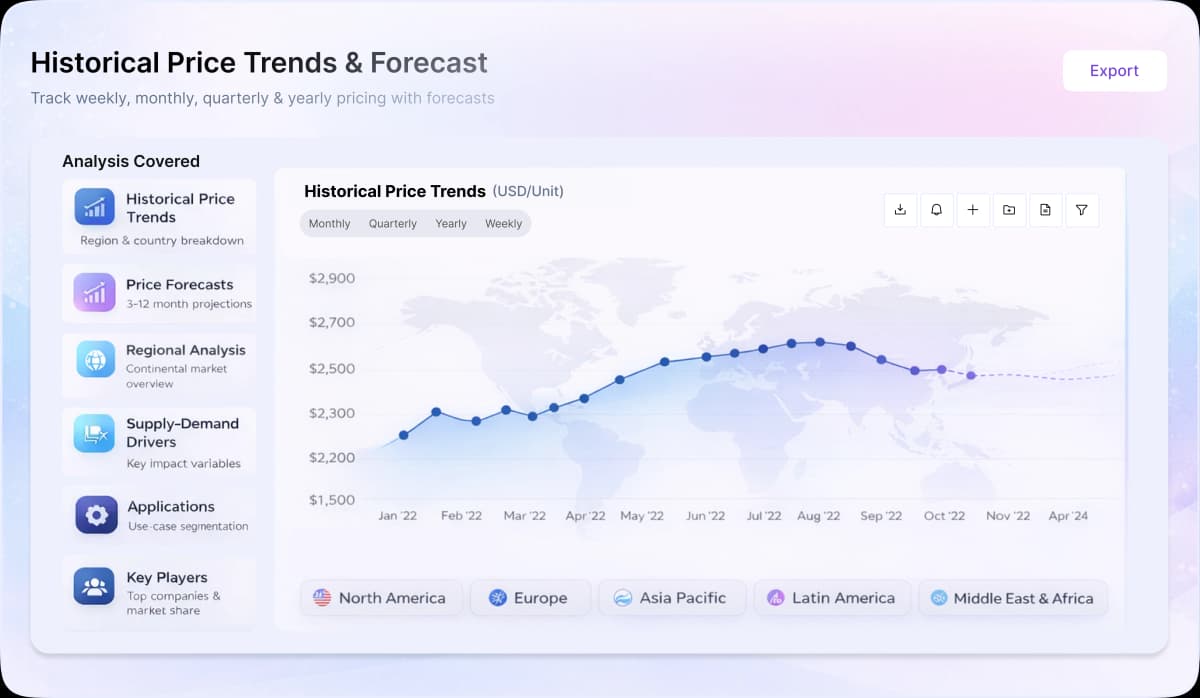
Get real-time price assessments, periodic trends, forecasts and price driver insights across key global markets.
Unlock Price Insights NowOur Clients

Turn price intelligence into action with the Procurement Resource Database. Log in or subscribe to unlock live price trends, historical charts, supplier databases, cost curves, and analyst-backed insights across chemicals, agriculture, energy, packaging, and more. Use these tools to benchmark your contracts, plan budgets with confidence, and stay ahead of market moves on every product you buy.

0
+Products
0
+Regions
0
+Subscriptions
| Product | Category | Region | Price | Last Updated Month |
| Bromine | Chemicals | India | 4295 USD/MT | October 2025 |
| Bromine | Chemicals | India | 4295 USD/MT | December 2025 |
| Bromine | Chemicals | China | 4025 USD/MT | October 2025 |
| Bromine | Chemicals | China | 4910 USD/MT | December 2025 |
Stay updated with the latest Bromine prices, historical data, and tailored regional analysis
Asia
Chinese bromine markets experienced progressive price appreciation throughout the fourth quarter, driven by tightening supply conditions and sustained downstream demand. The prices were about 4025 USD/MT (Spot FD) in October and around 4910 USD/MT in December. The quarter witnessed consistent upward momentum with minimal volatility, as prices advanced steadily from opening levels through year-end. Supply-side constraints emerged as production facilities faced operational limitations, while environmental regulations continued influencing output capacity in key manufacturing regions. Demand from flame retardant applications, pharmaceutical intermediates, and water treatment sectors maintained strong consumption patterns, absorbing available supply and supporting price increases. Manufacturing costs remained elevated due to energy expenses and raw material inputs, providing additional support for upward price adjustments. The combination of controlled supply availability and steady end-use demand created favourable market conditions for price appreciation across the quarter.
In Q4’25, the bromine price curve displayed range bound movements in the Indian markets. The prices were about 4295 USD/MT (CIF) in October and around 4295 USD/MT in December. Prices reached their highest levels as supply tightness coincided with active procurement from downstream sectors. However, the latter portion witnessed weakening as supply conditions eased and demand moderated. End-use consumption from flame retardants, agrochemicals, and pharmaceutical applications softened as buyers adopted cautious purchasing strategies. The declining trajectory reflected improved supply availability and reduced immediate procurement requirements, with prices ending the quarter below opening levels despite the mid-period strength.
Europe
European bromine markets mirrored Chinese pricing trends, experiencing steady appreciation throughout the fourth quarter. Supply constraints and stable downstream consumption from flame retardant, pharmaceutical, and specialty chemical sectors supported progressive price increases. Manufacturing facilities maintained consistent operating rates while managing elevated production costs. The upward price trajectory aligned with global supply tightness and sustained end-use demand across key application segments.
North America
North American bromine markets followed patterns similar to China, with slight price strengthening throughout the quarter. Demand from flame retardant applications, oil and gas drilling fluids, and water treatment chemicals remained steady, supporting consistent consumption levels. Supply conditions stayed relatively tight as domestic production balanced against end-use requirements, enabling manufacturers to implement sequential price adjustments in line with cost pressures and market conditions.
Bromine is a chemical element having atomic number 35. A naturally occurring element, it is the third-lightest member of the halogen series in the periodic table. At room temperature, it appears as a fuming red-brown liquid with a pungent odour that evaporates quickly to produce a similar coloured gas.
Its properties are intermediate between the two adjacent halogens, that is, chlorine and iodine. Elemental Bromine is represented by the symbol Br. Commercially, the element is extracted from brine pools across several nations, including the US and others.
Br2
Chemical intermediate, Fuel additives and fire retardants, Pesticides, Oil well drilling fluids, Brominating agent, Water and surface disinfectant, Pharmaceuticals, Bleaching agent
Br
ICL Group Ltd, Albemarle Corporation, Lanxess AG, Tosoh Corporation, Tata Chemicals Ltd
CurrencyUS$ (Data can also be provided in local currency)
Supplier Database AvailabilityYes
Customization ScopeThe report can be customized as per the requirements of the customer
Post-Sale Analyst Support360-degree analyst support after report delivery
Note: Our supplier search experts can assist your procurement teams in compiling and validating a list of suppliers indicating they have products, services, and capabilities that meet your company's needs.
Bromine is more abundant in the oceans, and salt lakes and brine wells also have higher bromine concentrations. Thus, Bromine is extracted from these sources due to its economic feasibility.
In order to liberate Bromine, the process of halogen exchange is utilised, which involves the use of chlorine gas to produce Br2. It is then separated with a blast of steam or air, followed by condensation and purification.
Udeesha Tomar
AVP - Strategy and Solutions
Leading procurement research solutions across chemicals, materials, and food & beverages, with expertise in price forecasting and market analytics.

Our Price Analysis Methodology

Experience how Procurement Resource transforms raw material price data into clear, decision ready intelligence. Optimise your performance with reliable, expert market data and analysis. Schedule your demo today to experience a live walk-through where our experts will showcase interactive price charts, forecasted prices, and insights driving the prices for your key commodities, tailored to your workflows. Contact us now!
Our Team will be happy to assist you
We are just a text away
Still Need Help?
This report presents the cost structure of Tetrabromobisphenol A (TBBPA) production with the aid of bisphenol A (BPA) and bromine.
Unlock full access to Procurement Resource's price databases, interactive charts, and short-term forecasts for thousands of commodities. Elevate your sourcing decisions by comparing prices across regions, downloading historical data, and layering in analyst-backed insights, all with our flexible plans that scale as your portfolio grows.
Still have any Questions
Contact Us


Price Trend Dashboard - What's Included
Price trends across a diverse portfolio of categories and products, spanning board to niche chemicals
Coverage extendable to grade-specific chemicals based on procurement requirements
Regular price tracking supported by robust historical datasets
News, policy updates, and key market drivers impacting price movements
Short-term and long-term price outlooks and forecasts
Supply-demand dynamics and capacity-driven market analysis

Producer Results Confirm Strong Bromine Pricing Amid Jordan And Hormuz Disruption

Bromine Based Compounds Manufacturers, Neogen, to Secure Electrolytes Manufacturing Technology through Acquisition from a Japanese Company

Ford Plans to Invest £230 Million to Produce Electric Vehicles Components in United Kingdom