

Udeesha Tomar
AVP - Strategy and Solutions
Leading procurement research solutions across chemicals, materials, and food & beverages, with expertise in price forecasting and market analytics.

Asia
In Asia, cellulose ether prices followed a mixed trend during the second half of 2025. During the third quarter, prices remained subdued due to ample wood pulp supply, high domestic port inventories, and weak demand from downstream sectors such as construction additives, coatings, and paper manufacturing. Although some temporary destocking activity improved market sentiment briefly, high raw material availability and cautious buying behaviour kept the market under pressure. In the fourth quarter, the market showed gradual firmness as evolving trade policy developments, particularly China’s restrictions on dry-milled recycled pulp imports, created uncertainty in the fibre supply chain. Rising feedstock costs and tighter spot availability toward the end of the period provided additional support to cellulose ether prices.
Europe
In Europe, cellulose ether prices remained largely stable to firm during H2 2025. During the third quarter, the market stayed range-bound, supported by steady demand from construction-related applications such as dry-mix mortars, plasters, and coatings. Balanced operating rates, stable input costs, and moderate downstream demand helped maintain market equilibrium. In the fourth quarter, prices moved upward gradually as feedstock cost pressures increased and regulatory developments, including the Carbon Border Adjustment Mechanism, influenced procurement strategies. Tightening supply conditions and logistics pressures further supported firmer pricing toward the close of the year.
North America
In North America, cellulose ether prices followed a firming trend during H2 2025. In the third quarter, the market experienced mild upward movement as demand from the pharmaceutical, personal care, and construction materials sectors remained steady, while improved access to Brazilian cellulose eased earlier feedstock concerns. In the fourth quarter, prices increased further due to higher production costs in exporting regions, rising ocean freight rates, and tighter inventory positions among importers. Stable downstream demand and limited spot availability supported the stronger pricing environment through the end of the period.
Analyst Insight
According to Procurement Resource, cellulose ether prices are expected to maintain a broadly firm tone in the near term, supported by tighter feedstock availability and steady demand from construction, pharmaceutical, and industrial applications.
Need Latest Cellulose Ether Prices?
Get real-time price assessments, periodic trends, forecasts and price driver insights across key global markets.
Our Clients































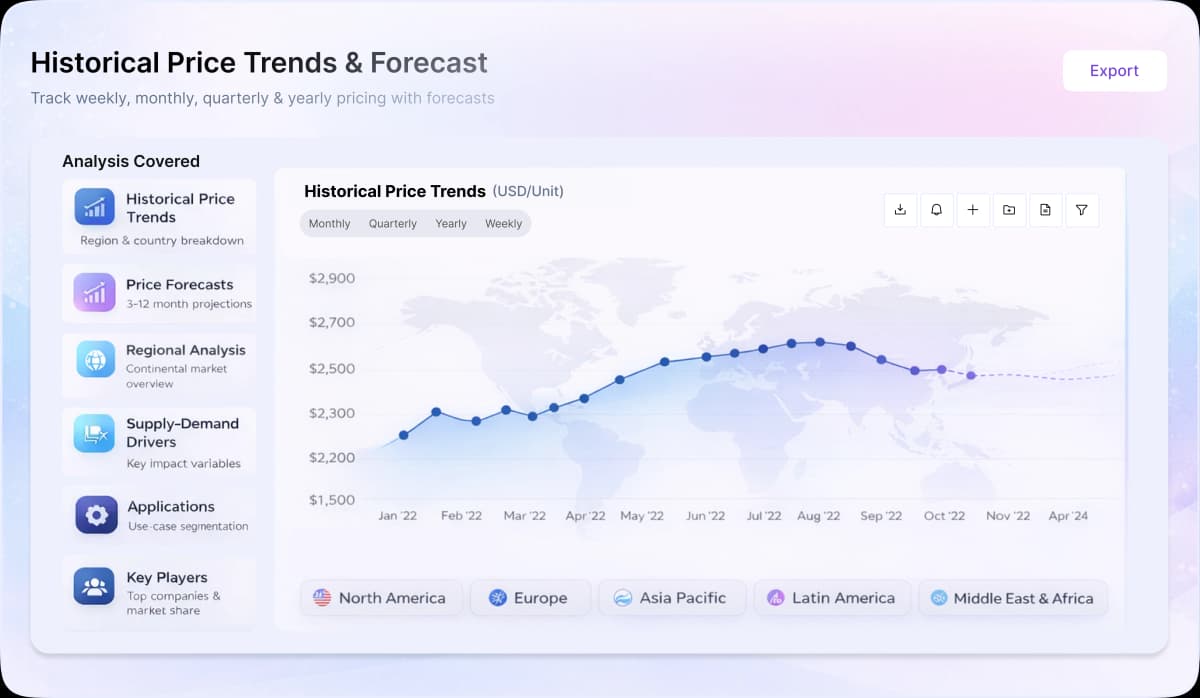
Turn price intelligence into action with the Procurement Resource Database. Log in or subscribe to unlock live price trends, historical charts, supplier databases, cost curves, and analyst-backed insights across chemicals, agriculture, energy, packaging, and more. Use these tools to benchmark your contracts, plan budgets with confidence, and stay ahead of market moves on every product you buy.
0
+Products
0
+Regions
0
+Subscriptions
Asia
Asian cellulose ether prices in Q2 2025 were affected by persistent weakness in upstream wood pulp prices and slack seasonal demand. The market experienced a steady reduction in pulp prices as major ports maintained high inventories and downstream demand remained weak. While there was some disruption to supply in producing nations, it had little effect on availability. Broadleaf and softwood pulp exports to China held steady or rose, but downstream applications like packaging and cultural paper still saw lower operating rates.
Although there was some recovery in paper mill production following the May Day holiday, buyers were still timid and tended to purchase on an as-needed basis. The net effect was a subdued pricing climate for cellulose ether, with thin transaction volume and narrow margins. Rolling futures and decreased trade risk on softening tariffs temporarily boosted sentiment, but general price direction remained constrained within a tight range.
Europe
In Europe, the market for cellulose ether dropped further with BEK pulp values continuing to drop. Pulp producers experienced increasing pressure with low prices and little success in enforcing rises. The balance of market power shifted towards buyers with a number of them resisting new offers and postponing orders. The pressure was fueled by soft demand for major end-use industries including construction, paint, and coatings.
Concern over the surge in Asian paper products, caused by rerouted shipments originally bound for the U.S. market, added pressure. Port inventories continued high, and slow paper and board segments helped to keep caution present. Although NBSK pulp exhibited some price stability, it did not carry over into stronger pricing for cellulose ether. Sentiment was poor, and producers tempered production in accordance with slower offtake.
North America
Cellulose ether prices in North America were relatively flat, although cost structures continued to come under pressure from raw material volatility and changing trade dynamics. Though tariffs continued to influence sourcing strategies, the market was somewhat cushioned by demand in markets like oilfield services, food, and pharma.
However, buyer behavior was influenced by backlogged shipments and extended order cycles, and this resulted in a cautious buying strategy. Competition from Latin American and Asian producers increased, providing alternative supply channels with better logistics and cost terms. Local suppliers thus experienced pushback on prices, and total transaction volumes were modest during the quarter.
Cellulose ether refers to a group of water-soluble polymers derived from cellulose; a natural polysaccharide found in plant cell walls. It is produced by modifying cellulose through chemical reactions, resulting in different types of cellulose ethers with diverse properties. These ethers are widely used in various industries as thickeners, stabilizers, binders, and water-retention agents in products like construction materials, pharmaceuticals, personal care items, food, paints, and coatings.
Paints and coatings, Oil and gas, Food stabilizer, Sizing agent, Paper industry, Construction
The Dow chemical company, Shin-Etsu Chemical Co. Ltd, Ashland Global Holdings, Inc, LOTTE Fine Chemicals, Rayonier Advanced Materials Inc, Shandong Head Co. Ltd, Zibo Hailan Chemical Co Ltd
CurrencyUS$ (Data can also be provided in local currency)
Supplier Database AvailabilityYes
Customization ScopeThe report can be customized as per the requirements of the customer
Post-Sale Analyst Support360-degree analyst support after report delivery
Note: Our supplier search experts can assist your procurement teams in compiling and validating a list of suppliers indicating they have products, services, and capabilities that meet your company's needs.
The reaction of cellulose with aqueous solution of sodium hydroxide is the first step of this process. In the subsequent steps, the resulting solution is reacted with alkyl halide to finally give cellulose ether.
Our Price Analysis Methodology
AVP - Strategy and Solutions
Leading procurement research solutions across chemicals, materials, and food & beverages, with expertise in price forecasting and market analytics.

Experience how Procurement Resource transforms raw material price data into clear, decision ready intelligence. Optimise your performance with reliable, expert market data and analysis. Schedule your demo today to experience a live walk-through where our experts will showcase interactive price charts, forecasted prices, and insights driving the prices for your key commodities, tailored to your workflows. Contact us now!
Our Team will be happy to assist you
We are just a text away
Still Need Help?
Unlock full access to Procurement Resource's price databases, interactive charts, and short-term forecasts for thousands of commodities. Elevate your sourcing decisions by comparing prices across regions, downloading historical data, and layering in analyst-backed insights, all with our flexible plans that scale as your portfolio grows.
Still have any Questions
Contact Us



Price Trend Dashboard - What's Included
Price trends across a diverse portfolio of categories and products, spanning board to niche chemicals
Coverage extendable to grade-specific chemicals based on procurement requirements
Regular price tracking supported by robust historical datasets
News, policy updates, and key market drivers impacting price movements
Short-term and long-term price outlooks and forecasts
Supply–demand dynamics and capacity-driven market analysis

Track prices, market movements, supply-demand dynamics, and industry developments across hundreds of commodities through a centralized intelligence platform built for informed procurement decisions.

Understand market fluctuations using analyst-backed forecasts, historical pricing patterns, and evolving industry trends to strengthen sourcing strategies and budget planning.

Leverage cost models, pricing benchmarks, and procurement insights to evaluate purchasing opportunities, improve negotiations, and enhance operational efficiency.
Access region-specific price trends, trade activities, capacity changes, and supply chain developments influencing commodity markets worldwide.