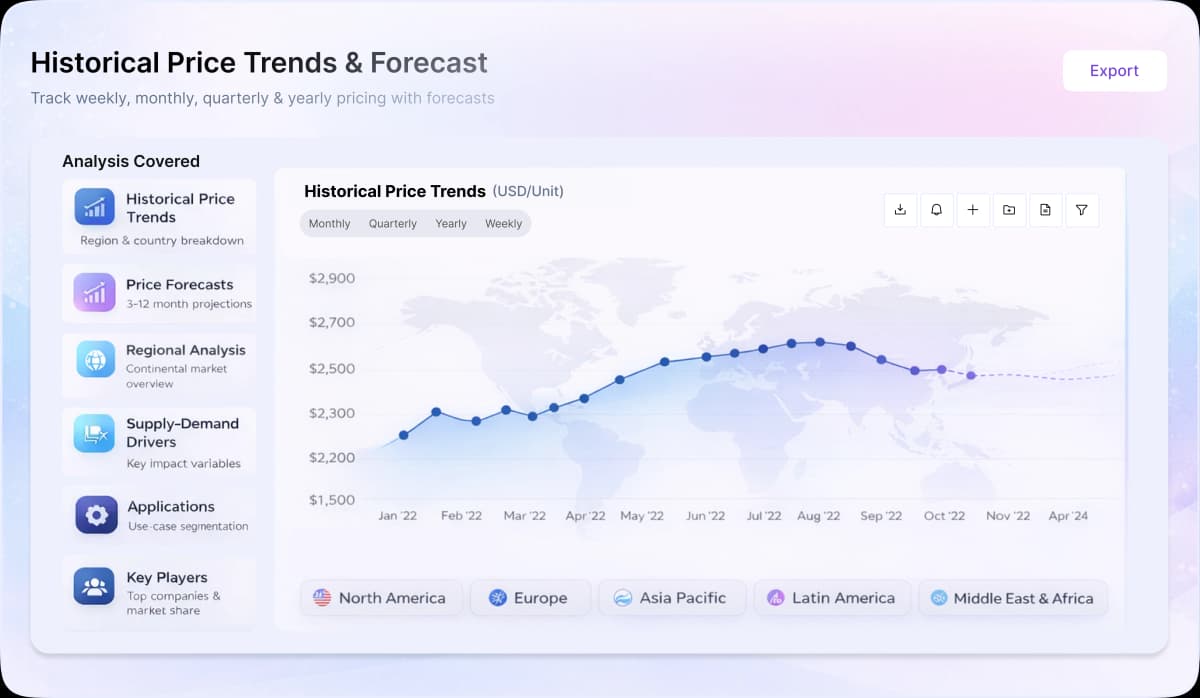
Cocoa Price Trend Analysis 2026: Historical Prices, Price Drivers, Latest News, Market Insights & Supply Demand Analysis

Pragati Agarwal profile photo
Written ByPragati Agarwal

Procurement Resource Database

Laptop screen

Turn price intelligence into action with the Procurement Resource Database. Log in or subscribe to unlock live price trends, historical charts, supplier databases, cost curves, and analyst-backed insights across chemicals, agriculture, energy, packaging, and more. Use these tools to benchmark your contracts, plan budgets with confidence, and stay ahead of market moves on every product you buy.

Cocoa Dashboard Inclusions

Cocoa Price Dasboard

0

+

Products

0

+

Regions

0

+

Subscriptions

  • Cocoa prices declined globally in Q1’26 as improved harvest outlooks in West Africa shifted the market from deficit to surplus, reversing the previous upward cycle.
  • Feedstock and supply dynamics weakened price support, with favourable weather boosting production while exporters locked in future prices to hedge volatility.
  • Downstream demand remained subdued earlier due to high costs and reformulation trends, before showing a slight pickup during the Easter season supported by seasonal consumption patterns.

Cocoa prices trended downward, falling over 10% year-on-year at the start of 2026 and extending a broader correction of more than 70% from late-2024 highs, primarily driven by recovering production and improved harvest expectations in key West African origins. Favourable weather conditions in Côte d’Ivoire and Ghana, accounting for over 60% of global supply, supported early crop development, while expectations of surplus in the 2025/26 season weighed further on sentiment.

On the trade side, declining futures did not immediately translate into lower retail prices, as manufacturers continued to process higher-cost inventories purchased earlier, maintaining elevated shelf prices. Consumption patterns reflected pressure, with around 90% of Easter confectionery demand still chocolate-based and total seasonal spending estimated at about $3.3 billion yet supported by reformulation and cost control strategies rather than volume growth. Additionally, regulatory shifts such as traceability requirements increased compliance costs, influencing sourcing decisions.

About Cocoa

Cocoa, derived from the seeds of the Theobroma cacao tree, is a crucial agricultural commodity primarily used in the production of chocolate. The seeds, known as cocoa beans, undergo a meticulous process of fermentation, drying, roasting, and grinding to produce cocoa mass, cocoa butter, and cocoa powder.

Cocoa butter is valued for its rich, creamy texture and is also widely used in cosmetic products. The powder serves as a key ingredient in various food products due to its rich flavor and antioxidant properties. Native to the Amazon and Orinoco River basins, cocoa plays a significant role in global economies, especially in West Africa, which dominates global production.

Cocoa Product Detail

Hs Code
18010000
Synonyms

Cacao, Cocoa bean, Chocolate bean

Industrial Uses

Chocolate Production, Baking and Confectionery,Beverages, Cosmetics, Pharmaceuticals, Nutraceuticals

Supplier Database

Cargill Incorporated, Cocoa Processing Company Limited (CPC), ECOM Agroindustrial Corp. Limited, PRONATEC AG, Blommer Chocolate Company, Tradin Organic Agriculture B.V.

Regional Coverage

Asia Pacific

China, India, Indonesia, Pakistan, Bangladesh, Japan, Philippines, Vietnam, Iran, Thailand, South Korea, Iraq, Saudi Arabia, Malaysia, Nepal, Taiwan, Sri Lanka, UAE, Israel, Hongkong, Singapore, Oman, Kuwait, Qatar, Australia, and New Zealand

Europe

Germany, France, United Kingdom, Italy,Spain, Russia, Turkey, Netherlands, Poland, Sweden, Belgium, Austria, Ireland Switzerland, Norway, Denmark, Romania, Finland, Czech Republic, Portugal and Greece

North America

United States and Canada

Latin America

Brazil, Mexico, Argentina, Columbia, Chile, Ecuador, and Peru

Africa

South Africa, Nigeria, Egypt, Algeria, Morocco

CurrencyUS$ (Data can also be provided in local currency)

Supplier Database AvailabilityYes

Customization ScopeThe report can be customized as per the requirements of the customer

Post-Sale Analyst Support360-degree analyst support after report delivery

Note: Our supplier search experts can assist your procurement teams in compiling and validating a list of suppliers indicating they have products, services, and capabilities that meet your company's needs.

Cocoa Production Process

Cocoa is a natural product obtained from cocoa trees (obtained from cocoa bean that serves as its primary feedstock. Cocoa beans are first cleaned and roasted to develop flavor. The beans are then cracked, and shells are removed to obtain cocoa nibs. These nibs are ground into cocoa liquor. Cocoa butter is extracted from the liquor, leaving cocoa powder, both used in chocolate manufacturing.

Frequently Asked Questions

Cocoa prices remained highly volatile during Q1 2026 as weaker global grindings and softer chocolate demand pressured futures markets, while West African supply concerns continued supporting periodic rebounds. Weather risks, disease pressure, and slower farmer selling in Côte d’Ivoire and Ghana limited downside movement, although U.S. cocoa prices still declined approximately 21.51% between January and March amid broader demand weakness.
Cocoa prices are expected to remain highly sensitive to supply and demand developments during 2026. Improved crop expectations in West Africa may reduce extreme supply pressure, although weather risks, crop disease, farmer selling behaviour, and inventory rebuilding could continue supporting volatility. Demand recovery from grinders and chocolate manufacturers will remain critical after weaker global grindings and softer consumer spending reduced cocoa processing activity.
Cocoa prices in Q1 2026 were pressured by weaker chocolate demand and lower grindings activity in major consuming regions. At the same time, weather concerns, disease risks, delayed farmer selling, and uncertainty around West African crop quality continued supporting market volatility. Rising unsold cocoa stocks in Côte d’Ivoire also highlighted weaker physical demand and disrupted normal export trade flows.
ICCO (International Cocoa Organization) revised 2024/25 global cocoa production upward to approximately 4.728 million tonnes, representing an 8.4% year-on-year increase. Improved crop expectations in Côte d’Ivoire and Ghana supported expectations of better global cocoa availability after earlier supply deficits, although weather conditions and disease risks continued to create uncertainty around actual exportable supply.
Côte d’Ivoire and Ghana dominate global cocoa production and exports, followed by Ecuador, Nigeria, Cameroon, Brazil, and Indonesia. West Africa remains the world’s primary cocoa supply hub because of its large bean output, established export infrastructure, and central role in supplying cocoa beans to European, Asian, and North American grinding industries.
Cocoa grindings measure the volume of cocoa beans processed into cocoa liquor, cocoa butter, cocoa powder, and cake, making them an important indicator of chocolate and confectionery demand. ICCO revised 2024/25 global grindings to 4.606 million tonnes, down 4.2% year-on-year, reflecting weaker processing demand amid elevated cocoa costs and softer consumer purchasing activity.
Côte d’Ivoire and Ghana faced mounting cocoa trade pressure in 2026 after global cocoa futures declined sharply from 2024 highs while domestic farmgate prices remained elevated. The pricing mismatch reduced trader buying interest, contributed to unsold cocoa stocks in Côte d’Ivoire, and forced Ghana to cut farmer prices by nearly 29%, raising concerns about export competitiveness and procurement risk across West African supply chains.
Chocolate and confectionery are the largest consumers of cocoa, followed by bakery, beverages, dairy, cosmetics, and pharmaceuticals. Demand is mainly driven by cocoa liquor, cocoa butter, and cocoa powder usage. Premium chocolate, seasonal buying, and consumer spending strongly influence procurement trends.
Cocoa futures traded on the London and New York exchanges serve as global pricing benchmarks for physical cocoa trade. Procurement contracts commonly incorporate futures prices alongside origin premiums, quality differentials, and delivery terms. Futures volatility directly affects hedging strategies, inventory decisions, trader sentiment, and procurement costs for grinders and chocolate manufacturers.
Procurement Resource employs a structured methodology combining primary research, secondary market intelligence, analytical models, and validation processes to assess cocoa prices and market trends. Evaluations incorporate cocoa production, grindings activity, futures markets, trade flows, downstream demand, and value chain analysis, supported by continuous market monitoring and cross-verification.

About the Author

Pragati Agarwal profile photo

Pragati Agarwal

Senior Business Insights Analyst

Delivering price trend analysis and procurement market insights at Procurement Resource, with expertise in identifying commodity patterns, supporting purchasing strategies, and improving cost efficiency through actionable market intelligence.

Our Price Analysis Methodology

Schedule Demo

Schedule a demo

Experience how Procurement Resource transforms raw material price data into clear, decision ready intelligence. Optimise your performance with reliable, expert market data and analysis. Schedule your demo today to experience a live walk-through where our experts will showcase interactive price charts, forecasted prices, and insights driving the prices for your key commodities, tailored to your workflows. Contact us now!

Our Team will be happy to assist you

We are just a text away

+1

Still Need Help?

Europe & Africa

+44 7573 171117

[email protected]

USA & Canada

+1 307 363 1045

[email protected]

APAC

+91 8850629517

[email protected]

Other Related Reports

Cocoa Butter Production from Grinding and Pressing Method

This report provides the cost structure of cocoa butter production from the grinding and pressing methods. When the nibs extracted from cocoa beans are grounded, it produces chocolate liquor.

White Chocolate Production from Cocoa Butter

This report provides the cost structure of white chocolate production from cocoa butter. Cocoa butter is separated from the whole cocoa mass to make a press cake of cocoa beans.

Unlock full access to Procurement Resource's price databases, interactive charts, and short-term forecasts for thousands of commodities. Elevate your sourcing decisions by comparing prices across regions, downloading historical data, and layering in analyst-backed insights, all with our flexible plans that scale as your portfolio grows.

Still have any Questions

Contact Us
Mastercard
Wire
VISA
Stripe

Related News

View All

Why Procurement Database

Commodity Market Intelligence

Commodity Market Intelligence

Track prices, market movements, supply-demand dynamics, and industry developments across hundreds of commodities through a centralized intelligence platform built for informed procurement decisions.

Price Forecasts & Market Outlooks

Price Forecasts & Market Outlooks

Understand market fluctuations using analyst-backed forecasts, historical pricing patterns, and evolving industry trends to strengthen sourcing strategies and budget planning.

Cost & Procurement Optimization

Cost & Procurement Optimization

Leverage cost models, pricing benchmarks, and procurement insights to evaluate purchasing opportunities, improve negotiations, and enhance operational efficiency.

Global & Regional Market Insights

Global & Regional Market Insights

Access region-specific price trends, trade activities, capacity changes, and supply chain developments influencing commodity markets worldwide.

1/4