

Udeesha Tomar
AVP - Strategy and Solutions
Leading procurement research solutions across chemicals, materials, and food & beverages, with expertise in price forecasting and market analytics.

DSBP is an optical brightening agent used across laundry detergents, textiles, paper, and cosmetics, prized for imparting a bright white finish and strong stability with hypochlorite bleach. It is manufactured from biphenyl, reacted with hydrogen chloride and formaldehyde to form 4,4'-bis(chloromethyl)biphenyl, then further reacted with trimethylphosphite and benzaldehyde-2-sulphonic acid to yield DSBP, meaning its cost structure tracks biphenyl and formaldehyde feedstock markets.
Through H1 2026, DSBP pricing stayed soft, extending the declining trajectory seen through 2024 and 2025. In Asia, ample domestic supply and weak demand from the electronics and optical brightener sectors kept prices under pressure, with manufacturing slowdowns in China and India further suppressing procurement enthusiasm. European markets softened in a similarly muted fashion, tracking Asian trends but to a lesser degree, as buyers favored smaller, more frequent purchases over building inventory.
Analyst Insight
According to Procurement Resource, DSBP prices should stay soft near term as high stocks and weak demand persist.
Related Report
Need Latest DSBP (4,4-Distyryl Biphenyl Derivative) Prices?
Get real-time price assessments, periodic trends, forecasts and price driver insights across key global markets.
Our Clients































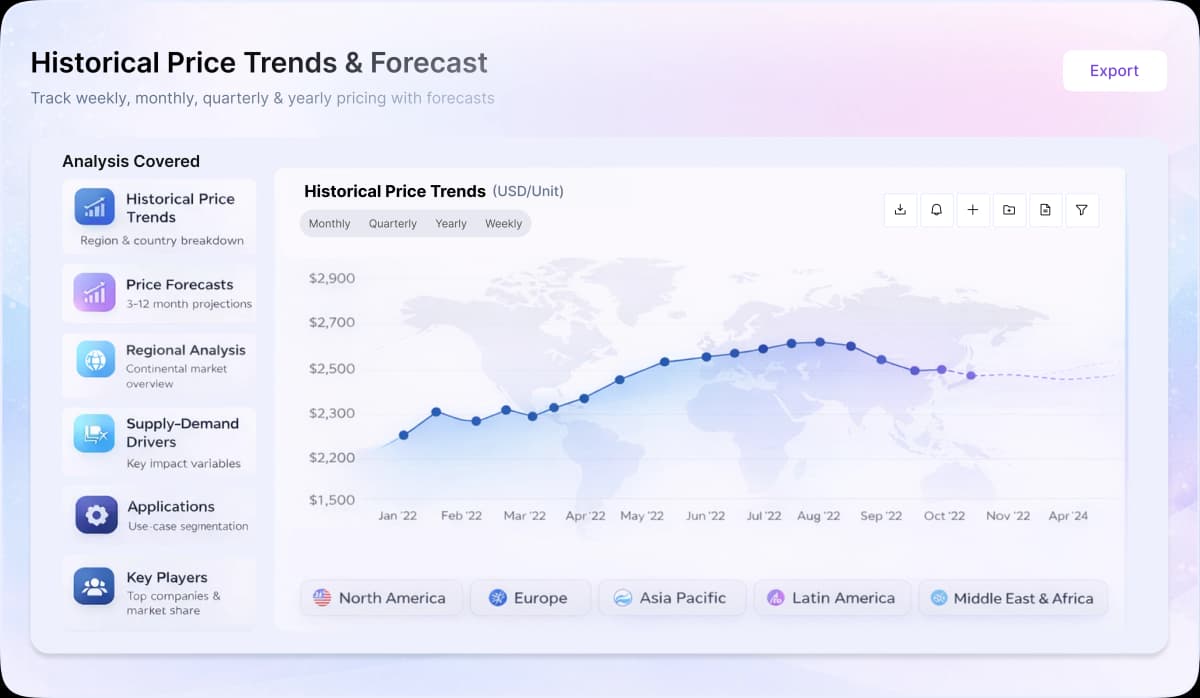
Turn price intelligence into action with the Procurement Resource Database. Log in or subscribe to unlock live price trends, historical charts, supplier databases, cost curves, and analyst-backed insights across chemicals, agriculture, energy, packaging, and more. Use these tools to benchmark your contracts, plan budgets with confidence, and stay ahead of market moves on every product you buy.
0
+Products
0
+Regions
0
+Subscriptions
During the first half of 2025, DSBP prices showed a steady to slightly bullish trend across major regions. The price movement was influenced by raw material dynamics, particularly the supply and cost trends of formaldehyde and other aromatic intermediates. In Asia, stable demand from the textile and paper industries supported prices, while fluctuations in China’s formaldehyde supply around the Lunar New Year had a mild impact on overall production costs. India's consistent construction and resin activity also indirectly influenced DSBP markets through stable formaldehyde inputs.
In Europe, the upward momentum in DSBP pricing was more pronounced due to tight raw material supply and rising energy costs. Disruptions in methanol and formaldehyde availability early in the year led to cost pressures, which producers passed down the chain. North America followed a similar pattern, where supply issues and plant outages pushed input costs higher, keeping DSBP prices elevated despite mixed demand signals from construction and industrial coatings sectors.
DSBP, popularly known as Tinopal CBS-X, appears as a greenish yellow solid. It is used as an optical brightening agent for home care applications. It provides excellent white effects on cellulosic fibres over the whole temperature range, particularly from cold to medium working temperatures. It has a higher yield of whiteness than the traditional stilbene type brighteners. It finds wide applications in paper and pulp industry.
C28H20Na2O6S2
Fluorescent whitening agent, Laundry detergents and Industrial detergents, Soaps and boosters, Dyes, Cosmetics, Finishing agents, Intermediates, Photosensitive chemicals
27344-41-8, Tinopal CBS-X, 4,4'-Bis(2-sulfostyryl)biphenyl Disodium, Disodium 4,4'-Bis(2-sulfonatostyryl)biphenyl
BASF SE, Toronto Research Chemicals Inc, Paramount Minerals and Chemicals Limited, Archroma
CurrencyUS$ (Data can also be provided in local currency)
Supplier Database AvailabilityYes
Customization ScopeThe report can be customized as per the requirements of the customer
Post-Sale Analyst Support360-degree analyst support after report delivery
Note: Our supplier search experts can assist your procurement teams in compiling and validating a list of suppliers indicating they have products, services, and capabilities that meet your company's needs.
In this process, 4,4- bis(chloromethyl) biphenyl, obtained from the reaction between biphenyl and formaldehyde, is utilised to produce DSBP. 4,4- bis(chloromethyl) biphenyl is heated at a temperature between 117 and 119oC in the presence of trimethyl phosphite to give 4,4- bis(dimethoxyphosphonomethyl)biphenyl and methyl chloride, which finally reacts with benzaldehyde sulphonic acid to form DSBP.
Our Price Analysis Methodology
AVP - Strategy and Solutions
Leading procurement research solutions across chemicals, materials, and food & beverages, with expertise in price forecasting and market analytics.
Experience how Procurement Resource transforms raw material price data into clear, decision ready intelligence. Optimise your performance with reliable, expert market data and analysis. Schedule your demo today to experience a live walk-through where our experts will showcase interactive price charts, forecasted prices, and insights driving the prices for your key commodities, tailored to your workflows. Contact us now!
Our Team will be happy to assist you
We are just a text away
Still Need Help?
Unlock full access to Procurement Resource's price databases, interactive charts, and short-term forecasts for thousands of commodities. Elevate your sourcing decisions by comparing prices across regions, downloading historical data, and layering in analyst-backed insights, all with our flexible plans that scale as your portfolio grows.
Still have any Questions
Contact Us



Price Trend Dashboard - What's Included
Price trends across a diverse portfolio of categories and products, spanning board to niche chemicals
Coverage extendable to grade-specific chemicals based on procurement requirements
Regular price tracking supported by robust historical datasets
News, policy updates, and key market drivers impacting price movements
Short-term and long-term price outlooks and forecasts
Supply–demand dynamics and capacity-driven market analysis

Track prices, market movements, supply-demand dynamics, and industry developments across hundreds of commodities through a centralized intelligence platform built for informed procurement decisions.

Understand market fluctuations using analyst-backed forecasts, historical pricing patterns, and evolving industry trends to strengthen sourcing strategies and budget planning.

Leverage cost models, pricing benchmarks, and procurement insights to evaluate purchasing opportunities, improve negotiations, and enhance operational efficiency.
Access region-specific price trends, trade activities, capacity changes, and supply chain developments influencing commodity markets worldwide.