

Udeesha Tomar
AVP - Strategy and Solutions
Leading procurement research solutions across chemicals, materials, and food & beverages, with expertise in price forecasting and market analytics.

Asia
In the second half of 2025, HEDP prices in Asia mostly followed a stable to slightly firm trend. Demand from the oil and gas sector provided steady support, especially in India, where large public-sector procurement activity improved buying confidence. Water treatment, industrial cleaning, and energy-related applications continued to generate regular consumption, even though overall chemical demand remained mixed. Feedstock availability in the phosphorus chain was relatively stable, which helped producers manage costs. However, weak demand from some industrial sectors and cautious purchasing behaviour limited strong price movement.
Europe
In Europe, HEDP prices remained mostly steady during H2’25, supported by stable downstream demand and controlled supply conditions. The phosphorus chemical chain showed signs of resilience, helped by consistent demand from water treatment and agrochemical-related applications. Improved transport conditions and stable feedstock costs supported smoother deliveries and predictable supply. However, the broader chemical industry continued to face weak industrial activity and high operating costs, which limited aggressive buying. Buyers preferred regular restocking instead of bulk purchases, keeping price movement limited.
North America
In North America, HEDP prices showed a stable trend throughout the second half of 2025. Demand from oil and gas operations, industrial water treatment, and cleaning chemicals remained steady but not strong. Buyers focused on contract-based sourcing and avoided excess inventory buildup. Adequate availability of upstream raw materials helped producers maintain consistent supply without major cost pressure. However, slower industrial activity and careful spending by end users kept the market from gaining momentum. As a result, pricing conditions stayed largely unchanged during H2’25.
Analyst Insight
According to Procurement Resource, HEDP prices are expected to remain stable, with demand from oil and gas and water treatment sectors likely to support the market in the near term.
Related Report
Need Latest HEDP (Etidronic Acid) Prices?
Get real-time price assessments, periodic trends, forecasts and price driver insights across key global markets.
Our Clients































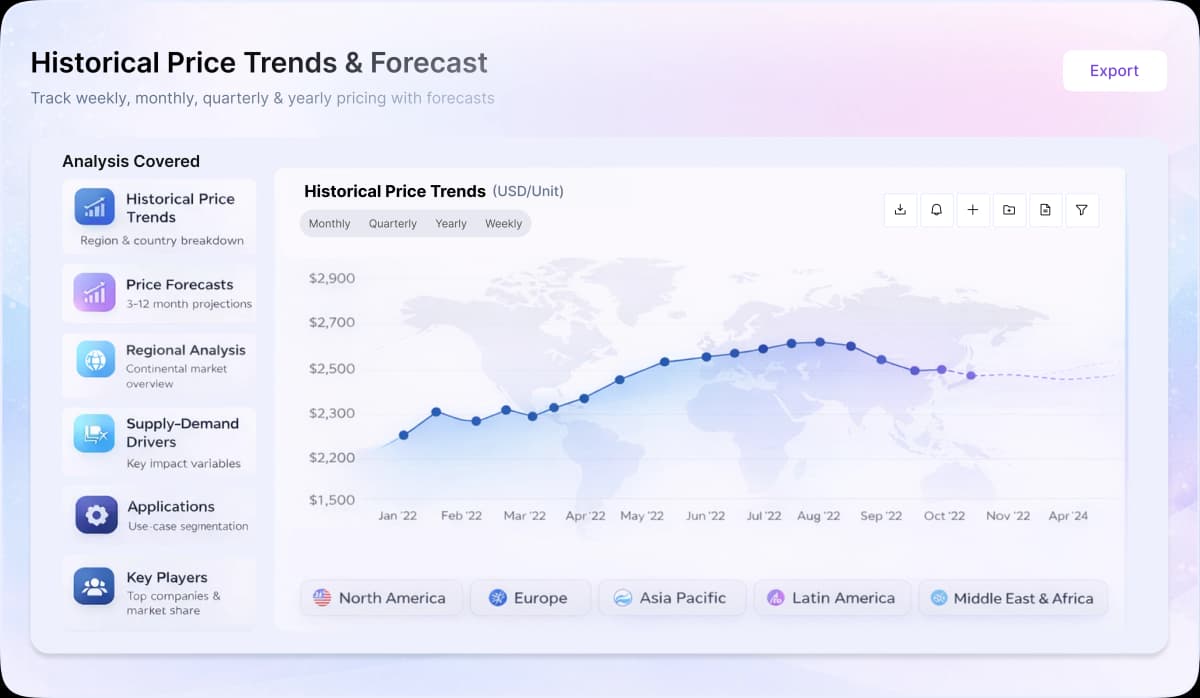
Turn price intelligence into action with the Procurement Resource Database. Log in or subscribe to unlock live price trends, historical charts, supplier databases, cost curves, and analyst-backed insights across chemicals, agriculture, energy, packaging, and more. Use these tools to benchmark your contracts, plan budgets with confidence, and stay ahead of market moves on every product you buy.
0
+Products
0
+Regions
0
+Subscriptions
Asia
In the first half of 2025, the HEDP market in Asia remained under pressure due to weak fundamentals in the upstream and downstream sectors. The oversupplied acetic acid market, especially in China, contributed to reduced cost support for HEDP production. Chinese suppliers, facing high inventory levels and lacklustre domestic demand, focused on maintaining export volumes to balance the market.
However, the impact of increased tariffs by the U.S. on Chinese-origin acetic acid and related chemicals raised uncertainty, indirectly affecting market sentiment for HEDP. Pre-Lunar New Year buying activity in key regions like North China and Shandong was subdued, which limited offtake. While trading conditions stabilized slightly in East and South China due to long-term contracts, overall demand remained weak, keeping prices under pressure.
Europe
In Europe, HEDP prices softened through H1’25 amid economic stagnation and declining industrial activity. The German chemical sector, in particular, struggled with poor business confidence, rising energy costs, and weak downstream demand. Phosphorus trichloride, a key raw material for HEDP, saw price declines due to limited demand from flame retardant and agrochemical sectors.
Additionally, muted construction activity and subdued fertilizer use further reduced demand for HEDP applications. These challenges, coupled with strong competition from Asian imports, kept prices on a downward trajectory throughout the period.
North America
The North American HEDP market experienced mixed trends in H1’25. While local demand was steady from water treatment and cleaning sectors, the imposition of high tariffs on Chinese acetic acid imports led to cost pressures for U.S.-based formulators.
Some players sought alternative sourcing or reduced production to manage cost volatility. Despite this, downstream activity in housing and municipal water treatment provided a degree of support. Nonetheless, concerns about sustained cost inflation and slower chemical sector growth kept buying activity cautious.
HEDP or Etidronic acid is a 1,1-bis (phosphonic acid), which is an (ethane-1,1-diyl) bis(phosphonic acid) with a hydroxy substituent at the 1-position. It inhibits the formation, growth, as well as the dissolution of hydroxyapatite crystals by chemisorption to calcium phosphate surfaces. This bisphosphonate is used in medication. It plays a role as a bone density conservation agent, a chelator and an antineoplastic agent.
C2H8O7P2
Medication, Detergents, Cosmetics, Water Treatment Agent, Chelating agent and antioxidant
2809-21-4, etidronate, 1-Hydroxyethylidene-1,1-diphosphonic acid
Zschimmer & Schwarz, Shandong Taihe Water Treatment Technologies Co., Ltd., Zhonglan Industry Co., Ltd, Acuro Organics Limited, Ava Chemicals Private Limited, Innova Corporate (India)
CurrencyUS$ (Data can also be provided in local currency)
Supplier Database AvailabilityYes
Customization ScopeThe report can be customized as per the requirements of the customer
Post-Sale Analyst Support360-degree analyst support after report delivery
Note: Our supplier search experts can assist your procurement teams in compiling and validating a list of suppliers indicating they have products, services, and capabilities that meet your company's needs.
In order to produce HEDP or Etidronic Acid, a reaction takes place between phosphorus trichloride and acetic acid in water that helps it in converting into phosphorus acid. After the conversion, it further reacts with the acetic anhydride in a vessel to finally produce HEDP.
Our Price Analysis Methodology
AVP - Strategy and Solutions
Leading procurement research solutions across chemicals, materials, and food & beverages, with expertise in price forecasting and market analytics.
Experience how Procurement Resource transforms raw material price data into clear, decision ready intelligence. Optimise your performance with reliable, expert market data and analysis. Schedule your demo today to experience a live walk-through where our experts will showcase interactive price charts, forecasted prices, and insights driving the prices for your key commodities, tailored to your workflows. Contact us now!
Our Team will be happy to assist you
We are just a text away
Still Need Help?
Unlock full access to Procurement Resource's price databases, interactive charts, and short-term forecasts for thousands of commodities. Elevate your sourcing decisions by comparing prices across regions, downloading historical data, and layering in analyst-backed insights, all with our flexible plans that scale as your portfolio grows.
Still have any Questions
Contact Us



Price Trend Dashboard - What's Included
Price trends across a diverse portfolio of categories and products, spanning board to niche chemicals
Coverage extendable to grade-specific chemicals based on procurement requirements
Regular price tracking supported by robust historical datasets
News, policy updates, and key market drivers impacting price movements
Short-term and long-term price outlooks and forecasts
Supply–demand dynamics and capacity-driven market analysis

Track prices, market movements, supply-demand dynamics, and industry developments across hundreds of commodities through a centralized intelligence platform built for informed procurement decisions.

Understand market fluctuations using analyst-backed forecasts, historical pricing patterns, and evolving industry trends to strengthen sourcing strategies and budget planning.

Leverage cost models, pricing benchmarks, and procurement insights to evaluate purchasing opportunities, improve negotiations, and enhance operational efficiency.
Access region-specific price trends, trade activities, capacity changes, and supply chain developments influencing commodity markets worldwide.