Need latest Methyl Isobutyl Ketone prices?
Get real-time price assessments, periodic trends, forecasts and price driver insights across key global markets.
Unlock Price Insights NowOur Clients
Asia
In Q2 2024, Methyl Isobutyl Ketone (MIBK) prices in China saw a significant upward trend driven by various factors. The increasing demand from downstream sectors, particularly the paint and coatings industries linked to construction and automotive activities, supported the price rise against the backdrop of elevated crude oil costs and supply chain disruptions. China's economic growth, fueled by strong export performance and manufacturing expansion, further bolstered the demand for petrochemicals like Methyl Isobutyl Ketone.
Additionally, geopolitical tensions in the Middle East and rising crude oil prices, along with positive demand signals from the US, contributed to this upward price movement. Despite stable feedstock availability, MIBK prices were influenced by disruptions in southern China's supply chain caused by severe weather and production facility shutdowns. In India, Methyl Isobutyl Ketone prices followed a similar trend, driven by strong overseas demand and increased industrial activity.
Europe
In Europe, Methyl Isobutyl Ketone prices were similarly supported by rising downstream activities and limited production output. Although the quarter started with subdued market conditions due to weak inquiries and limited cost support from crude oil, OPEC+ output cuts led to a rise in crude oil prices in the latter half of the quarter, which was reflected in Methyl Isobutyl Ketone price trends. Geopolitical tensions further strained supply chains and raised transportation costs, hampering market growth. The trade exchange between the key markets, especially Asia and Europe, was also hampered because of these long-stretched supply chain hindrances.
North America
In North America, Methyl Isobutyl Ketone prices were pressured by high inventories and moderate demand initially. Early in the quarter, falling crude oil prices affected the market, but a mid-quarter boost in offtakes from the automotive and coatings sectors provided some relief. However, global shipping costs and rising freight charges led to cautious market behavior, causing fluctuations in Methyl Isobutyl Ketone prices throughout Q2 2024. The crude oil market also started improving significantly as the quarter concluded. Conclusively, a varying price trajectory was observed.
Analyst Insight
According to Procurement Resource, Methyl Isobutyl Ketone prices are expected to improve in the coming months as the petrochemical sector has started to pick up.
Related Report
Get real-time price assessments, periodic trends, forecasts and price driver insights across key global markets.
Unlock Price Insights NowOur Clients

Turn price intelligence into action with the Procurement Resource Database. Log in or subscribe to unlock live price trends, historical charts, supplier databases, cost curves, and analyst-backed insights across chemicals, agriculture, energy, packaging, and more. Use these tools to benchmark your contracts, plan budgets with confidence, and stay ahead of market moves on every product you buy.

0
+Products
0
+Regions
0
+Subscriptions
| Product | Category | Region | Price | Last Updated Month |
| Methyl Isobutyl Ketone | Chemicals | USA | 1623 USD/MT | March 2024 |
Stay updated with the latest Methyl Isobutyl Ketone prices, historical data, and tailored regional analysis
Asia
Methyl isobutyl ketone observed a mixed price trend during the first quarter of 2024. The first half of the quarter was more downward tilted compared to the latter half of the quarter. Chinese market started the year on a lower note in January as the prices were dwindling down. Supplies were tight; a lackluster customer interest compelled suppliers to keep the prices confined.
However, as days progressed, and the demands started rebounding the price trend also started to ascend up in the latter phase. A varying price trajectory was seen; the prices mostly remained muted in January’24 till the downstream demands again started motivating the market in the middle of the quarter.
Europe
In the European markets, the methyl isobutyl ketone prices closely followed the market behaviors of its feedstock materials, acetone, and isobutylene. For the majority of the discussed time span, the methyl isobutyl ketone prices were found to be wavering within a very narrow range. The feedstock costs were plunging, pushing the prices down along with them. The rise in crude oil and energy rates in the region pushed up the manufacturing upstream costs for methyl isobutyl ketone too. With this, the concerned market remained buoyant and vacillated within a limited spectrum.

North America
The methyl isobutyl ketone demand trajectory was witnessed to be modest in the US market as well. A decline in the acetone market also exerted downward pressure. This kept methyl isobutyl ketone prices swinging for the most part since the production costs were on an incline in the American markets, too, just like the European markets. With various market drivers acting differently, the Methyl Isobutyl Ketone market remained anchored in the American region. Conclusively, a moderate performance was experienced during Q1’24


Methyl Isobutyl Ketone (MIBK) is an organic molecule with the chemical formula CH3COCH2CH2CH(CH3)2. It is a transparent, colorless liquid. It smells strongly like sugar and is highly combustible. In many industrial applications, including paints, coatings, adhesives, and chemical processes, it is predominantly employed as a solvent. It is suited for applications that call for controlled drying and great solvency for a variety of substances due to its characteristics, which include a high solvency power, low water solubility, and a relatively slow evaporation rate.
C6H12O
Paints and coatings, Adhesives and sealants, Printing inks, Extraction
4-Methylpentan-2-one, MIBK
Sasol, Dow, Shell plc, Mitsui Chemical, Inc,KUMHO P&B CHEMICALS, INC
CurrencyUS$ (Data can also be provided in local currency)
Supplier Database AvailabilityYes
Customization ScopeThe report can be customized as per the requirements of the customer
Post-Sale Analyst Support360-degree analyst support after report delivery
Note: Our supplier search experts can assist your procurement teams in compiling and validating a list of suppliers indicating they have products, services, and capabilities that meet your company's needs.
In the first step of production of Methyl Isobutyl Ketone via aldol condensation, barium hydroxide is used to transform acetone into diacetone alcohol, which is then further dehydrated to produce mesityl oxide. The resulting mesityl oxide is then hydrogenated, saturating the double bond to provide methyl isobutyl ketone.
Our Price Analysis Methodology

Experience how Procurement Resource transforms raw material price data into clear, decision ready intelligence. Optimise your performance with reliable, expert market data and analysis. Schedule your demo today to experience a live walk-through where our experts will showcase interactive price charts, forecasted prices, and insights driving the prices for your key commodities, tailored to your workflows. Contact us now!
Our Team will be happy to assist you
We are just a text away
Still Need Help ?
Unlock full access to Procurement Resource's price databases, interactive charts, and short-term forecasts for thousands of commodities. Elevate your sourcing decisions by comparing prices across regions, downloading historical data, and layering in analyst-backed insights, all with our flexible plans that scale as your portfolio grows.
Still have any Questions
Contact Us


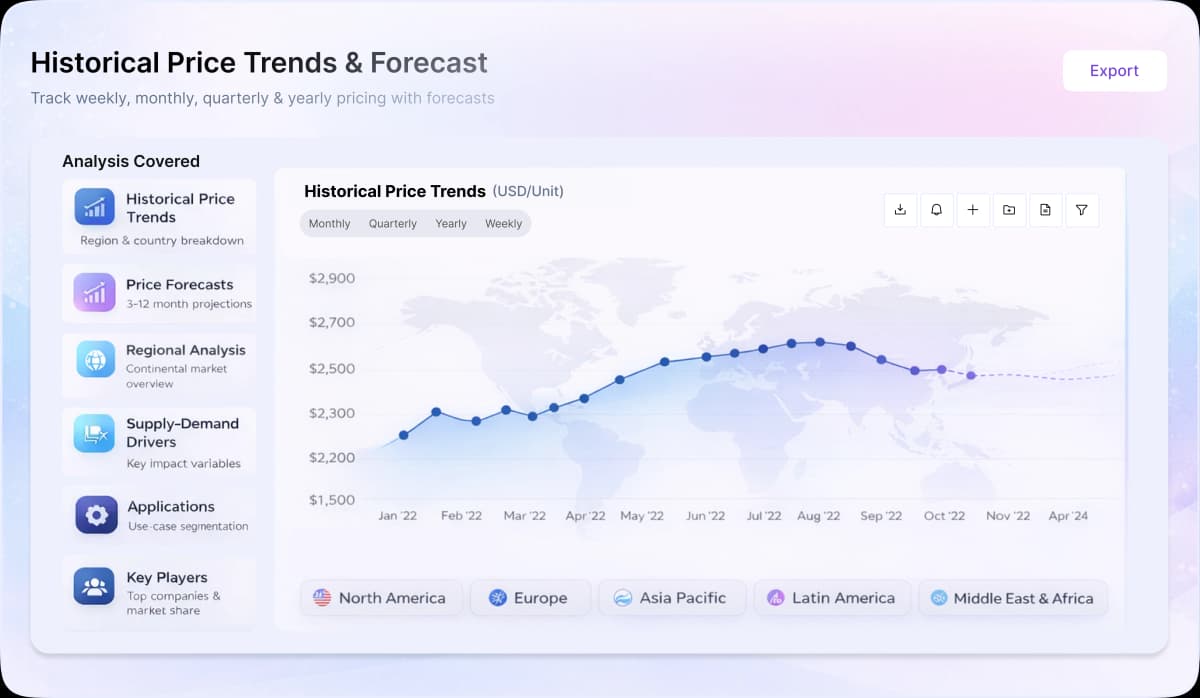
Price Trend Dashboard - What's Included
Price trends across a diverse portfolio of categories and products, spanning board to niche chemicals
Coverage extendable to grade-specific chemicals based on procurement requirements
Regular price tracking supported by robust historical datasets
News, policy updates, and key market drivers impacting price movements
Short-term and long-term price outlooks and forecasts
Supply–demand dynamics and capacity-driven market analysis