Udeesha Tomar
AVP - Strategy and Solutions
Leading procurement research solutions across chemicals, materials, and food & beverages, with expertise in price forecasting and market analytics.
| Product | Region | Incoterm Basis | Price | Time Period |
|---|---|---|---|---|
| Phenolic Resin | China | FOB | USD 1,687.91/MT | April 2026 |
| Phenolic Resin | USA | CIF | USD 1,774.91/MT | April 2026 |
| Phenolic Resin | Germany | CIF | USD 1,813.91/MT | April 2026 |
| Phenolic Resin | India | CIF | USD 1,737.91/MT | April 2026 |
| Phenolic Resin | Japan | CIF | USD 1,729.91/MT | April 2026 |
| Phenolic Resin | China | FOB | USD 1,790.00/MT | March 2026 |
| Phenolic Resin | USA | CIF | USD 1,877.00/MT | March 2026 |
| Phenolic Resin | Germany | CIF | USD 1,872.00/MT | March 2026 |
| Phenolic Resin | India | CIF | USD 1,845.00/MT | March 2026 |
| Phenolic Resin | Japan | CIF | USD 1,826.00/MT | March 2026 |
Stay updated with the latest phenolic resin prices, historical data, and tailored regional analysis
Asia
During the first quarter of 2026, phenolic resin production in Asia showed a firm upward trend, supported by tightening supply conditions and strong cost push from phenol amid rising benzene and propylene values. Chinese markets saw significant feedstock escalation, with monthly increases of over 30% during February to March, driven by reduced import availability, plant maintenance shutdowns, and declining port inventories. Indian markets followed similar direction due to elevated import costs and higher freight rates. Export flows from China remained active, while supply tightness limited regional availability, and steady downstream demand from laminates and construction resins supported the upward movement.
Europe
During the first quarter of 2026, phenolic resin production in Europe reflected a moderate upward trend, influenced by constrained supply and elevated production costs linked to phenol. The Iran conflict raised crude-linked input costs, increasing benzene and propylene values and tightening manufacturing economics. Import dependency exposed the region to higher freight and insurance costs, while logistical delays restricted inflows. Limited regional output and steady demand from the automotive and construction sectors supported consumption, though cautious purchasing reduced aggressive buying activity.
North America
During the first quarter of 2026, phenolic resin production in North America followed an upward fluctuating trend, supported by cost pass-through from phenol and a stable domestic supply. Early quarter conditions remained balanced with steady output and consistent downstream demand from automotive and industrial applications. As the quarter progressed, crude oil disruptions increased freight and insurance costs, raising input expenses for resin manufacturers. Trade flows remained stable with sufficient domestic production, while steady downstream demand maintained consumption despite rising cost pressures.
Analyst Insight
According to Procurement Resource, looking ahead, phenolic resin prices are expected to remain firm as upstream phenol supply tightens and insurance costs remain elevated, while steady downstream demand supports the market.
Related Report
Get real-time price assessments, periodic trends, forecasts and price driver insights across key global markets.
Unlock Price Insights NowOur Clients

Turn price intelligence into action with the Procurement Resource Database. Log in or subscribe to unlock live price trends, historical charts, supplier databases, cost curves, and analyst-backed insights across chemicals, agriculture, energy, packaging, and more. Use these tools to benchmark your contracts, plan budgets with confidence, and stay ahead of market moves on every product you buy.

0
+Products
0
+Regions
0
+Subscriptions
Asia
The market for Phenolic Resin in Asia experienced progressive weakness throughout the fourth quarter, mirroring declining trends in phenol, its primary feedstock. Prices softened from their opening levels as supply-demand imbalances intensified across the region. New capacity additions in upstream sectors increased total material availability significantly, contributing to oversupply conditions. Maintenance activities at multiple production units provided temporary relief, though overall operating rates remained elevated, keeping supply abundant. Demand from key downstream applications remained disappointing throughout the quarter. The construction materials sector showed subdued consumption as infrastructure projects slowed during the period. Automotive applications, including friction materials and brake components, maintained cautious procurement strategies amid uncertain market conditions. Wood panel and laminates manufacturers reduced their intake due to weak housing market activity. Operating rates in derivative sectors declined as buyers adopted need-based purchasing approaches rather than building inventories. Import arrivals continued throughout the quarter, adding further pressure to domestic pricing despite efforts to manage port inventory levels.


Europe
European Phenolic Resin markets, particularly experienced price appreciation throughout the quarter despite facing structural cost challenges. Production economics remained under pressure from elevated electricity costs and high energy expenses that impacted manufacturing processes. The reliance on phenol as feedstock added to production burdens, though pricing strengthened progressively as the period unfolded. The European phenolics chain faced rationalization pressures due to cost disadvantages compared to Asian and Middle Eastern producers. Demand from downstream applications remained moderate as end-users navigated challenging market conditions. Insulation materials for construction and industrial applications maintained baseline consumption levels. Moulding compounds for electrical and automotive components showed steady but unspectacular offtake patterns throughout the quarter.

North America
North American Phenolic Resin markets displayed gradual strengthening throughout the fourth quarter. Domestic production remained stable as phenol availability supported normal operating rates across manufacturing facilities. Supply-demand fundamentals remained balanced, with stable cost structures supporting gradual price appreciation. Demand from downstream sectors maintained steady consumption patterns throughout the period. Bisphenol A applications, phenolic moulding compounds, and various specialty chemical intermediates demonstrated consistent offtake. The construction sector's demand for plywood adhesives and composite materials remained stable, while automotive friction products and abrasives maintained regular procurement schedules.
Analyst Insight
According to Procurement Resource, Phenolic Resin prices are expected to remain influenced by feedstock cost movements and downstream consumption patterns in the near term. Supply-demand dynamics will continue to be the primary determinant of pricing direction across major markets.
A synthetic polymer called phenolic resin is produced when phenol reacts with an aldehyde, usually formaldehyde. It is appropriate for a wide range of applications as it has outstanding heat and chemical resistance. They are frequently used in the production of molded goods, including kitchenware, circuit boards, electrical components, and automobile parts. Because of their powerful bonding abilities, they are also utilized as binders, varnishes, and adhesives. Due to its durability and flame-retardant properties, phenolic resins are also used in consumer products, construction, and aerospace industries.
Aerospace and defense, Rubber industry, Wood-based products, Filtrations, Coatings and adhesives, Automotive industries
Phenol-formaldehyde resins, PF resins
Hexcel Corporation, Bakelite Synthetics, Ashland Global Holdings Inc, BASF SE, Akrochem Corporation, Georgia- Pacific Chemicals, Kraton Corporation
CurrencyUS$ (Data can also be provided in local currency)
Supplier Database AvailabilityYes
Customization ScopeThe report can be customized as per the requirements of the customer
Post-Sale Analyst Support360-degree analyst support after report delivery
Note: Our supplier search experts can assist your procurement teams in compiling and validating a list of suppliers indicating they have products, services, and capabilities that meet your company's needs.
The mixture of phenol and formaldehyde are stirred and heated till 60°C and then the reaction undergoes refluxing till around 98°C. This mixture is then added to methanol for dilution once the water has been removed from the vessel base and as a result, phenolic resin is produced as the final product.

Udeesha Tomar
AVP - Strategy and Solutions
Leading procurement research solutions across chemicals, materials, and food & beverages, with expertise in price forecasting and market analytics.
Our Price Analysis Methodology

Experience how Procurement Resource transforms raw material price data into clear, decision ready intelligence. Optimise your performance with reliable, expert market data and analysis. Schedule your demo today to experience a live walk-through where our experts will showcase interactive price charts, forecasted prices, and insights driving the prices for your key commodities, tailored to your workflows. Contact us now!
Our Team will be happy to assist you
We are just a text away
Still Need Help?
Unlock full access to Procurement Resource's price databases, interactive charts, and short-term forecasts for thousands of commodities. Elevate your sourcing decisions by comparing prices across regions, downloading historical data, and layering in analyst-backed insights, all with our flexible plans that scale as your portfolio grows.
Still have any Questions
Contact Us


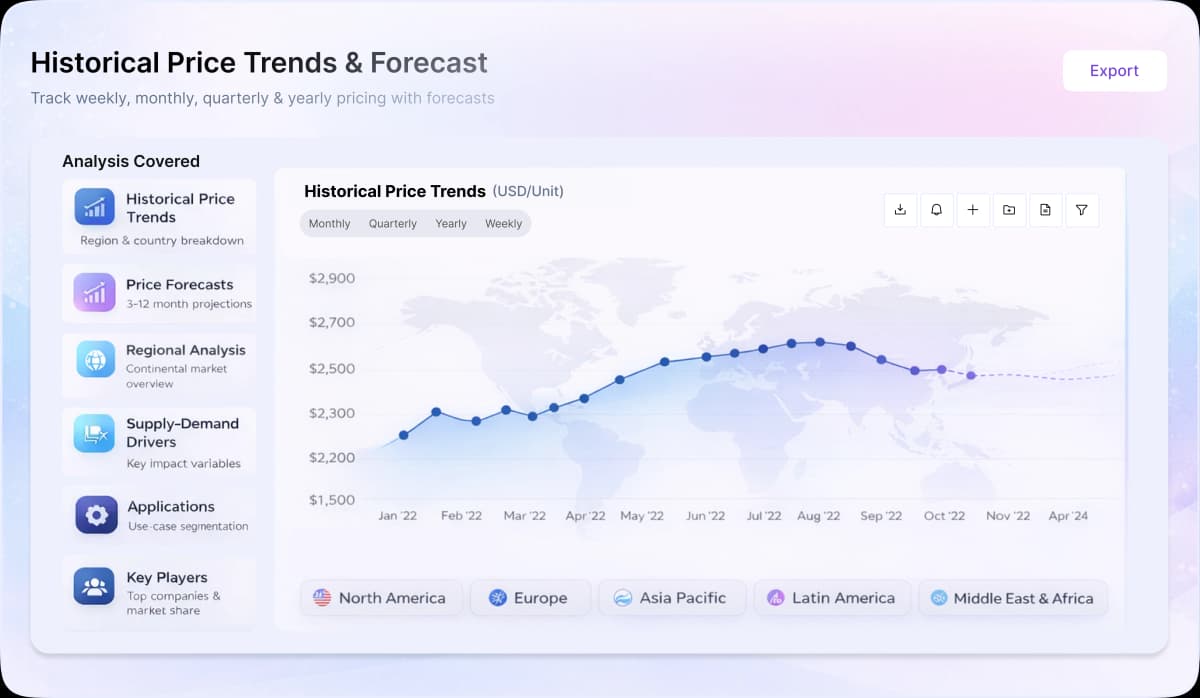
Price Trend Dashboard - What's Included
Price trends across a diverse portfolio of categories and products, spanning board to niche chemicals
Coverage extendable to grade-specific chemicals based on procurement requirements
Regular price tracking supported by robust historical datasets
News, policy updates, and key market drivers impacting price movements
Short-term and long-term price outlooks and forecasts
Supply-demand dynamics and capacity-driven market analysis