

Udeesha Tomar
AVP - Strategy and Solutions
Leading procurement research solutions across chemicals, materials, and food & beverages, with expertise in price forecasting and market analytics.

Potassium Bicarbonate prices maintained a solid and rising direction throughout 2025, primarily backed by supply constraints and a steady rate of demand from significant regions. In Asia, the supply of Potassium Bicarbonate was constrained by tight supply conditions, as Chinese producers struggled with inventory issues, delayed restarts, and logistics challenges.
Additionally, higher raw material costs and congestion at ports added pressure to manufacturers, while buying sentiment in significant markets like China and India remained cautious, reflecting uncertain demand recovery. In the later part of the year, supply-side constraints like raw material availability and transportation challenges continued to support prices, even as seasonal weakness persisted in the fertilizers segment and purchases were selective.
In Europe, Potassium Bicarbonate prices increased due to restricted potash imports, increased production costs, and issues like low levels of Rhine water and port congestion. The demand for industrial goods like glass, ceramics, and agricultural products remained firm. Precautionary stockpiling by fertilizer companies also contributed to demand.
In North America, restricted imports from Asia, increased freight costs, and firm production levels with increased costs contributed to firm prices. Agricultural demand and forward-looking purchasing strategies also contributed to prices. Towards the end of the year, prices remained firm with marginal fluctuations in regions due to balanced markets and forward-looking purchasing strategies.
Analyst Insight
According to Procurement Resource, Potassium Bicarbonate prices are expected to remain firm due to tight markets and firm demand from agricultural and industrial markets.
Related Report
Need Latest Potassium Bicarbonate Prices?
Get real-time price assessments, periodic trends, forecasts and price driver insights across key global markets.
Our Clients































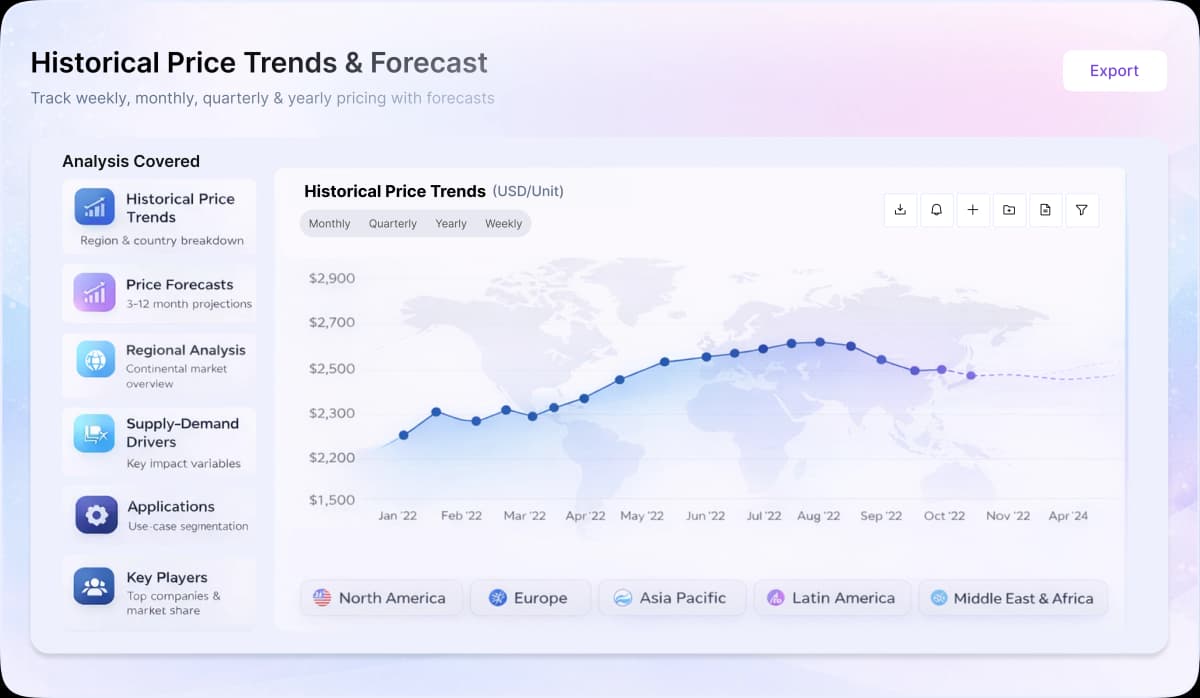
Turn price intelligence into action with the Procurement Resource Database. Log in or subscribe to unlock live price trends, historical charts, supplier databases, cost curves, and analyst-backed insights across chemicals, agriculture, energy, packaging, and more. Use these tools to benchmark your contracts, plan budgets with confidence, and stay ahead of market moves on every product you buy.
0
+Products
0
+Regions
0
+Subscriptions
Potassium Bicarbonate prices recorded an overall stable but wavering growth curve in H2’24. In Asia, the Potassium Bicarbonate prices were quite stable in the third quarter. The prices were impacted by the stable caustic potash market. The demand for Potassium Bicarbonate was impacted in the fertilizers segment due to the harvesting season. However, the Indian government’s support for the fertilizers segment ensured that the prices were stable and that the prices were not impacted in any way.
In the fourth quarter, the Potassium Bicarbonate prices were impacted in an irregular way. The downward pressure was caused by the fall in feedstock prices and the industrial sector’s reduced activities. However, the demand for Potassium Bicarbonate in the agriculture and chemical sectors was up in the latter part of the quarter.
In the European region, the prices of Potassium Bicarbonate remained rangebound in the third quarter of H2’24, as the prices of the raw materials used in the manufacturing of the product remained stable, and the demand for fertilizers was moderate. In the fourth quarter, the prices of the product declined initially and then started to increase, as the demand for the product slowed down and the raw materials used in the manufacturing of the product started to go down.
In the North American region, the prices of the raw materials used in the manufacturing of the product faced a few ups and downs in the third quarter, and then started to increase in the fourth quarter as the raw materials used in the manufacturing of the product started to go down. Overall, Potassium Bicarbonate prices remained stable with mild fluctuations during H2’24.
Potassium bicarbonate is a white, crystalline salt used widely as a fungicide in agriculture, especially in organic farming. In the food industry, it serves as a leavening agent in baking and is an ingredient in effervescent drinks. It’s also employed in winemaking to adjust acidity. Medically, potassium bicarbonate is used as an antacid and electrolyte replenisher. Additionally, it's utilized in fire extinguishers for combating electrical and flammable liquid fires and in aquaculture to manage water pH levels.
KHCO3
Agriculture as a Fungicide, Food Industry as a Leavening Agent, Fire Extinguishing Agents, Medicine as an Antacid and Electrolyte Supplement, Effervescent Drinks, Winemaking to Reduce Acidity, Aquaculture to Regulate pH Levels
Potassium Hydrogen Carbonate
Shandong Lunan Chemical, Evonik, Wentong Potassium Salt Group, Baoding Runfeng, Armand Products, Hebei Xinji Chemical Group, Shanxi Wencheng Chemical, Toagosei Group
CurrencyUS$ (Data can also be provided in local currency)
Supplier Database AvailabilityYes
Customization ScopeThe report can be customized as per the requirements of the customer
Post-Sale Analyst Support360-degree analyst support after report delivery
Note: Our supplier search experts can assist your procurement teams in compiling and validating a list of suppliers indicating they have products, services, and capabilities that meet your company's needs.
Initially, potassium carbonate is prepared by the chemical reaction between liquid caustic potash and carbon dioxide. The compounds react to give potassium carbonate with a water mixture. The mixture obtained is further filtered and dried to obtain potassium carbonate as an intermediate. Finally, potassium carbonate is treated with carbon dioxide and then recrystallized to give potassium bicarbonate as the final product.
Our Price Analysis Methodology
AVP - Strategy and Solutions
Leading procurement research solutions across chemicals, materials, and food & beverages, with expertise in price forecasting and market analytics.
Experience how Procurement Resource transforms raw material price data into clear, decision ready intelligence. Optimise your performance with reliable, expert market data and analysis. Schedule your demo today to experience a live walk-through where our experts will showcase interactive price charts, forecasted prices, and insights driving the prices for your key commodities, tailored to your workflows. Contact us now!
Our Team will be happy to assist you
We are just a text away
Still Need Help?
This study analyzes Potassium Bicarbonate Production by Chemical Reaction Between Potassium Carbonate and Carbon Dioxide, covering manufacturing, process flow, operating expenses, and financial considerations.
Unlock full access to Procurement Resource's price databases, interactive charts, and short-term forecasts for thousands of commodities. Elevate your sourcing decisions by comparing prices across regions, downloading historical data, and layering in analyst-backed insights, all with our flexible plans that scale as your portfolio grows.
Still have any Questions
Contact Us



Price Trend Dashboard - What's Included
Price trends across a diverse portfolio of categories and products, spanning board to niche chemicals
Coverage extendable to grade-specific chemicals based on procurement requirements
Regular price tracking supported by robust historical datasets
News, policy updates, and key market drivers impacting price movements
Short-term and long-term price outlooks and forecasts
Supply–demand dynamics and capacity-driven market analysis

Track prices, market movements, supply-demand dynamics, and industry developments across hundreds of commodities through a centralized intelligence platform built for informed procurement decisions.

Understand market fluctuations using analyst-backed forecasts, historical pricing patterns, and evolving industry trends to strengthen sourcing strategies and budget planning.

Leverage cost models, pricing benchmarks, and procurement insights to evaluate purchasing opportunities, improve negotiations, and enhance operational efficiency.
Access region-specific price trends, trade activities, capacity changes, and supply chain developments influencing commodity markets worldwide.