Udeesha Tomar
AVP - Strategy and Solutions
Leading procurement research solutions across chemicals, materials, and food & beverages, with expertise in price forecasting and market analytics.

| Product | Region | Incoterm Basis | Price | Last Updated Month |
|---|---|---|---|---|
| Silicone Rubber | China | FOB | USD 2,189.10/MT | April 2026 |
| Silicone Rubber | USA | FOB | USD 2,276.10/MT | April 2026 |
| Silicone Rubber | Germany | FOB | USD 2,315.10/MT | April 2026 |
| Silicone Rubber | India | CIF | USD 2,239.10/MT | April 2026 |
| Silicone Rubber | Japan | CIF | USD 2,231.10/MT | April 2026 |
| Silicone Rubber | China | FOB | USD 2,110.99/MT | March 2026 |
| Silicone Rubber | USA | FOB | USD 2,198.00/MT | March 2026 |
| Silicone Rubber | Germany | FOB | USD 2,193.00/MT | March 2026 |
| Silicone Rubber | India | CIF | USD 2,166.00/MT | March 2026 |
| Silicone Rubber | Japan | CIF | USD 2,147.00/MT | March 2026 |
Stay updated with the latest silicone rubber prices, historical data, and tailored regional analysis
Asia
In Asia, silicone rubber prices increased during Q1’26 due to rising feedstock costs and restricted supply. Production costs remained elevated as silicon metal markets fluctuated and methyl chloride prices increased, supporting higher silicone intermediate costs. Supply tightness was further reinforced by emission reduction measures of around 35%, which limited output. Demand remained cautious, with buyers relying on just-in-time procurement, though export orders and presale coverage for March production supported overall market stability.
Europe
In Europe, silicone rubber prices moved upward during the quarter, driven mainly by cost pass-through from producers. A key development was WACKER’s price increase of up to 25% effective February 1, reflecting sharp increases in platinum costs used in silicone production. This cost pressure impacted sectors such as automotive, medical, and electrical engineering. Demand remained steady but cautious, limiting stronger price escalation, while higher input and energy costs continued to support the market.
North America
In North America, silicone rubber prices also trended upward, supported by global cost pressures and stable downstream demand. Rising raw material costs, particularly for silicon-based inputs and catalysts, kept production expenses elevated. Demand from industrial, automotive, and healthcare sectors remained consistent but conservative, with buyers focusing on short-term procurement. Supply tightness and cost-driven pricing strategies maintained firm market conditions throughout the quarter.
Analyst Insight
According to Procurement Resource, in the near term, silicone rubber prices are expected to remain firm, supported by sustained feedstock costs and controlled supply, while demand continues to follow a cautious, need-based pattern.
Related Report
Get real-time price assessments, periodic trends, forecasts and price driver insights across key global markets.
Unlock Price Insights NowOur Clients

Turn price intelligence into action with the Procurement Resource Database. Log in or subscribe to unlock live price trends, historical charts, supplier databases, cost curves, and analyst-backed insights across chemicals, agriculture, energy, packaging, and more. Use these tools to benchmark your contracts, plan budgets with confidence, and stay ahead of market moves on every product you buy.

0
+Products
0
+Regions
0
+Subscriptions
Asia
In Asia, silicone rubber prices during Q4’25 generally moved downward due to weak demand and continued oversupply in the silicone market. Downstream industries such as automotive, construction, and consumer goods showed slow recovery, which limited buying interest. The automotive sector remained a key pressure point, as vehicle sales declined in Japan and South Korea, reducing demand for silicone rubber used in seals, gaskets, and moulded parts. Although India showed strong passenger car sales due to festive demand, this positive trend was not enough to offset weakness in other Asian markets. Trade data reflected mixed signals, with China’s silicone exports declining slightly, while South Korea increased imports, mainly for feedstock restocking rather than fresh consumption. Feedstock costs, including silicon metal, stayed mostly stable, which prevented sharp cost-driven changes.
Europe
In Europe, silicone rubber prices during the fourth quarter remained under pressure, moving within a narrow range with a soft tone. Demand from automotive and industrial sectors stayed inconsistent, especially as vehicle registrations fluctuated in key markets such as Germany. Buyers remained cautious due to weak economic confidence and uncertain industrial outlook. Imports continued to meet most of the regional demand, keeping supply sufficient. Although some support came from aerospace and specialty applications, these segments were too small to lift the broader market. Producers focused on cost control and inventory management rather than pushing volumes, which kept prices stable but low.
North America
In North America, silicone rubber prices during Q4’25 showed a mild downward trend. Demand from consumer and industrial applications remained steady but lacked strong growth. Automotive demand stayed moderate, while improved use of siloxanes did not fully translate into stronger silicone rubber pricing. Oversupply and competitive market conditions limited suppliers’ pricing power. Buyers preferred short-term purchases and avoided inventory buildup, which kept the market balanced but weak.
Analyst Insight
According to Procurement Resource, Silicone Rubber prices are expected to improve gradually as downstream demand recovers, especially from electronics and semiconductor-related applications.
Silicone Rubber is a phenomenal elastomer constituting high resistance. It comprises silicone along with various molecules, including hydrogen, carbon, and oxygen. It is a significant, highly productive elastomer having remarkable properties, such as electrical insulation, high endurance, and transparency, among others.
R2SiO
Seals & gaskets, electrical insulation, coating material for various equipment, housing- roofing and sealants, aerospace and automotive industry- seals and gasket
Dongguan Hongju Silicone Rubber Products Co., Ltd., Wuxi Aomeite Seal Technology Co.Ltd., Vip Rubber & Plastic Company, Jefferson Rubber Works Inc
Polysiloxane, Silicone Elastomer
CurrencyUS$ (Data can also be provided in local currency)
Supplier Database AvailabilityYes
Customization ScopeThe report can be customized as per the requirements of the customer
Post-Sale Analyst Support360-degree analyst support after report delivery
Note: Our supplier search experts can assist your procurement teams in compiling and validating a list of suppliers indicating they have products, services, and capabilities that meet your company's needs.
Silicone rubber is made by polymerizing silicon and oxygen through polycondensation. The process starts with synthesizing silanes, reacting them with chlorine to form chlorosilanes, and then reacting them with oxygen to create silicone rubber.

AVP - Strategy and Solutions
Leading procurement research solutions across chemicals, materials, and food & beverages, with expertise in price forecasting and market analytics.
Our Price Analysis Methodology

Experience how Procurement Resource transforms raw material price data into clear, decision ready intelligence. Optimise your performance with reliable, expert market data and analysis. Schedule your demo today to experience a live walk-through where our experts will showcase interactive price charts, forecasted prices, and insights driving the prices for your key commodities, tailored to your workflows. Contact us now!
Our Team will be happy to assist you
We are just a text away
Still Need Help?
The study offers a detailed cost analysis of Silicone Rubber Production via Silanes. In addition, the report incorporates the manufacturing process with detailed process and material flow, operating costs along with financial expenses and depreciation charges.
This report presents a detailed cost structure of silicone elastomers production. Silicone elastomers are derived from the copolymerization of cyclic siloxane with phenylmethylsiloxane and vinylmethylsiloxane.
Unlock full access to Procurement Resource's price databases, interactive charts, and short-term forecasts for thousands of commodities. Elevate your sourcing decisions by comparing prices across regions, downloading historical data, and layering in analyst-backed insights, all with our flexible plans that scale as your portfolio grows.
Still have any Questions
Contact Us


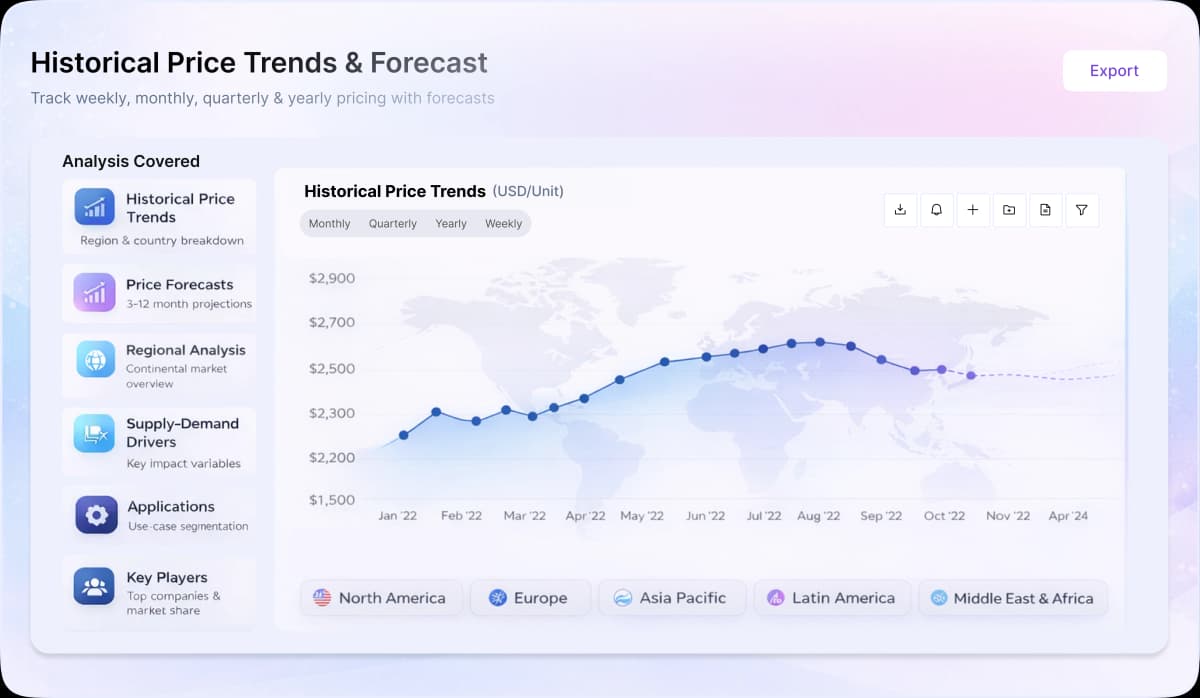
Price Trend Dashboard - What's Included
Price trends across a diverse portfolio of categories and products, spanning board to niche chemicals
Coverage extendable to grade-specific chemicals based on procurement requirements
Regular price tracking supported by robust historical datasets
News, policy updates, and key market drivers impacting price movements
Short-term and long-term price outlooks and forecasts
Supply-demand dynamics and capacity-driven market analysis