

Udeesha Tomar
AVP - Strategy and Solutions
Leading procurement research solutions across chemicals, materials, and food & beverages, with expertise in price forecasting and market analytics.

Asia
In Asia, Thiophene prices showed a mixed trend throughout Q2’25. The quarter began on a weaker note due to low demand and excess supply in the broader chemical market. This led to softer pricing in the early weeks. However, as the quarter progressed, demand picked up especially from the agricultural and pharmaceutical sectors with the approach of the planting season and steady orders from cosmetic and specialty chemical manufacturers.
Although freight-related costs were slightly unpredictable at times, overall market activity improved by June, helping prices stabilize and inch upward toward the end of the quarter.
Europe
In Europe, Thiophene prices showed some early strength in Q2, supported by supply-side tightness and moderate demand from the pharmaceutical and coatings industries. However, this momentum faded in the latter part of the quarter. A slowdown in new orders and better inventory availability led to a softening of prices by June. Logistics challenges, including congestion at key ports and inland transport issues, added complexity but did not result in significant price swings. Overall, the European market remained largely balanced, with limited room for major fluctuations.
North America
In North America, the Thiophene market remained relatively stable but leaned slightly soft during the first half of Q2. Buyers remained cautious, adjusting purchases to match demand from personal care, pharmaceutical, and eco-friendly product segments. In the second half of the quarter, there was a modest recovery in pricing as import volumes rose and logistical conditions remained manageable. While overall demand held steady, concerns around costs and trade policies kept price movements in check.
Analyst Insight
According to Procurement Resource, Thiophene prices are expected to remain steady in the near term, with a slight chance of upward movement if seasonal demand continues and supply conditions tighten.
Related Report
Need Latest Thiophene Prices?
Get real-time price assessments, periodic trends, forecasts and price driver insights across key global markets.
Our Clients































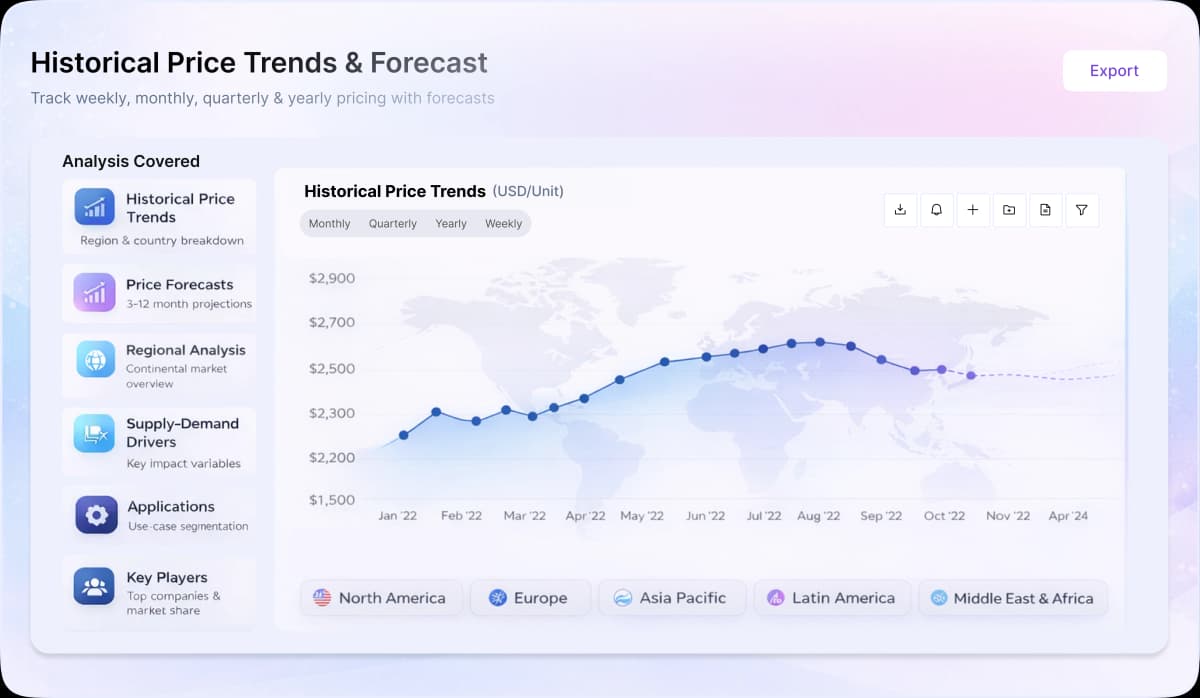
Turn price intelligence into action with the Procurement Resource Database. Log in or subscribe to unlock live price trends, historical charts, supplier databases, cost curves, and analyst-backed insights across chemicals, agriculture, energy, packaging, and more. Use these tools to benchmark your contracts, plan budgets with confidence, and stay ahead of market moves on every product you buy.
0
+Products
0
+Regions
0
+Subscriptions
Asia
In Q1’25, the Thiophene market in Asia experienced a noticeable upward trend. This was largely influenced by the rising prices of sulfuric acid and sulfur—both critical feedstocks for Thiophene production. In China, strong demand from the fertilizer and agrochemical industries drove up sulfur and sulfuric acid prices, creating cost-push pressure on Thiophene manufacturing.
The spring planting season further accelerated demand for sulfur-based chemicals, pushing operating rates higher and tightening raw material supply. At the same time, domestic production of sulfuric acid faced disruptions due to reduced output from copper smelters, which compounded supply constraints. As a result, Thiophene producers experienced higher input costs, leading to a bullish pricing environment, particularly toward the latter half of the quarter.
Europe
In Europe, the Thiophene market remained relatively stable throughout Q1’25. While there was some seasonal demand from agrochemical sectors, overall consumption levels were moderate, and there were no major supply disruptions. The sulfuric acid market in the region stayed balanced, with domestic supply meeting demand comfortably. This stability in key feedstocks helped prevent any sharp swings in Thiophene pricing. Additionally, ample inventories in regions like Germany and Belgium provided further price cushioning. As a result, Thiophene prices in Europe saw only slight upward movement, mainly driven by steady operational costs rather than demand surges or feedstock volatility.
North America
In North America, the Thiophene market showed slight firmness during Q1’25. Although the overall demand remained steady, the pricing scenario was impacted by underlying feedstock trends. Sulfur availability was somewhat constrained in the southeast US, and producers in the Gulf Coast prioritized exports over local supply, causing domestic availability to tighten. This, coupled with the closure of a major refinery in Houston, added mild pressure on sulfur prices. While these factors didn’t lead to sharp Thiophene price spikes, they did contribute to modest upward movement during the quarter, particularly in areas dependent on imported sulfur.
Thiophene is a five-membered heterocyclic organic complex. It is a versatile building block in organic chemistry due to its chemical structure and aromatic qualities. It is a volatile, colorless liquid with a low boiling point that is combustible. Thiophene plays a crucial role in the production of many different compounds, such as agrochemicals and medicines. It is useful as a precursor for the synthesis of several thiophene derivatives with particular uses and in the development of organic semiconductors used in electronics, such as OLEDs, due to its aromatic character and reactivity.
C4H4S
Lubricants and fuel additives, OLEDS, Corrosion Inhibitors, Solvents and extractants, Flavor and fragrance compounds, Batteries, Herbicides and pesticides
Arkema Group, BASF SE, DuPont de Nemours Inc, Dow Chemical Company, Merck KGaA, Sinopec Group, Chevron Phillips Chemical Company LP, Honeywell International Inc, Royal Dutch Shell plc, Lanxess AG, Sumitomo Chemical Company
CurrencyUS$ (Data can also be provided in local currency)
Supplier Database AvailabilityYes
Customization ScopeThe report can be customized as per the requirements of the customer
Post-Sale Analyst Support360-degree analyst support after report delivery
Note: Our supplier search experts can assist your procurement teams in compiling and validating a list of suppliers indicating they have products, services, and capabilities that meet your company's needs.
The process involves the reaction of sodium succinate and phosphorus trisulfide at approximately 200 degrees Celsius to produce sodium thiophene as the end product.
Our Price Analysis Methodology
AVP - Strategy and Solutions
Leading procurement research solutions across chemicals, materials, and food & beverages, with expertise in price forecasting and market analytics.
Experience how Procurement Resource transforms raw material price data into clear, decision ready intelligence. Optimise your performance with reliable, expert market data and analysis. Schedule your demo today to experience a live walk-through where our experts will showcase interactive price charts, forecasted prices, and insights driving the prices for your key commodities, tailored to your workflows. Contact us now!
Our Team will be happy to assist you
We are just a text away
Still Need Help?
Europe & Africa
+44 7573 171117
Sales@procurementresource.com
USA & Canada
+1 307 363 1045
Sales@procurementresource.com
APAC
+91 8850629517
Sales@procurementresource.com
Unlock full access to Procurement Resource's price databases, interactive charts, and short-term forecasts for thousands of commodities. Elevate your sourcing decisions by comparing prices across regions, downloading historical data, and layering in analyst-backed insights, all with our flexible plans that scale as your portfolio grows.
Still have any Questions
Contact Us



Price Trend Dashboard - What's Included
Price trends across a diverse portfolio of categories and products, spanning board to niche chemicals
Coverage extendable to grade-specific chemicals based on procurement requirements
Regular price tracking supported by robust historical datasets
News, policy updates, and key market drivers impacting price movements
Short-term and long-term price outlooks and forecasts
Supply–demand dynamics and capacity-driven market analysis

Track prices, market movements, supply-demand dynamics, and industry developments across hundreds of commodities through a centralized intelligence platform built for informed procurement decisions.

Understand market fluctuations using analyst-backed forecasts, historical pricing patterns, and evolving industry trends to strengthen sourcing strategies and budget planning.

Leverage cost models, pricing benchmarks, and procurement insights to evaluate purchasing opportunities, improve negotiations, and enhance operational efficiency.
Access region-specific price trends, trade activities, capacity changes, and supply chain developments influencing commodity markets worldwide.