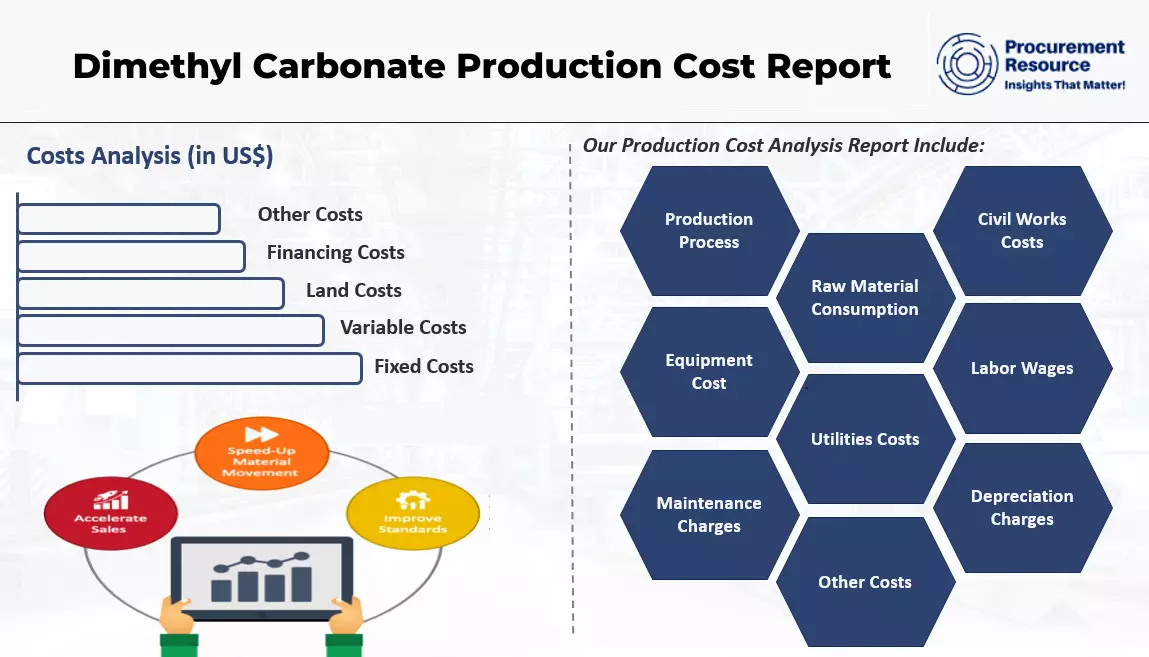
The report provides a detailed analysis essential for establishing a dimethyl carbonate production plant. It encompasses all critical aspects necessary for dimethyl carbonate production, including the cost of dimethyl carbonate production, dimethyl carbonate plant cost, dimethyl carbonate production costs, and the overall dimethyl carbonate production plant cost. Additionally, the study covers specific expenditures associated with setting up and operating a dimethyl carbonate production plant. These encompass production processes, raw material requirements, utility requirements, infrastructure needs, machinery and technology requirements, manpower requirements, packaging requirements, transportation requirements, and more.
Dimethyl carbonate is a chemical fluid that is largely associated with electronic, plastic, construction, chemical, and petrochemical industries. The compound serves as a thermoset resin blend that is included in adhesives, coatings, such as paints, and more. It is utilized for the production of plastic and resin varieties. It is a co-solvent and acts as an electrolyte in lithium-ion batteries. It is an eco-friendly solvent that is used in the production of cleansing and degreasing products, including disinfectants, etc. It can also be used as a fuel additive in gasoline production. Moreover, it serves as a raw material in certain chemical reactions, including methylations, carbonylation, and carbomethoxylation reactions.
The market for dimethyl carbonate, commonly known as DMC, is strongly driven by its demand as a chemical fluid for electronic, chemical, petrochemical, and plastic industries. Its large-scale application as a thermoset resin blend for plastic and coatings production increases its demand and strengthens its market growth. Similarly, its usage in synthesizing another compound, in chemical reactions (including methylation, etc.), as well as production of degreasing and cleansing chemical products, drives its demand in the chemical industry. Moreover, its usage in gasoline production fuels its demand in the petrochemical sectors. Industrial dimethyl carbonate procurement is majorly dependent upon the variations observed in its demand, as well as its market prices and distribution. Hence, its demand as a chemical fluid in plastic, resin, electronic, chemical, and petrochemical industries, along with its market prices and supply, is essential for its procurement in the market.
Raw Material for Dimethyl Carbonate Production
According to the dimethyl carbonate production plant project report, the key raw material for dimethyl carbonate production includes methyl nitrite; phosgene-methanol; oxygen-carbon monoxide-methanol; methanol-ethylene carbonate; carbon dioxide.
Production Process of Dimethyl Carbonate
The extensive dimethyl carbonate production cost report consists of the major industrial production process:
- By Carbonylation Reaction: Dimethyl carbonate or DMC can be produced by the carbonylation of dimethyl nitrite in the presence of a catalyst.
- From Phosgene and Methanol: Dimethyl carbonate is a chemical compound, prepared by the chemical reaction between phosgene and methanol.
- From Methanol: The production process of dimethyl carbonate is carried out by the oxidative carbonylation of methanol in the presence of a catalyst.
- By Transesterification Reaction: DMC or dimethyl carbonate is synthesized by the transesterification of methanol with ethylene carbonate.
- From Carbon Dioxide: Dimethyl carbonate is prepared by the conversion of carbon dioxide in the presence of a catalyst.
Dimethyl carbonate is an organic compound and is abbreviated by DMC. It is in the form of carbonate ester. It is produced through the carbonation process. Oxygen, Methanol, and Carbon Monoxide react with each other in the presence of the catalyst copper chloride. It is extensively employed as a methylating agent.
The structural formula of dimethyl carbonate is C3H6O3, and its molecular weight is 90.08 g/mol. The boiling point of dimethyl carbonate is 90 °C and its solubility in water is 13.9 g/100 mL. The melting point of dimethyl carbonate is 2 to 4 °C (36 to 39 °F; 275 to 277 K). It is colourless and flammable in nature.