Need latest Acrylic Acid prices?
Get real-time price assessments, periodic trends, forecasts and price driver insights across key global markets.
Unlock Price Insights NowOur Clients
| Product | Region | Incoterm Basis | Price | Last Updated Month |
|---|---|---|---|---|
| Acrylic Acid | China | FOB | USD 1,830.19/MT | April 2026 |
| Acrylic Acid | USA | CIF | USD 1,917.19/MT | April 2026 |
| Acrylic Acid | Germany | CIF | USD 1,956.47/MT | April 2026 |
| Acrylic Acid | India | CIF | USD 1,880.07/MT | April 2026 |
| Acrylic Acid | Japan | CIF | USD 1,872.14/MT | April 2026 |
| Acrylic Acid | China | FOB | USD 1,680.45/MT | March 2026 |
| Acrylic Acid | China | FOB | USD 887.00/MT | February 2026 |
| Acrylic Acid | USA | CIF | USD 972.00/MT | February 2026 |
| Acrylic Acid | Germany | CIF | USD 992.00/MT | February 2026 |
| Acrylic Acid | India | CIF | USD 928.00/MT | February 2026 |
| Acrylic Acid | Japan | CIF | USD 905.00/MT | February 2026 |
Stay updated with the latest Acrylic Acid prices, historical data, and tailored regional analysis
Asia
The Asian acrylic acid market in Q1’26 evolved from a weak and balanced state to a sharply bullish phase by the end of the quarter. In January and early February, the market remained constrained by sluggish downstream demand from coatings and adhesives, coupled with seasonal slowdowns, even as rising propylene costs provided a firm cost floor. Producers maintained stable operations, with some capacity adjustments, but overall supply remained sufficient. However, the market dynamics changed significantly from late February onward, as geopolitical tensions in the Middle East triggered a surge in crude oil and upstream feedstock costs. Despite high operating rates and new capacity additions being absorbed efficiently, panic procurement and inventory building by downstream users tightened spot availability. Asia’s reliance on imported petrochemical feedstocks further amplified cost transmission, resulting in heightened volatility and a strong upward trend.
Europe
In Europe, acrylic acid prices in Q1’26 were primarily driven by escalating feedstock and logistics costs linked to geopolitical disruptions. The Strait of Hormuz crisis significantly impacted naphtha and petrochemical supply chains, increasing raw material costs and freight rates. Producers faced mounting margin pressure as rising input costs outpaced contract pricing mechanisms, while extended shipping times and supply chain congestion tightened availability. Although demand recovery remained moderate, inflationary pressure across the broader petrochemical sector supported price increases. European companies also moved to adjust pricing strategies to offset rising costs, reflecting a cost-driven firming trend under persistent logistical and energy-related uncertainties.
North America
The North American acrylic acid market experienced a firm upward trend during Q1 2026, supported by rising production and logistics costs amid global petrochemical disruptions. While the region benefited from feedstock advantages due to its reliance on natural gas, insulating it partially from naphtha volatility, global energy inflation still exerted upward pressure. Producers responded by implementing price increases, with companies such as BASF adjusting acrylic monomer pricing to reflect higher raw material and transportation costs. Stable domestic supply and strong export competitiveness supported market balance, while downstream sectors such as packaging and consumer goods absorbed cost increases, maintaining steady demand.
Analyst insights
Acrylic acid prices are expected to remain volatile, with geopolitical developments and feedstock cost trends continuing to dictate short-term market direction.
Related Report
Get real-time price assessments, periodic trends, forecasts and price driver insights across key global markets.
Unlock Price Insights NowOur Clients

Turn price intelligence into action with the Procurement Resource Database. Log in or subscribe to unlock live price trends, historical charts, supplier databases, cost curves, and analyst-backed insights across chemicals, agriculture, energy, packaging, and more. Use these tools to benchmark your contracts, plan budgets with confidence, and stay ahead of market moves on every product you buy.

0
+Products
0
+Regions
0
+Subscriptions
Asia
The Asian acrylic acid market during the fourth quarter experienced downward pressure as weak demand fundamentals outweighed supply-side dynamics. Chinese markets, representing the dominant regional production hub, witnessed declining prices throughout the period as downstream consumption remained subdued and raw material propylene costs declined. Major producers implemented strategic price reductions to maintain market share, intensifying competitive pressures and accelerating the bearish trajectory. Demand from key downstream sectors including butyl acrylate, coatings, textiles, and adhesives applications remained lacklustre, with end-user industries demonstrating cautious just-in-time procurement strategies rather than building inventories.


Supply conditions remained ample as major manufacturing facilities maintained stable operating rates, contributing to inventory pressures that compelled producers to compete aggressively on pricing. The combination of declining feedstock costs, weak downstream appetite, and abundant availability drove prices progressively lower through the quarter, with the downward trend moderating only as prices reached levels that compressed producer margins sufficiently to establish a cost-based floor.
Europe
European acrylic acid markets mirrored the downward trajectory observed in Asian regions during the fourth quarter, experiencing similar fundamental pressures from demand weakness and supply abundance. Downstream sectors including coatings, adhesives, and chemical derivatives demonstrated subdued consumption patterns as broader industrial activity remained constrained. Feedstock cost dynamics followed global trends, with propylene markets providing diminishing support as prices softened. Purchasing behaviour reflected cautious inventory management strategies, with buyers limiting procurement to immediate requirements amid expectations of continued price weakness. Competitive pressure from Asian imports and ample regional production capacity contributed to sustained downward pricing momentum throughout the period.
North America
North American acrylic acid markets followed patterns consistent with Asian and European regions during Q4’25, experiencing progressive price declines driven by comparable supply-demand imbalances. Downstream demand from coatings, superabsorbent polymer, and adhesive applications remained measured, providing insufficient consumption growth to absorb available supply. Feedstock propylene costs declined in line with global trends, reducing production cost support for acrylic acid pricing. Market participants adopted conservative purchasing approaches, maintaining minimal inventory positions as price expectations remained bearish. The combination of adequate supply availability and tepid end-use demand sustained downward price pressure through the quarter.
Analyst Insight
According to Procurement Resource, looking ahead, acrylic acid prices are expected to stabilize within narrow ranges as cost support from moderately firming propylene markets establishes a pricing floor while weak downstream demand limits upside potential.
Acrylic Acid is corrosive in liquid and vapour form, but it is an organic molecule. It is also, the simplest of the unsaturated acids. Many polymers are formed by Acrylic Acid, thus, making it a very useful raw material across several industries. It can be used to make plastics, detergents, paints, polishes, hygienic medical products, waste-water treatment chemicals, and others.
C3H4O2
Resins, Adhesives, Oil treatment chemicals, Detergent , Water treatment, Water absorbent, Diapers, Textiles
Propenoic acid, Propenoic acid, Prop-2-enoic acid , Acroleic acid, Vinylformic Acid
The Dow Chemical Company, BASF SE, LG Chem Ltd. , Mitsubishi Chemical Corp., PJSC Sibur Holdings
CurrencyUS$ (Data can also be provided in local currency)
Supplier Database AvailabilityYes
Customization ScopeThe report can be customized as per the requirements of the customer
Post-Sale Analyst Support360-degree analyst support after report delivery
Note: Our supplier search experts can assist your procurement teams in compiling and validating a list of suppliers indicating they have products, services, and capabilities that meet your company's needs.
In this process, a starting reactant gas mixture which contains propylene, oxygen, and steam is passed through the first reactor containing molybdenum-based catalyst. The resulted gas is then passed through the second reactor in the presence of multi-component catalysts containing vanadium and molybdenum. The resulted gas out of this equation is Acrylic Acid, which is later collected in liquid form.
Our Price Analysis Methodology

Experience how Procurement Resource transforms raw material price data into clear, decision ready intelligence. Optimise your performance with reliable, expert market data and analysis. Schedule your demo today to experience a live walk-through where our experts will showcase interactive price charts, forecasted prices, and insights driving the prices for your key commodities, tailored to your workflows. Contact us now!
Our Team will be happy to assist you
We are just a text away
Still Need Help ?
This report shows the cost structure of ethyl acrylate production using acrylic acid and ethanol.
This report presents a cost analysis of sodium polyacrylate production from glacial acrylic acid and sodium hydroxide.
This report presents a detailed cost analysis of starch-graft sodium polyacrylate production from corn and glacial acrylic acid.
This report presents a detailed cost analysis of acrylic maleic copolymer production from maleic anhydride and acrylic acid. In this process, maleic anhydride, before being reacted with acrylic acid, is hydrolyzed using demineralized water.
This report presents a detailed cost analysis of Acrylic Acid production from propylene using oxidation process. Oxidation of propylene results in the formation of Acrylic Acid.
This report presents a detailed cost analysis of 2-Ethylhexyl Acrylate preparation from acrylic acid and 2-ethylhexanol through the process of esterification.
Unlock full access to Procurement Resource's price databases, interactive charts, and short-term forecasts for thousands of commodities. Elevate your sourcing decisions by comparing prices across regions, downloading historical data, and layering in analyst-backed insights, all with our flexible plans that scale as your portfolio grows.
Still have any Questions
Contact Us


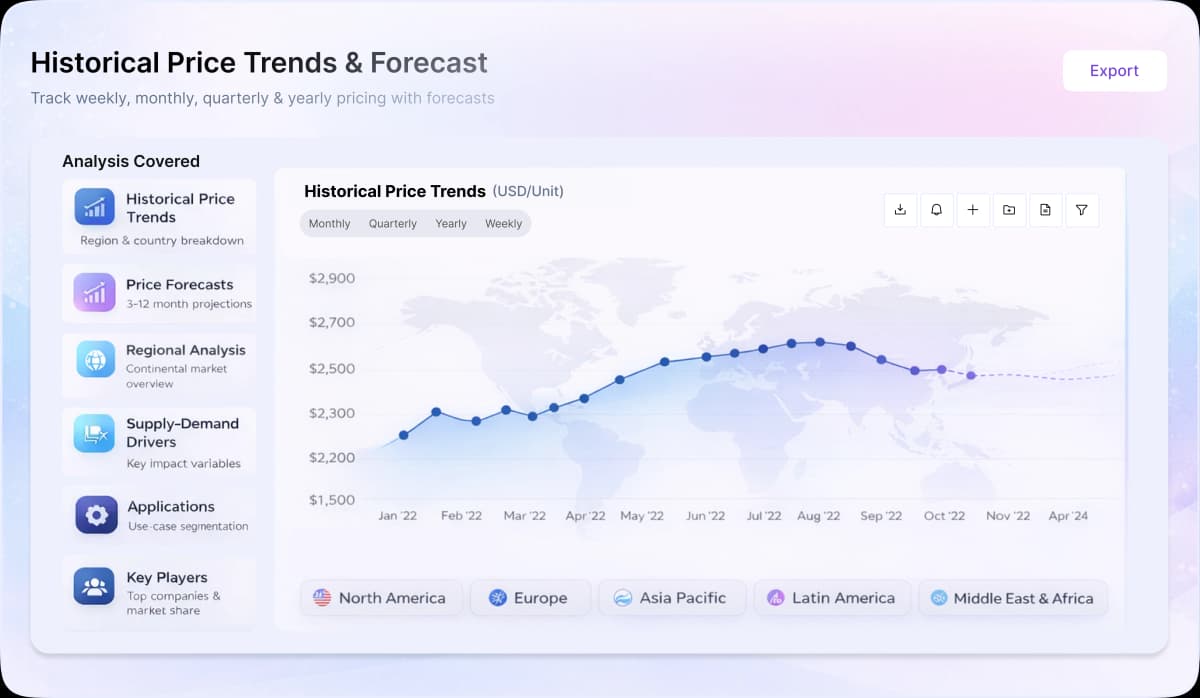
Price Trend Dashboard - What's Included
Price trends across a diverse portfolio of categories and products, spanning board to niche chemicals
Coverage extendable to grade-specific chemicals based on procurement requirements
Regular price tracking supported by robust historical datasets
News, policy updates, and key market drivers impacting price movements
Short-term and long-term price outlooks and forecasts
Supply–demand dynamics and capacity-driven market analysis